

September 17, 2025, 8:54 am | Read time: 5 minutes
The Falkensteiner Ufer in Hamburg’s upscale Blankenese district is a special attraction for fans of dark tourism. Here lie several shipwrecks, some for almost 100 years. Today, they are almost like an unofficial landmark of the Hanseatic city. However, people repeatedly put themselves in deadly danger trying to get close to the wrecks.
There’s no question, Hamburg is one of the most popular cities in Germany for tourists from around the world. Attractions such as the Michel, the harbor, and of course the Reeperbahn draw countless visitors to the Hanseatic city every year. But fans of dark tourism also get their money’s worth in the metropolis on the Elbe. In Hamburg’s Blankenese district, a posh villa neighborhood, there is a small ship graveyard. Here lie the wrecks of two sunken barges, some for almost a hundred years. And they not only fascinate but also pose a potentially deadly danger.
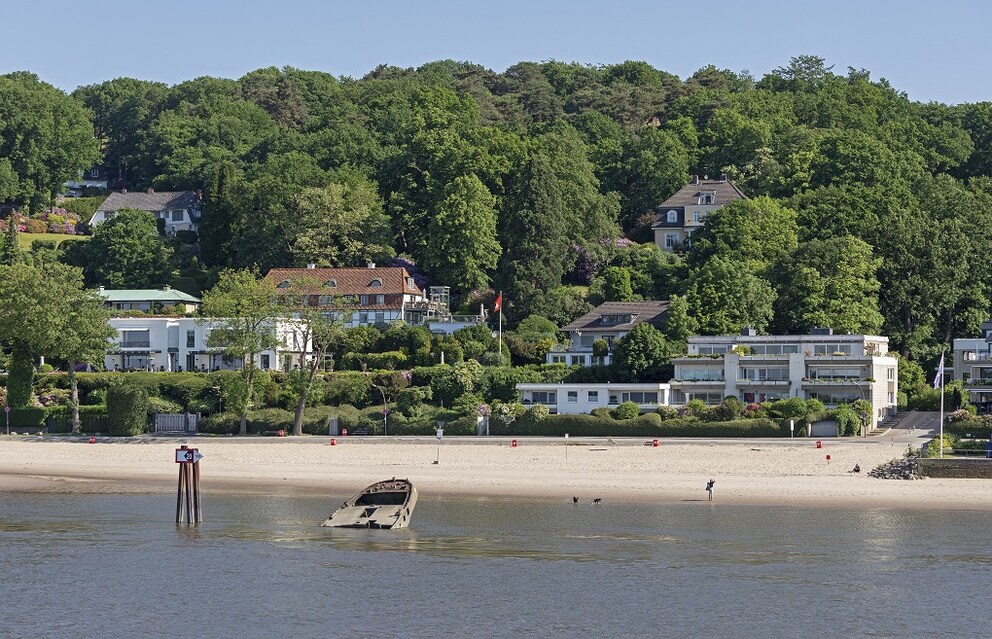
The Blankenese ship graveyard was established in 1926, as noted on the official tourism website of the city. According to the site, the Finnish schooner “Polstjernan” (a type of boat, editor’s note) was en route to England with a load of wood when it caught fire on October 20, 1926. Within minutes, the entire ship was ablaze. The fire could not be extinguished, so tugs from a Blankenese salvage company first brought it to the mouth of the Elbe and then to the Falkensteiner Ufer. Its remains can still be seen from the shore today. The wreck now serves as a breakwater, weighted down with stones and submarine scrap. And as an unusual tourist attraction.
The Wreck as a Landmark
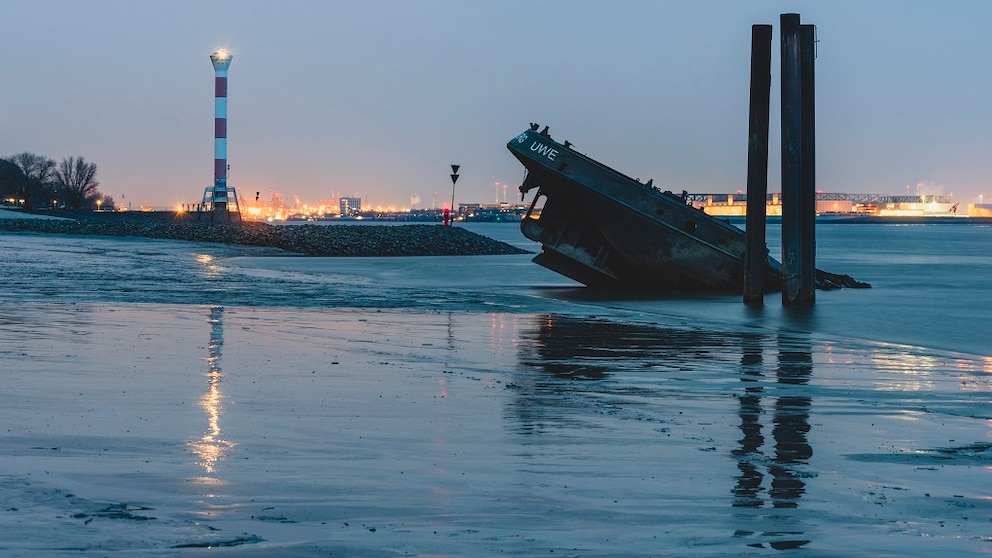
Almost an unofficial landmark of Blankenese and its ship graveyard is the inland vessel “Uwe,” which was wrecked on December 19, 1975. On that day, it fell victim to a disastrous accident. The freighter “Wiedau” was overtaking it on the Elbe when the Polish freighter “Mieczyslaw Kalinowski” suddenly emerged from the fog. As a result, it rammed the “Wiedau,” which then turned and got in the path of the “Uwe.” This split the Hamburg ship in two, killing two crew members. The captain of the “Uwe” and 16 members managed to save themselves at the Wittenbergen pier.
Also interesting: The largest ship graveyard in the world lies off the Chuuk Atoll
The “Uwe” became famous due to the subsequent, failed salvage attempt. According to NDR, while trying to tow the inland vessel with steel cables, it broke into three parts. While the bow and midship could be pulled ashore, the stern got stuck in the waters of the Elbe. And so it can still be seen today at the Blankenese ship graveyard. In fact, removing the stern would have been much more expensive than the entire salvage operation, during which the “Wiedau” was also brought ashore. Additionally, the citizens of Blankenese decided they would like to keep the wreck.
Deadly Danger

Neither the city of Hamburg nor the insurers wanted to bear the costs of salvaging the stern, so it was decided to leave the wreck of the “Uwe” in place. Thus, it has been a small but very unusual tourist attraction since 1976. In fact, there is another, smaller ship graveyard in the Hamburg Elbe. At the Moorburger Schanze, you can see the “Mountbatten,” which sank in 1951. It was wrecked while being transferred from England to Germany. Notably, plants and even small trees now grow on the 49-meter-long and eight-meter-wide ship.
Also interesting: How the wreck of this German ship ended up in the desert
A spokesperson for Hamburg Tourismus GmbH told TRAVELBOOK: “Hamburg’s history has always been connected to its harbor. And the ship graveyard is a small part of that history.” However, they don’t see great marketing potential in it: “I’ve been working here for 16 years, and this is the very first inquiry on the topic.” While the city of Hamburg does promote the Blankenese ship graveyard on its website, it also strongly warns of the danger it poses. In the past, there have been several fatal accidents because people wanted to view the wrecks from the water or even swim to them.
Therefore, TRAVELBOOK also issues a clear warning: The Elbe is not a designated swimming area, and its current is very strong in many places. This can be life-threatening even for experienced swimmers. In the past, there have been calls to remove the wrecks to eliminate the potentially deadly danger. “This debate arises repeatedly for safety reasons.” Others, however, see the sunken ships as a kind of quirky landmark of the city. And as long as they exist, they will likely remain an attraction.