

February 22, 2026, 1:43 pm | Read time: 4 minutes
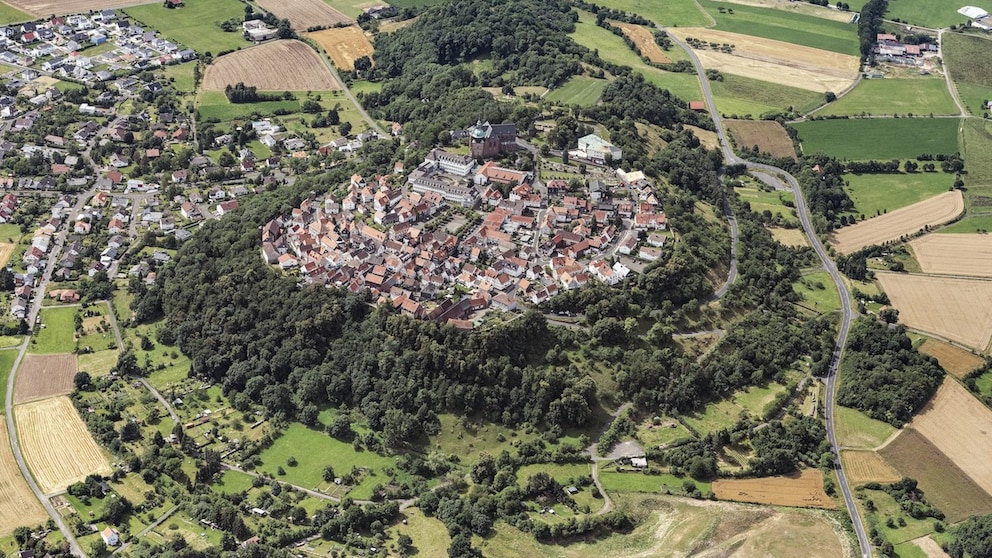
The Hessian town of Amöneburg is situated on a 365-meter-high basalt cone left by an extinct volcano. It is located in a region that holds a European superlative in this regard. Traces from this era, millions of years ago, can still be seen on site today. This was once worth a visit to the area by a real royal.
The Hessian Vogelsberg landscape is characterized by gently rolling hills, green valleys, and deep forests. Only those who look closely will discover evidence of a past when the region was literally shaped and formed by the primal forces of the Earth. Vogelsberg is the largest contiguous volcanic area in Central Europe and the largest extinct one of its kind on the entire European continent. And in the middle of this natural paradise lies the small town of Amöneburg, perched 365 meters high on the basalt cone of an extinct volcano. Its unique location has unsurprisingly made it a small tourist magnet.
According to the official website of the town, its history dates back to the year 721. At that time, it was first mentioned in a document when Saint Boniface founded the first of many monasteries on Mount Amöneburg. Initially, it was just a mountain fortress called “Amanaburch,” which over time developed into a proper town and the name we know today. It is named after the elevation on which it is located, the Amöneburg Mountain. As early as the 6th millennium BC, this region was already settled, and in the 3rd century BC, the Celts built a fortress here, the “Amanaburg.”
The Town on the Volcano
The formation of the Vogelsberg landscape, Germany’s oldest nature park today, dates back to an even earlier time. Where today Amöneburg’s impressive basalt cone rises visibly from the landscape, there was a prehistoric volcano during the late Tertiary, the so-called Miocene. Rock samples found on site indicate that it must have been active at least temporarily and also erupted. According to the official website of the Vogelsberg volcanic region, you can still see slanted basalt columns on the east side of the Amöneburg Mountain today. These suggest that there may once have been volcanic vents and lava lakes here.
With the onset of an ice age about 1.8 million years ago, the transformation of the Vogelsberg landscape into its current appearance began. Through cold, ice, wind, and water, the volcanic rock eroded more and more, eventually leaving behind the gentle low mountain range we know as Vogelsberg. Today, only a small part of Amöneburg’s nearly 5,000 residents live in the eponymous district located on the long-extinct volcano. The rest are spread across the districts of Erfurtshausen, Roßdorf, Rüdigheim, and Mandorf. Amöneburg is considered one of the oldest half-timbered towns in Hesse.

Royal Visit
Unsurprisingly, the hilly landscape of the Vogelsberg volcanic region is now primarily a paradise for hikers and nature lovers. The official website offers numerous possible tours around Amöneburg and its surroundings. A popular destination is, for example, the aforementioned steep eastern wall of the basalt mountain. The Amöneburg nature reserve, where some rare plants thrive, has existed since 1927, making it the second oldest in all of Hesse. An excursion to the “Brücker Mühle” inn, which has been processing grain since 1248, might also be exciting. In 1997, it was even worth a visit from the then Prince Charles, now King of England.
“Our special location is clearly a tourist factor,” says the town of Amöneburg confidently in response to a TRAVELBOOK inquiry. “In addition to the great panoramic view, we have our beautiful old town, a church, and two castles.” The town museum is also proud: “The landscape is incredibly impressive. In the area, only the mountain is called Amöneburg, and the people are the ‘Berger.’ It has always been tempting to settle here. The Amöneburg Basin is very fertile and has been inhabited since the Stone Age.” The mountain is also a very good starting point for excursions in the region. The famous university town of Marburg is only about a 15-minute drive away.