

August 31, 2023, 11:30 am | Read time: 6 minutes
Unfortunately, it often happens that popular attractions are destroyed, whether by human hands or natural forces. And they are not always rebuilt, or in some cases, it is not even possible. TRAVELBOOK presents seven examples worldwide.
7 Attractions That Are Now Gone or Destroyed
Azure Window, Gozo, Malta

It was one of the most photographed places in Malta, adorning countless postcards and Instagram accounts: the famous Azure Window on the small neighboring island of Gozo. But the attraction in this form is now gone. The shock came in March 2017: The rock arch Azure Window collapsed due to severe storms. Already a year earlier, a piece of the “Blue Window” had broken off during stormy seas, and no one was allowed to walk on it since then.
The coast of Gozo is still spectacular, but today it lacks the rock arch that was once one of the most famous landmarks of the Mediterranean island nation.
Buddha Statues of Bamiyan, Afghanistan

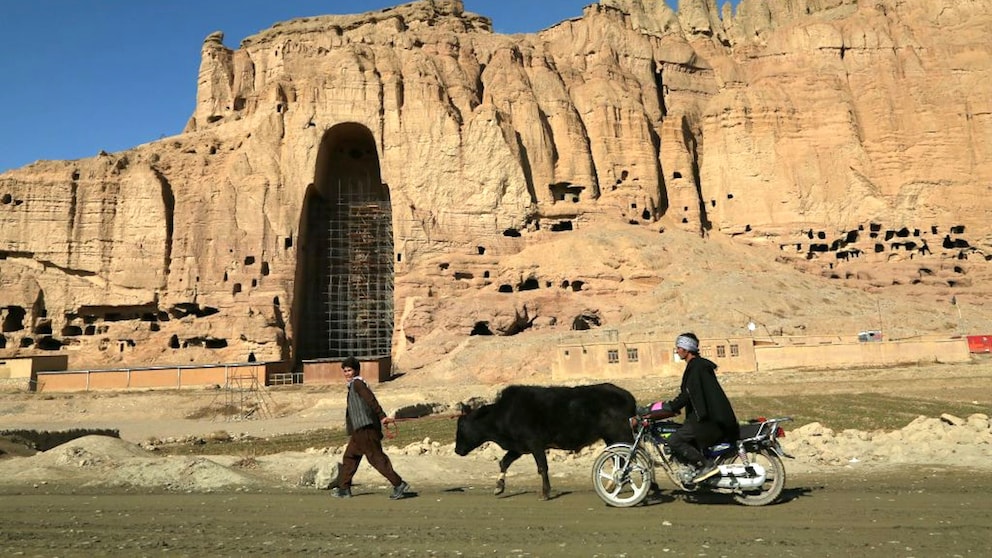
At 53 and 35 meters, they were once the largest standing Buddha statues in the world and, along with other cultural sites, were part of the Bamiyan Valley in central Afghanistan, which UNESCO declared a World Heritage Site in 2003. But by that time, the two Buddha statues carved into a rock no longer existed; they had been destroyed by the Taliban two years earlier.
The remains of the statues, believed to date from the 3rd to 10th centuries, were recovered, and the niches where they stood were secured (see large photo above). Efforts to rebuild them have so far come to nothing.
Also interesting: These 7 Attractions Were Created Especially for Tourists
Love Locks Bridge, Paris

The Pont des Arts in Paris was perhaps the most romantic bridge in the world: Thousands of couples over the years had attached a lock with their names to the railings as a sign of their love. But eventually, the bridge simply became too heavy; the locks weighed a staggering 45 tons in the end, according to a report by WELT. One of the railings even gave way under the weight and crashed onto the bridge, fortunately without injuring anyone.
The city administration of the French capital finally deemed the risk too great that the massive weight could pose further safety risks if the structure of the bridge were permanently compromised or if parts of the railing broke off and fell onto boats. Therefore, all love locks were promptly removed, and the railing was redesigned so that no more locks could be attached. However, resourceful couples have found ways to still leave their mark on the bridge—such as on one of the bridge piers, where a considerable number of locks now hang again.

Crystal Palace, London

Another of the attractions that are now gone is the Crystal Palace in London. It was built specifically for the first World’s Fair in 1851 in London’s Hyde Park. It was designed by Sir Joseph Paxton, who was not only considered an innovative architect but also a botanist, author, and politician. The building, planned in the Victorian style, was made entirely of glass and cast iron and was constructed in just 17 weeks.
After the end of the World’s Fair, the modularly constructed Crystal Palace was dismantled and then rebuilt and expanded in the Sydenham district in southeast London by 1854. The glass building stood there for more than 80 years but was completely destroyed by a fire in 1936. However, the Crystal Palace Park still exists today.

Pink and White Terraces, New Zealand

Looking at old pictures of the Pink and White Terraces on New Zealand’s North Island, they strongly resemble the travertine terraces of Pamukkale in southwestern Turkey. The pools, surrounded by a thick layer of the mineral geyserite and glowing in the most beautiful colors, were once considered an impressive natural wonder and attracted many tourists for bathing.
Today, however, nothing remains of the Pink and White Terraces; the former attraction has disappeared. In June 1886, the volcano Mount Tarawera, five kilometers away, erupted. The travertine terraces were buried, and a new lake eventually formed in the massive crater that opened above them. This is now Lake Rotomahana, which is 30 meters higher and much larger than the old lake of the same name before the eruption.
West Pier, Brighton, England

The West Pier was a beautiful pier in the English seaside resort of Brighton, built in 1866 as a cast-iron structure. The building was not only beautiful to look at but also a cultural center in Brighton. Inside, there was a concert hall and a large theater hall, among other things.
At the beginning of the 21st century, the long-overdue renovation of the pier was hit by several disasters that together spelled its end: A severe storm surge in 2002 caused the structure to collapse, and two pier supports sank into the sea. About a year later, one of the pavilions was destroyed by fire, and a few months later, the concert hall also burned. It finally collapsed during a storm surge in 2004. Today, only a steel skeleton stands off the coast of Brighton, and all plans to rebuild the once-famous pier have so far failed.

Also interesting: The 10 Most Googled Attractions in the World
Chacaltaya Glacier, Bolivia

The Chacaltaya Glacier near La Paz in Bolivia was once considered the highest ski area in the world, with slopes at an altitude of 5,260 meters, and even the Austrian Alpine Club operated a hut here. The first ski lift in South America was opened here in 1940, and as recently as 2001, winter sports competitions were held on Chacaltaya.
Due to climate change, however, the glacier has shrunk more and more over the past decades. Since 2009, the ice has almost completely disappeared, and winter sports no longer take place here.
