

February 3, 2026, 11:56 am | Read time: 5 minutes
Floating stones, flying dragons, and holographically projected giant humans: What sounds like a sci-fi blockbuster is actually the Saudi crown prince’s plan for a gigantic cube skyscraper in Saudi Arabia. “The Mukaab” was supposed to become the highlight of the new $620 billion “New Murabba” center in Riyadh by 2030. However, the kingdom has now halted construction of the massive building.
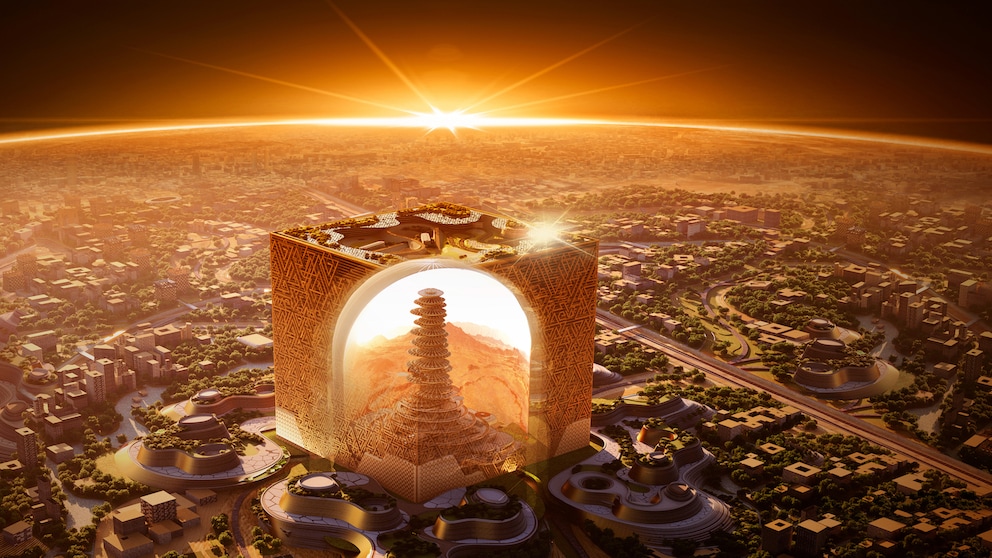
400 meters high, long, and wide, and large enough for 20 Empire State Buildings: Saudi Crown Prince Mohammed bin Salman had planned a colossal structure in the capital, Riyadh. “The Mukaab,” which means “cube” in Arabic, was to be the centerpiece and heart of the brand-new, futuristic city center, “The Murabba.” With the planned city center at the intersection of King Salman Street and King Khalid Street in northwest Riyadh, the aim was to expand the Saudi capital by 19 square kilometers and create space for hundreds of thousands of residents, as “Arab News” reported in February 2023. The giga-cube “The Mukaab” was to become the world’s largest inner-city building, shaping Riyadh’s skyline and attracting visitors from around the world with state-of-the-art entertainment, dining, and shopping offerings. That was the plan. According to the news agency Reuters, the project has now been temporarily halted.
Overview
Saudi Arabia Reviews Finances of Its Vision 2030
Saudi Arabia has “temporarily suspended” the planned construction of the “colossal, cube-shaped skyscraper,” writes the news agency, citing four people familiar with the matter. The reason: Saudi Arabia wants to reassess the financing and feasibility of this and other projects.
“The Mukaab,” like “New Murabba,” is part of Saudi Arabia’s futuristic “Vision 2030.” And it is not the only gigantic project included in it that is currently on hold and being reassessed. Plans for “The Line,” a skyscraper originally intended to stretch 170 kilometers in the future city of Neom, have already been significantly scaled back.
Originally, the so-called “Vision 2030” was a strategy to diversify the Saudi economy. To become less dependent on the oil sector, strengthening tourism is also one of Prince Mohammed’s major initiatives. By 2030, he intended to attract 55 million international tourists annually. The desert state announced its goal to become “a Mecca” for tourists as early as 2017.
According to Reuters, the kingdom is now increasingly turning away from its futuristic mega-projects and focusing instead on more urgent and potentially more profitable projects. According to Reuters sources, the focus is on “the infrastructure for the 2030 World Expo and the 2034 FIFA World Cup.” Additionally, the Saudi kingdom continues to focus on the massive “$60 billion Diriyah mixed-use cultural zone and the Qiddiya tourism mega-project.” The news agency interprets this realignment of the Saudi kingdom as a sign of its “fiscal pressure.”
Saudi Arabia Halts Construction of Mega-City ‘The Line’
Bridge Over the Red Sea to Connect Megaproject Neom With Egypt
“The Mukaab” Was Once to Be “a Gateway to Another World”
On the official website, the giga-cube with its 121 floors was described in 2023 as a “gateway to another world.” Inside the gigantic cube, whose facade was to be inspired by the traditional architectural style of the “Najdi” region, the plan was to create the world’s first immersive destination. This was to be achieved through digital and virtual technology with cutting-edge holography. The entire “dome” was to be a screen capable of simulating the environment on Mars, for example. Visitors were to be able to travel through distant planets and magical worlds in “The Mukaab” without ever leaving the building.

The “immersive experience structure” was to include hotel and residential units, commercial spaces, and leisure facilities, as well as retail, cultural, and tourist attractions. A museum, a college of technology and design, more than 80 entertainment and cultural events, and a theater were also to be housed in the futuristic cube. In total, the world’s newest largest inner-city building, “The Mukaab,” was to offer 25 million square meters of usable space. Everything was to be accessible on foot within 15 minutes. An internal transportation system was also planned.
That was the original vision for the gigantic cube building. How exactly “The Mukaab” will proceed in the future is currently unclear. “Work beyond excavation and piling has been halted,” according to Reuters. The news agency cites three sources. However, development of surrounding plots will continue.
“New Murabba” and “The Mukaab” Are Controversial
While residents were forcibly relocated for “The Line,” and about 20,000 members of the indigenous Howeitat tribe were displaced from their homes, the controversy surrounding the giga-cube “The Mukaab” is not humanitarian but religious. Many Muslims accuse the crown prince of blasphemy. “The Mukaab,” in its cube form, is reminiscent of the Kaaba, located in the courtyard of the Holy Mosque in Mecca and considered the “House of God,” the central sanctuary of Islam. The new largest building in the world, “The Mukaab,” is criticized as a “sacred site of capitalism,” with its symbolism causing anger. Critics argue that the billion-dollar project serves to further Westernize and liberalize society with entertainment.
Moreover, regardless of its now uncertain future, it was assumed that the project would not include affordable offerings for everyone. “The planners must ensure that this district is not perceived as an enclave for the wealthy and integrates into the overall city. Connections must be created to ensure that the district and the iconic building are accessible to a wide range of people and that it is not purely a commercial and profit-oriented enterprise,” Yasser Elsheshtawy explained to “Arab News.”