

February 6, 2026, 9:17 am | Read time: 5 minutes
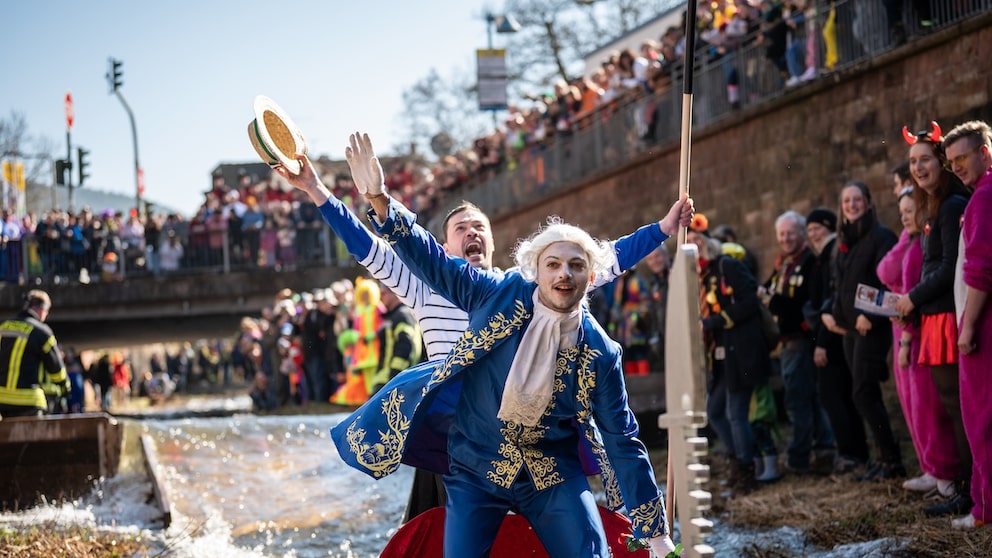
Every year on Rose Monday, the Black Forest town of Schramberg in Baden-Württemberg hosts one of Germany’s most colorful and charming carnival traditions. That’s when 80 participants sail down the local stream in creatively self-built vehicles during the so-called Da-Bach-Na-Fahrt. Cheered on by tens of thousands of spectators, many get thoroughly soaked. TRAVELBOOK explains this unique custom and tells its story.
It’s expected that the upcoming Rose Monday in the small Black Forest town of Schramberg in Baden-Württemberg will be quite loud again. That’s when a very special carnival parade takes place—on the water of the local Schiltach stream. During the Da-Bach-Na-Fahrt (which roughly translates to “Down the Stream”), 80 participants in 40 creatively self-built vehicles sail over the stream, cheered on by tens of thousands of onlookers. It traditionally gets very colorful, and some participants get thoroughly soaked. It’s an unusual carnival party that involves the whole town and will celebrate its 90th anniversary in 2026.
On February 24, 1936, according to the Narrenzunft Schramberg website, the idea for the Da-Bach-Na-Fahrt was born. It might be said it came from a beer-fueled whim during a morning gathering of some gentlemen at a local establishment. The “Café Brubeck,” which still exists today, is located right by the Schiltach stream—and so the thought arose to honor Rose Monday by navigating it with wooden rafts. At that time, it wasn’t yet a holiday as it is today in the town. Instead of going to work, the original revelers spontaneously put their quirky idea into action, cheered on by curious spectators. It turned into a joyful celebration, and a tradition was born.
The Goal: Reach the Finish Dry
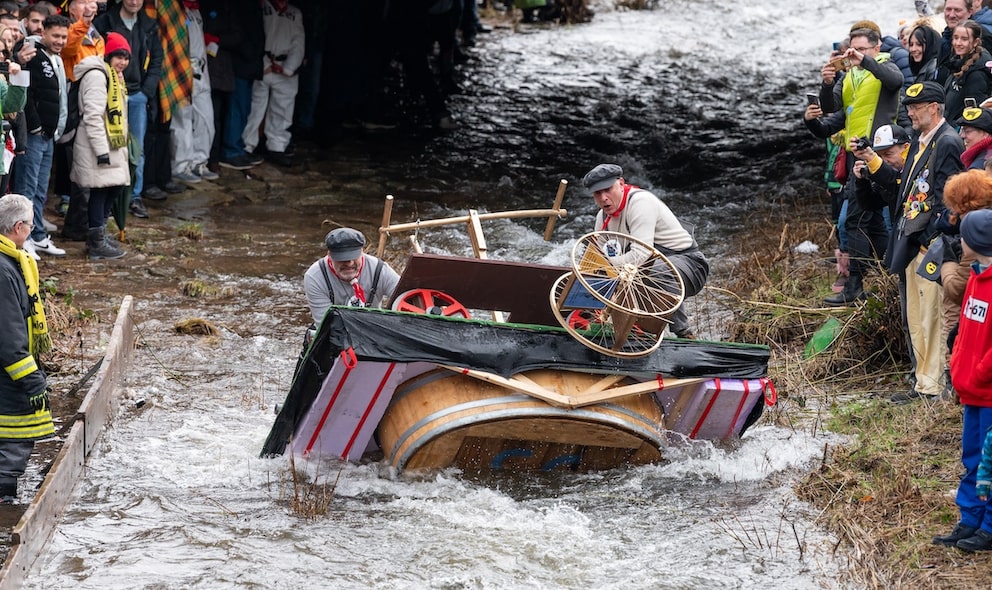
It’s an event eagerly anticipated locally every year. The Da-Bach-Na-Fahrt is the undisputed highlight of the carnival festivities in Schramberg. Since its “birth” 90 years ago, it has become a huge, vibrant spectacle that today is enthusiastically celebrated by up to 30,000 spectators. Here’s how it works: Three weeks before Rose Monday, the 40 participating teams each receive a wooden raft, which they lovingly build out, decorate, and adorn until the big event. Photos of the spectacle show revelers in a self-built DeLorean, the car from the iconic film “Back to the Future.” A pink Trabant or an oversized joint have also been part of the event in recent years.
It’s also popular to poke fun at political motives or events. The goal of the Da-Bach-Na-Fahrt is to reach the finish dry, with experienced raft builders typically having an advantage over newcomers. Above all, fun is the priority. The Rose Monday festivities traditionally begin with a parade of the participating vehicles through Schramberg, ending at the starting point for the quirky race on the Schiltach. At 1 p.m., the starting signal is given for the rafts on the relatively short 500-meter course. Those who complete it without falling into the water take between five and seven minutes. The greatest joy for the audience, however, might be when someone gets wet.
30,000 Pretzels for the Crowd
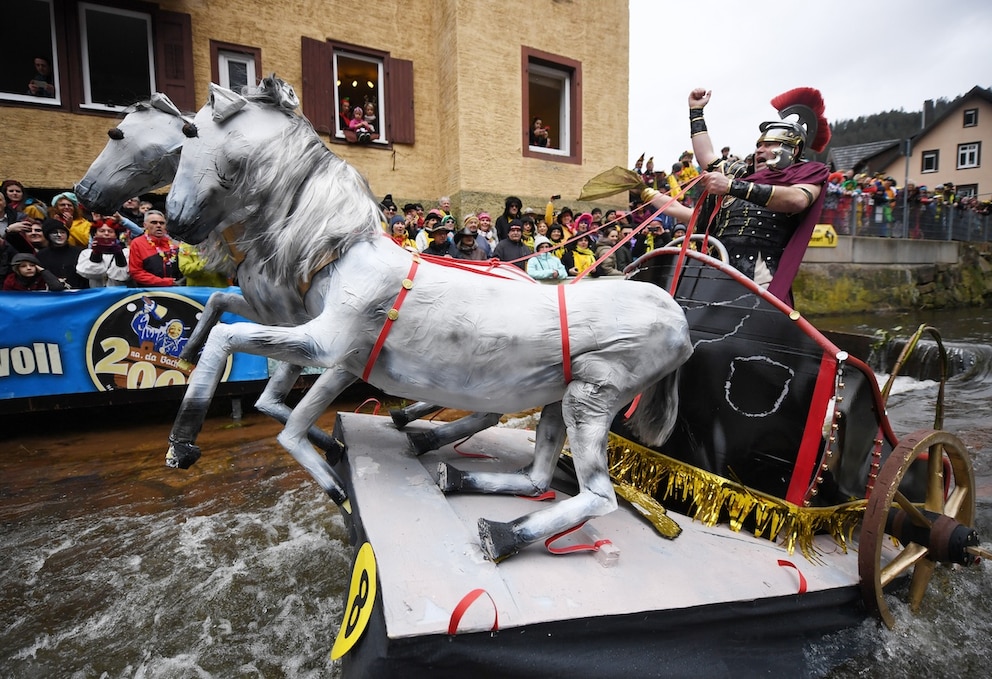
Those whose raft capsizes must swim to the finish. Heroes who complete the course unscathed shout the battle cry “Furz-trocka,” meaning bone dry. Those who fall into the water must shout “Batsch,” to which the crowd responds sympathetically or mockingly with “nass” (German for “wet”). The event culminates in the traditional evening Rose Monday ball, where an award ceremony for the best captains of the Da-Bach-Na-Fahrt takes place. Laurels are also given for the best newcomers, and there’s even a kind of consolation prize, the so-called “Batsch-nass-Order.” The rather short, vibrant fun is preceded by weeks of planning. The fire department, technical relief organization, and about 200 volunteers ensure a smooth operation every year.
Also interesting: The Most Beautiful Rivers and Waterfalls in the Harz
The Da-Bach-Na-Fahrt in Schramberg is just one of the highlights of a carnival tradition that can be traced back to the 16th century. Today, the small town is one of the most famous in the Black Forest for its colorful celebrations, attracting tens of thousands of visitors each year. The festivities last almost a week, from Thursday to Ash Wednesday. Other traditional performances occur, such as a parade called “Hanselsprung.” After this, the revelers distribute free pretzels to the people. In total, 30,000 of the popular pastries are given away during the carnival days. A larger parade of revelers takes place after the Da-Bach-Na-Fahrt. The event concludes on the night before Ash Wednesday with the so-called Rattenball.

On the occasion of the 90th anniversary of the Da-Bach-Na-Fahrt, there won’t be a particularly large celebration, as a city employee from Schramberg told TRAVELBOOK: “We can’t accommodate more guests. However, we will recreate some historical rafts based on pictures for the race.” Otherwise, the entire town is already eagerly anticipating the carnival days, as they do every year. “It’s a very special atmosphere that can’t really be described in words. You have to experience it.” Only members of the local guild of revelers are allowed to participate in the wild ride over the stream. “Sometimes we have to raffle off some starting spots. There’s definitely more demand than available spots.”