

October 26, 2026, 5:52 am | Read time: 5 minutes
The Heimkehle in the Harz between Saxony-Anhalt and Thuringia is now the largest show cave in all of Germany. Visitors learn everything about the impressive underground natural wonder on a fascinating tour. And also about its dark past. During World War II, the Nazis operated an underground aircraft factory here, where countless innocents suffered under inhumane conditions. TRAVELBOOK tells the story of the place.
A cool morning in mid-September 2025, and I stand before one of the proverbial greatest natural wonders in the entire Harz. Here, near the town of Uftrungen, between Saxony-Anhalt and Thuringia, lies the hidden underground Heimkehle. One of the largest gypsum caves in Germany and even in all of Europe, and the largest accessible show cave in the country. A fantastic long-distance hiking trail has led me here; the grotto is on one of the first stages of a 260-kilometer tour through the South Harz. Despite the late summer temperatures, I’m wearing a light jacket because soon I’ll be descending into the grotto with a group. Little do I know that I’ll soon be shivering for another, darker reason.
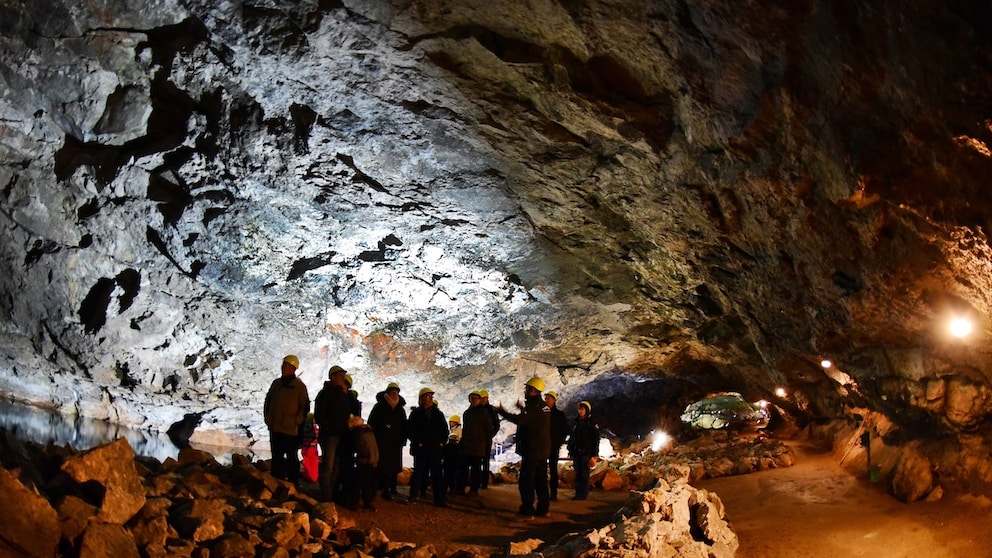
The jovial yet gruff cave guide Andreas Hammer greets the group, a colorful mix of children and adults. According to him, we are now entering, protected by stylish yellow helmets, the largest gypsum and anhydrite cave in all of Europe. It has an explored extension of 2,136 meters, and Hammer is precise about that. Seven hundred meters of it are also accessible to us as visitors without barriers. The Heimkehle has been open to visitors since 1920, after entrepreneur and consul Theodor Wienrich discovered it rather accidentally. He operated a hunting ground in the region and stumbled upon an entrance to the grotto during a forest excursion.
Dark Past
However, it was first mentioned in documents as early as 1357, as people then suspected a gateway to hell here. The cave itself is said to be 30,000 years old. With the end of the last ice age, the retreating glaciers washed it out to its current size. In the meantime, we have worked our way to the so-called Great Dome. Twenty-two meters of ceiling height, the largest tourist-accessible cavity in all of Germany. Here, underground, there is a constant temperature of just 8.4 degrees year-round. Where tourists walk today, early humans likely lived in ancient times.
Also interesting: The most beautiful castles and fortresses in the Harz
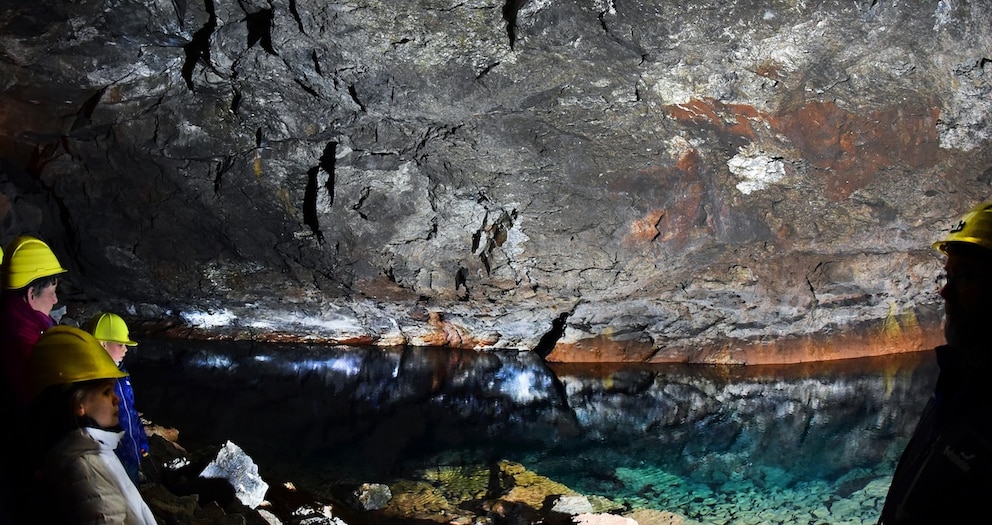
Two crystal-clear lakes are also on our path through the Heimkehle. Underground, one crosses the state border between Saxony-Anhalt and Thuringia, Hammer explains, pointing to a corresponding border marker. Just like the secretive inhabitants of the cave, who live here for part of the year. And indeed, small bodies hang from the ceilings–bats. Five thousand five hundred have been counted here, with 17 of the 19 species found in the region overwintering in Germany’s largest show grotto. When we ask what the graffiti on one of the massive ceiling support pillars means, Hammer speaks about the cave’s dark past.

Guadix — Europe’s Cave Capital

4 of the Most Beautiful Christmas Markets in Thuringia
Forced Labor and Death
During World War II, the Nazis operated an underground factory here, where forced laborers were made to produce aircraft parts under inhumane conditions. Junkers Motorenwerke AG began setting up under the code name Thyra-Werk in March 1944. Production was moved underground to protect it from enemy air raids. Prisoners from the Buchenwald concentration camp subcamp, later from the Mittelbau-Dora concentration camp, were employed there. The facility can still be visited near Nordhausen today. By October 1944, 819 prisoners had arrived here, working up to 12 hours a day driving tunnels into the mountain, setting supports, leveling areas, and laying power lines.
Also interesting: Fingal’s Cave: The legendary cave on the Scottish Hebrides
Junkers had springs and individual parts for aircraft production manufactured here. In neighboring Stempeda, the unfortunate prisoners also had to work, as an underground production facility was to be established there as well. A local infirmary had 36 beds, which were practically permanently occupied due to the heavy labor. At least six deaths are documented around the Heimkehle by the end of October 1944. After the war, the Soviet occupying forces then blew up the armament facilities and the entrances to the cave. Finally, on May 1, 1954, the Heimkehle was able to reopen for tourists. Since 2005, a memorial stone in front of the cave commemorates the dark chapter.
The Name Likely Comes from Celtic
Nevertheless, or perhaps because of this, the Heimkehle as the largest show cave in the country is today an extremely worthwhile place to visit. Visitors can also watch a short, interactive film about the creation of the natural wonder in an underground cinema at the end of the tour. The sound and images certainly seemed bombastic to me during my visit. According to guide Andreas Hammer, the peculiar name likely comes from Celtic. It might have originally been called Helmenkelle, which translates to “secret cellar.” This designation, in turn, pointed to its location underground.
Also interesting: In this Harz cave, researchers stumbled upon a sensation
Anyone who wants to visit the Heimkehle themselves has the opportunity to do so year-round. Tours take place from April to October from Tuesday to Sunday and on holidays from 10 a.m. to 5 p.m. From November to March, the cave can be visited Wednesday to Sunday and on holidays in Saxony-Anhalt between 10 a.m. and 4 p.m. Admission currently costs nine euros for adults, with a reduced rate of six euros. Since 2019, the cave has been designated as a “National Geotope,” marking it as particularly worthy of protection.