

December 1, 2025, 5:46 am | Read time: 4 minutes
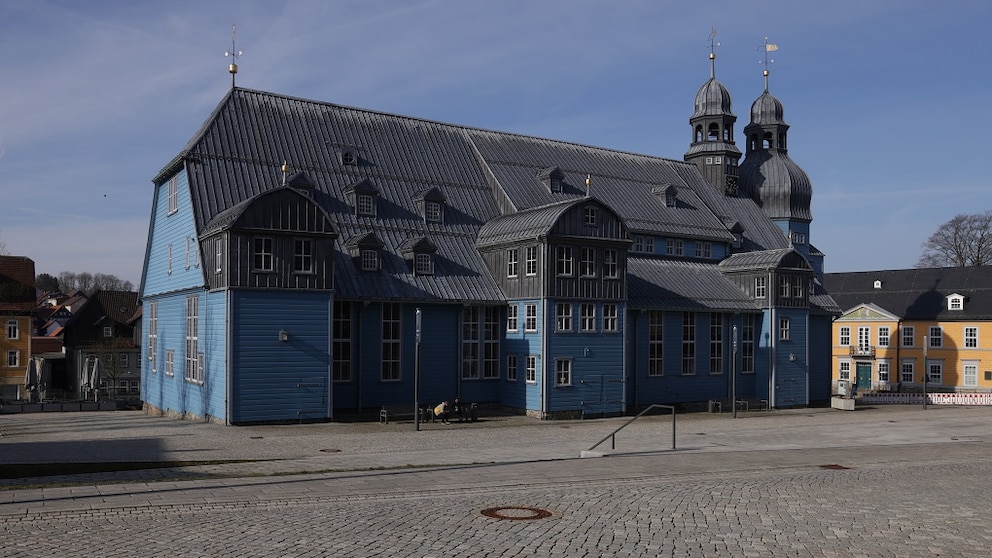
The Market Church of the Holy Spirit in the Harz town of Clausthal-Zellerfeld is the largest wooden church in Germany. It has a centuries-long, eventful history that began with a catastrophe. Today, the church is one of the most significant tourist attractions in the city–and narrowly escaped destruction in the summer of 2025.
Anyone visiting Clausthal-Zellerfeld will literally not miss it: On a square named after it, painted sky blue, the Market Church of the Holy Spirit stands as the unofficial landmark of the Lower Saxony town. But not only is its exterior unusual, its construction is as well, as it is the largest wooden church in all of Germany. The fact that services and concerts can still, or again, be held here today borders on a miracle. Or perhaps in this case, one might say: divine providence.
According to the tourism site “Harz Travel,” the history of the Market Church begins in 1639, when its construction was commissioned. Just five years earlier, in September 1634, a fire had destroyed a third of the then-town of Clausthal, and the old church had fallen victim to the flames. The financing for the new building was largely provided by the local mines, which were operating very profitably at the time. The town itself would not have had the money for the new construction, so secular donations helped build what is now the largest wooden church in Germany.
Space for up to 2,000 Worshippers
The Market Church is 57 meters long and 26 meters wide, offering space for up to 2,000 worshippers. It is constructed entirely of spruce and oak wood in a half-timbered style. The striking paint has a special reason, as blue was considered the color of divine wisdom at the time. After having other coatings over the centuries, the Market Church now shines again in its original color. Its bell tower is 30 meters high and served not only the church but also to literally ring in the beginning and end of shifts for the miners.
Also interesting: In this church, marijuana is revered
Today, the Market Church is considered one of the most significant monuments of North German Baroque, thanks in part to its magnificent altar and the recently extensively renovated organ. It was consecrated on Pentecost Sunday in 1642 after three years of construction. The altar, pulpit, and baptismal group were created by the highly esteemed sculptor Andreas Gröber. According to “NDR,” the church has five staircases leading to its galleries. Since a renovation in 1649, when the nave was extended by 12 meters, the Market Church has remained almost unchanged.
It Was Arson

In the 1990s, an extensive renovation was carried out, costing the equivalent of nearly 10 million euros today. Again, the church received support from the federal government, the state, and various foundations, which covered 40 percent of the costs. Only a few years ago, after the completion of the work, a new organ with 5,000 pipes was installed, resembling the original from the Baroque period. A staff member of the Clausthal-Zellerfeld tourist information office says upon TRAVELBOOK’s inquiry: “The Market Church is an important visitor magnet in our city. We are very proud of it.”
Also interesting: The unique rock church of Idar-Oberstein
Tourists coming to the city often ask about the Market Church first. Then, in July 2025, the shock came when the church suddenly went up in flames one July night. Fortunately, the local fire department was able to extinguish the fire, but the roof structure and the eastern side of the building were partially destroyed. “The church was open for the first time since then for the harvest festival. Fortunately, the damage was not so severe.” Unfortunately, the incident was arson.
Once the Market Church is restored again, concerts are to be held there once more. “Tickets for these can then also be obtained at the tourist information office.” Other sights in the city include the Upper Harz Mining Museum, the birthplace of Robert Koch, and the artisan courtyard, where six exhibitors have their studios. On the first Saturday of each month, tours are usually held in Germany’s largest wooden church. The church community’s website provides information on events and dates.