

September 25, 2026, 1:32 pm | Read time: 7 minutes
Corpses usually decompose. However, there are exceptions where bodies are preserved for posterity without artificial mummification processes. The Knight of Kalebuz is not only one of these exceptions but also Germany’s most famous mummy, which still poses mysteries.
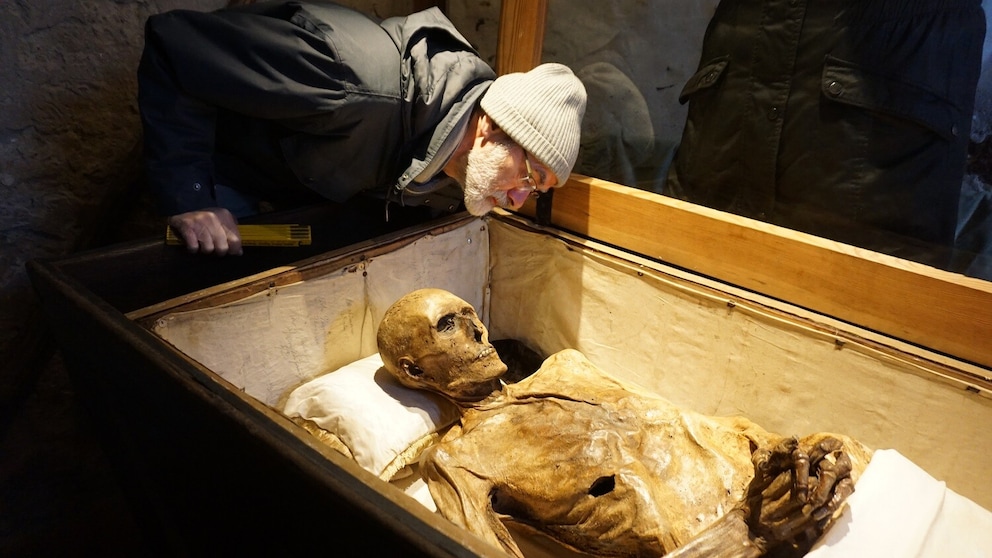
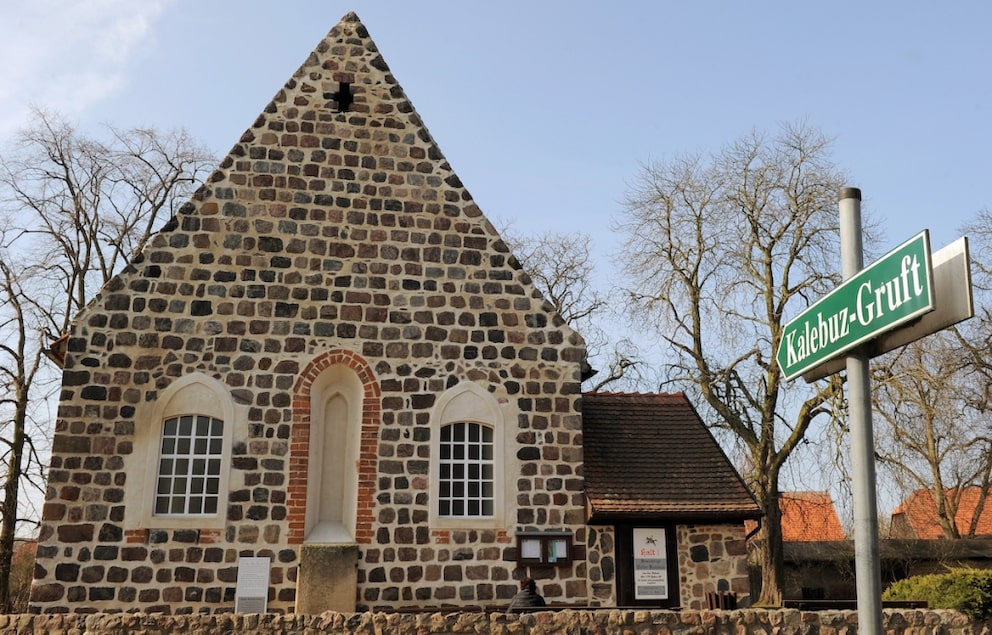
More than 300 years later, Knight Kalebuz has still not turned to dust. He remains at the place where he lived and died: in Kampehl, in today’s Ostprignitz-Ruppin district in Brandenburg, northwest of Berlin. Displayed in the Kalebuz crypt of the village church, his mummified body is a tourist attraction. The knight is considered Germany’s best-preserved dry mummy.
Numerous myths and rumors have always surrounded the Brandenburg mummy, especially regarding its good condition. For instance, it is said that hair and fingernails still grow and that God’s punishment for Kalebuz’s perjury is the reason why the knight did not decompose.
Who Was Knight Kalebuz?
Christian Friedrich von Kalebuz lived from 1651 to 1702. Although there are other spellings (Kahlebutz and Kahlbutz), “Kalebuz is considered correct according to the church register entry,” explains Dorit Geu. Strictly speaking, Kalebuz was not a knight but a cornet, a low-ranking officer. According to “National Geographic,” the term “knight” is understood as belonging to the Margraviate knighthood and thus to the lower nobility.
Cornet Christian Friedrich von Kalebuz fought in the Battle of Fehrbellin in 1675, where the Prussians decisively defeated the Swedish troops. An unexpected outcome for the then-great power Sweden. Alongside the Prince of Hesse-Homburg, Kalebuz achieved victory fame. The cannonballs in his coffin still testify to the battle today.
Astonishing Discovery in CT Scan
In 2024, researchers, according to a report by the “Berliner Zeitung,” examined the body using computed tomography (CT). They made fascinating discoveries. For one, a pencil was found in the mummy’s chest cavity. According to Andreas Winkelmann, professor of anatomy at the Brandenburg Medical School Theodor Fontane (MHB), it is a used pencil, likely manufactured between 1900 and 1920. The mummy has a larger opening in the chest, probably due to tissue removal in 1895 by the physician Rudolf Virchow. This defect allowed the pencil to enter the body. “This is part of known stories about the pranks played with the mummy in earlier centuries,” the “Berliner Zeitung” quotes Winkelmann.
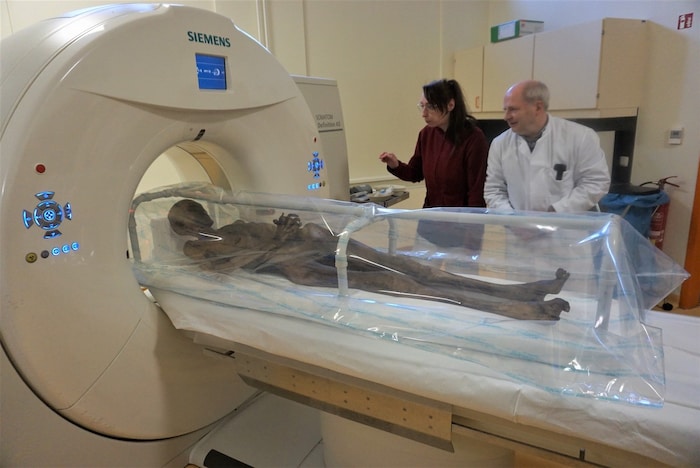
And the CT scans revealed something else. Experts found a round metal object in the mummy’s oral cavity, possibly a coin or an amulet. “Since the mummy’s mouth is too tightly closed, this object can only be retrieved by cutting into the tissue–whether to do this to the knight or leave him with this secret will be decided by the responsible parish church council,” explained Winkelmann. The item may have been placed with the body at some point.
The Many Mysteries of Knight Kalebuz’s Mummy
Knight Kalebuz is said to have been a cruel ruler over his domain. “Kalebuz was a despot and rapist,” said Mary Weingart, one of the guides in the crypt, to the “Kyritzer Tageblatt” in February 2022.
According to the “Ius primae noctis,” the abhorrent “right of the first night,” lords had the right to spend the first night with every newlywed woman on the estate. This right was never officially recorded in Brandenburg. However, Kalebuz was rumored to have claimed it anyway, forcing his maids into sexual intercourse. He had eleven legitimate children with his wife, the noble Margarete Sophie von Rohr, over twenty years. He is also said to have fathered more than thirty illegitimate offspring.
The Legend of the Knight’s Perjury
A maid on his estate, Maria Leppin, whose wedding to the shepherd of the neighboring village was imminent, reportedly refused him this right. As a result, Kalebuz allegedly killed the shepherd, prompting Marie Leppin to accuse the lord. During the trial, Kalebuz is said to have sworn the following oath: “If I am the murderer, then may God ensure my body never decomposes.”
TRAVELBOOK spoke with Dorit Geu, the secretary of the Evangelical Parish Office Neustadt (Dosse). The fieldstone church of Kampehl is part of its church district. She has been guiding visitors through the Kalebuz crypt for over 25 years. Dorit Geu emphasizes that there is no evidence for this oath, and the sentence is only orally transmitted. And, of course, the perjury was not the reason for the mummification. But what was?
The Mummification Is No Miracle, but a Phenomenon
When the Kampehl crypt was renovated in 1794 and the three coffins inside were to be buried–the other two contained Kalebuz’s sons–it was discovered that the lord’s body had not decomposed. Many scientists have since studied the phenomenon.
According to the official Knight Kalebuz website of the Evangelical Parish Office Neustadt (Dosse), even “renowned physicians like Strauch, Sauerbruch, and Virchow could not explain the mummification.” Dr. Andreas Ströbl, head of the crypt research center in Lübeck, describes Knight Kalebuz according to WELT as a “completely normal dry mummy.” Dorit Geu explains that “normal dry mummies” were usually intentionally mummified, whereas Kalebuz’s natural mummification was coincidental. The investigation by physicians Strauch, Sauerbruch, and Virchow was driven by curiosity about whether he was embalmed like Egyptian mummies or if organs were removed. This was ruled out–the organs are still present and simply dried out.
Crypt Is Well Ventilated
According to the parish secretary, the natural mummification is due to the special circumstances under which Knight Kalebuz was laid out in the crypt. Dr. Andreas Ströbl also confirmed this, according to Dorit Geu. The double coffin, made of fir wood inside and oak wood outside, provided exceptionally good ventilation. Due to Kalebuz’s wasting, long illness before his death, the lord was already very emaciated, which also favored his natural mummification. The cool, well-ventilated crypt also contributed to the so-called “natural leathering,” as did his time of death in the rather cold November.
What is special about the mummy, besides its excellent state of preservation, is that it can be clearly attributed to Knight Kalebuz and is not just any nameless man. “His mummified body was identified by his knee injury from the Battle of Fehrbellin and by the shroud with his initials in which he was wrapped,” explains Dorit Geu.

These 11 museums are terrifying!

Mummies on Display at St. Nicholas Church in Nedlitz
His Hair and Nails Are Said to Still Grow
The misconception persists that the hair and nails of the leathered Kalebuz still grow. Dorit Geu chuckles: “This legend stems from a teacher who once led tours through the crypt and mischievously claimed it.”
But even if nothing grows today, hair, fingers, and toenails are still clearly visible. He would even have more hair today: “Knight Kalebuz was previously displayed openly and certainly lost a few hairs when people touched him or stroked his head,” explains Dorit Geu.

His Ghost Is Said to Still Haunt
Kalebuz reportedly killed the shepherd at the Schwenzebrücke on his land. Dorit Geu reveals: “According to legend, at the time of the crime, between 11 p.m. and midnight, Kalebuz’s ghost is said to jump on you.” People would walk hunched over the bridge, and carriages barely made it to the other side.
The nine-square-meter crypt of Kampehl and Knight Kalebuz can be visited from April to October on Fridays, Saturdays, and Sundays from 11 a.m. to 4 p.m.