

May 3, 2025, 5:17 am | Read time: 5 minutes
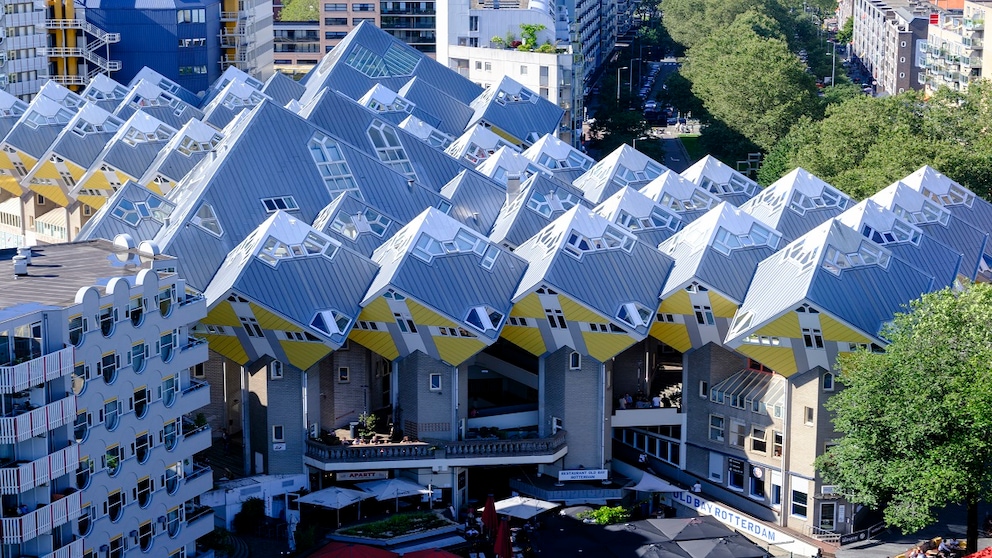
In one of the trendiest districts of the Dutch city of Rotterdam lies an architectural oddity: the Cube Houses. These are homes that look like giant cubes standing on their tips. Designed during the reconstruction of the city, which was destroyed in World War II, they are now one of its biggest tourist attractions. The architect, known for radical design, pursued a very unique vision with the unusual cube houses.
The Oude Haven district is probably the trendiest and hippest area of the Dutch city of Rotterdam today. This is largely due to the partly futuristic architecture found there among shops, bars, and nightclubs. The perhaps most famous project here, which has long become one of the city’s biggest tourist attractions, was created more than 40 years ago, marking the beginning of the entire district’s revival. We’re talking about the truly bizarre-looking Cube Houses, which can best be translated as “Cube Houses.” In fact, they are nothing more than giant, habitable cubes.
According to the site “Arch Daily,” the Cube Houses were built from 1980 to 1984. As early as the 1970s, the city of Rotterdam planned to finally rebuild its harbor district Oude Haven, which was severely destroyed in World War II. In 1940, the area was reduced to rubble by bombing raids by Nazi Germany. Thus, the architect Piet Blom, then something of a wild child of the scene, was commissioned to reinvent Rotterdam’s now most popular trendy district. He is known for saying that a building doesn’t have to be recognizable as a house to be habitable. By this time, Blom had already made a name for himself with his first cube houses in the city of Helmond.
A Quarter of the Living Space Is Unusable
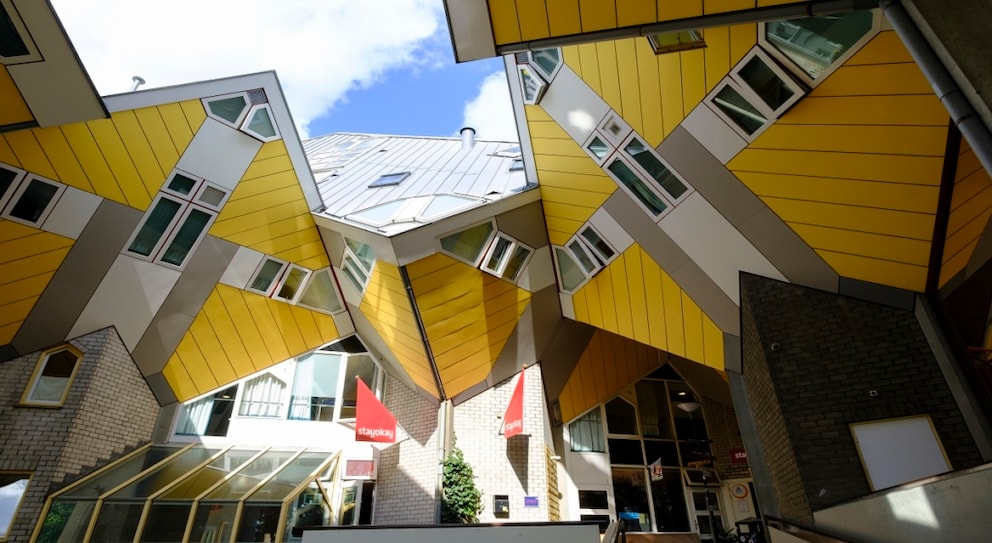
The Cube Houses in Rotterdam, a total of 39 homes, were meant to be his masterpiece. Blom had an unusual vision: The people living in the unique designer pieces should feel as if they were living in a tree. Together, the cube houses would form a postmodern forest in the middle of the city. And indeed, from a distance, one might get this impression, as each house stands on a kind of hexagonal trunk that serves as storage space and entrance area. On the first floor of the 106-square-meter living units are the kitchen and toilet. Above is an area with two bedrooms and another bathroom. The top floor, particularly bright due to its windows, was often used by its residents as a kind of natural solarium.
Also interesting: The Crazy Sphere House Settlement in the Netherlands
During the construction of the Cube Houses, there were many delays and difficulties. Among other things, historical fragments of old Rotterdam were found in the area intended for construction. Additionally, one of Blom’s partners withdrew from the project, and the entire Netherlands slipped into an increasingly deep economic crisis at the start of construction in 1980, triggered by a global recession. Nevertheless, Blom’s house forest was ready for occupancy in 1984 and became a unique landmark of Rotterdam in the following years. This was despite the fact that, due to the special construction of the cubes, which seem to stand on their tips, a quarter of their area cannot be used as living space.
Visit a Residential Cube

In addition to the 39 Cube Houses, there are also two larger Super Cubes, one of which was previously used as a school for architects. Today, it houses a youth hostel. The second larger unit is temporarily used as social housing. But Blom not only designed his iconic cube houses, he also renovated the entire Oude Haven district. This includes a similarly famous hexagonal tower called Blaaktoren and a complex of terraced buildings known as Spanse Kaade. Due to the project’s popularity, one of his Cube Houses now serves as a show house for tourists.
Also interesting: Nitt Witt Ridge: The Quirky U.S. Estate Made of Trash
If you want to see what it’s like to live in the Cube Houses, you can do so according to the official tourism website of Rotterdam daily from 11 a.m. to 5 p.m. The quirky attraction can be reached by bus and tram via the Blaak Station stop. Adults currently pay three euros for entry to the “Kijk-Kubus” (“Show Cube”), children only half. On the portal Tripadvisor, many users are enthusiastic about the insight into Piet Blom’s visionary living world. One says: “Really a fascinating building! The unusual architecture of the slanted cube houses offers plenty of great photo opportunities.” Another writes: “Should definitely be seen when in the city.” A third adds: “The houses are truly unique.”