

October 10, 2026, 5:16 am | Read time: 5 minutes
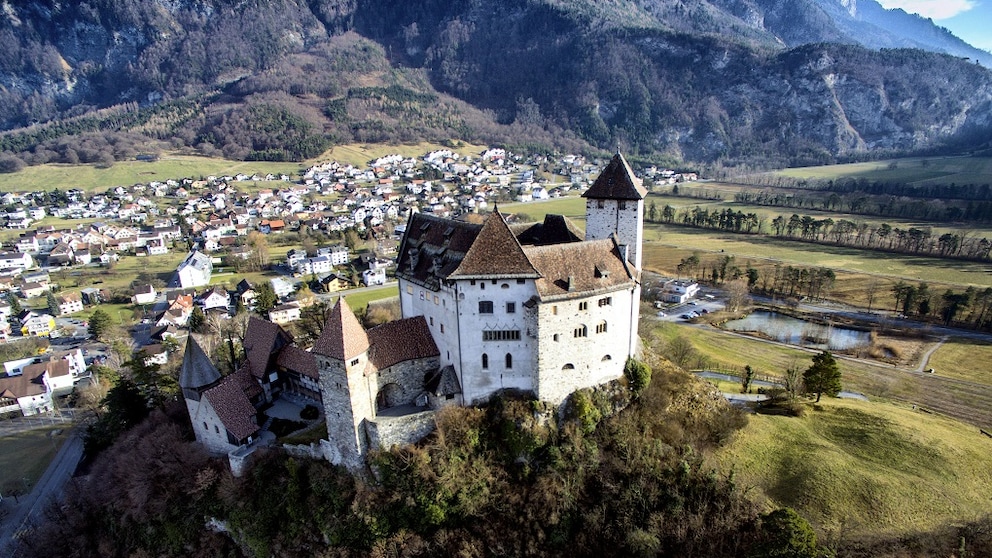
In the Liechtenstein community of Balzers, the Gutenberg Castle stands prominently on a hill above the Rhine Valley. Evidence of settlement in the area dates back to the Neolithic period, and over the centuries, the structure has experienced a varied history. It remains closely associated with local Egon Rheinberger, who impressively fulfilled a lifelong dream by rebuilding the dilapidated fortress. Our author has searched for traces on site.
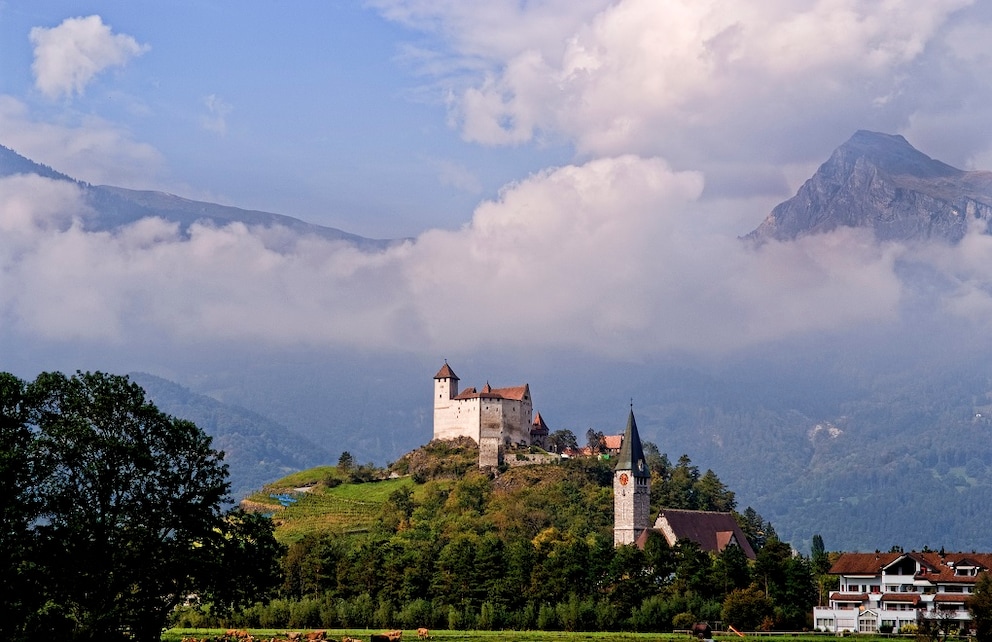
There it was, already visible from afar, the Gutenberg Castle in Balzers, Liechtenstein. I had been walking through the country for four days, and now the place and the fortress perched on a 60-meter-high hill above the Rhine Valley welcomed me at the end of my tour. Of course, I knew that for a fitting end to the hike, I would also climb the castle hill and visit the old structure. At that time, however, I had no inkling of the special history of the place, which can be traced back to the Neolithic period. As a nostalgist and fan of castles, I initially just thought I wanted to take a closer look.
So, one last short breath, a winding path led up a shady way to Gutenberg Castle. On the steep slopes, vines stretched out, with grapes already hanging heavily in mid-September. My enthusiasm was slightly dampened when I read a sign indicating that the fortress could only be visited in detail with prior registration. But at least its courtyard, chapel, and rose garden were open to me, and I could never resist the allure of the history of old masonry. What I found inside, however, was even more—a trail to an exciting story.
Significant Archaeological Finds
That Gutenberg Castle is today one of Liechtenstein’s landmarks and a truly impressive building is thanks to a local named Egon Rheinberger, born in the capital Vaduz. He bought the castle from the principality at the beginning of the 20th century, fulfilling a lifelong dream with its remarkable reconstruction. In doing so, he also created a monument that honorably commemorates the history of this place, whose first traces appear around 4500 B.C., more than 6,000 years ago. But first things first.
According to the website of the Kultur-Treffs Burg Gutenberg, it was probably built sometime in the 12th century. However, the hill on which it stands has been demonstrably settled since the Neolithic period. This is evidenced by some of the most significant archaeological finds in the entire Alpine region, such as intricately crafted figures of humans and animals. The first lords of the fortress were the von Frauenberg family, and in 1314 it fell to the Habsburgs. In the following centuries, numerous rulers took turns here. The story of the siege of the structure by the Swiss in 1499 during the Swabian War is memorable.
Also interesting: The most beautiful castles and palaces in the Harz
In the Heart of Europe: This Hidden Country Feels Like a Fairy Tale

Is the Liechtenstein Trail Across the Country Worth It?
Ingenious Ruse
Consequently, the capture of the castle failed because the attackers’ cannons were not strong enough. The Austrian garrison held out until their food supplies ran out. Then they came up with a brilliant trick. To deceive the aggressors into thinking the supplies would last much longer, they threw the last calf over the castle wall. The ruse actually worked, and the attackers withdrew without accomplishing their goal. Subsequently, the castle lost its significance and was abandoned by the Austrians in 1748, according to the “Historical Dictionary of the Principality of Liechtenstein.” Its fate seemed sealed.
When the village of Balzers burned in 1795, stones from Gutenberg Castle were used for the reconstruction of the place. In 1824, the community bought it, and in 1854 it passed to the Liechtenstein princely house. The structure then spent further decades in a dormant state until its fate finally changed on May 30, 1905. On that day, the architect, painter, and sculptor Egon Rheinberger from Vaduz bought the ruin from the state for a symbolic sum of 1,000 crowns. Around 1890, he had studied at the Munich Academy of Arts. Now he fulfilled a lifelong dream with the elaborate reconstruction of the dilapidated fortress.
Also interesting: The Wartburg: Thuringia’s World Heritage Fortress
Changing Owners
In the style of historicism and castle renaissance, he expanded Gutenberg Castle into the impressive complex that still towers over the town of Balzers today. Rheinberger initially used it as a summer residence, establishing a tavern and a bowling alley in the garden. From 1920, the Rheinberger family lived in the massive building year-round. It subsequently developed into a cultural meeting point. In 1925, open-air plays took place, and in 1933, scenes for the film “Wilhelm Tell. The Freedom Drama of a People” were shot here. Until his death in 1936, the self-made castle lord lived in his fortress. His family then moved back to Vaduz.
Gutenberg Castle then had further private owners, most recently filmmakers Hermine Kindle de Contreras-Torres and Miguel de Contreras-Torres. They bought the fortress in 1951 for 200,000 francs and eventually sold it to the Liechtenstein state in 1979 for an astronomical profit. The couple received 3.8 million francs for the property, which is more than four million euros in today’s value. Today, the castle is still occasionally a venue for cultural events.
Also interesting: This castle was built only because of a book
After renovations in the 1990s and from 2006 to 2010, parts of Gutenberg Castle are now accessible to the public through guided tours. Interested parties can register directly via the official website of the fortress from May to October. These are currently offered for a maximum of 20 people at a time. The rose garden is open to visitors from 10 a.m. to 5 p.m. during this period. The outer bailey is open year-round and freely accessible to all visitors. This even applies during private events in the courtyard, rose garden, or castle chapel.