

March 24, 2026, 12:03 pm | Read time: 4 minutes
At the border between Saxony and Saxony-Anhalt was the most secret location of the former East Germany during the time of the German division. A powerful bunker complex that was intended to serve as a command center and shelter for hundreds of members of the National People’s Army (NVA) in the event of a nuclear attack. Today, visitors can take a sobering look into the past at the Kossa Military Museum.
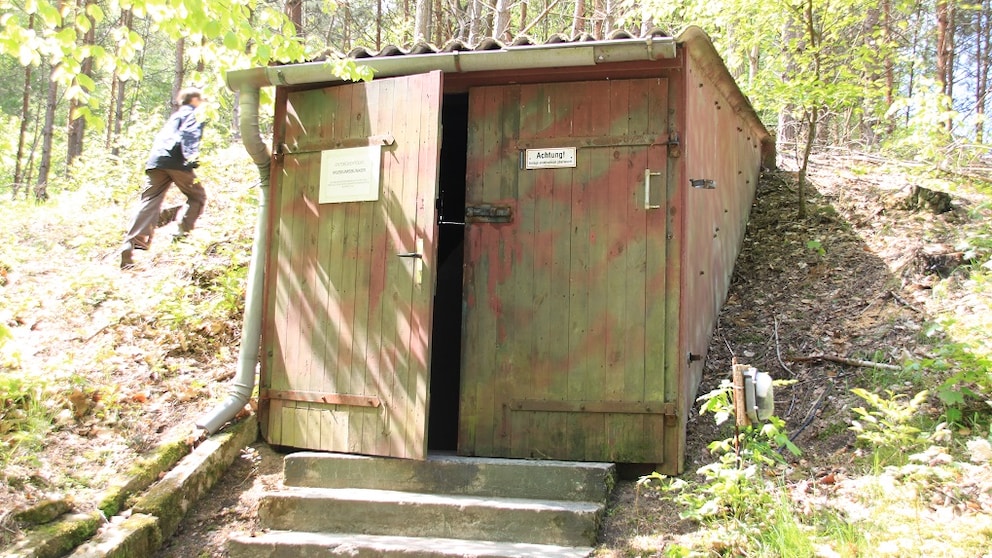
In an otherwise unremarkable forest area in the Dübener Heide, at the border between Saxony and Saxony-Anhalt, lies what was once the most secret location of the former East Germany. During the time of the German division, a system of bunkers was located here, meters deep underground, designed to protect the leadership of the National People’s Army in the event of a nuclear attack. An ultramodern command center for its time, capable of providing shelter to hundreds of people in an emergency. Today, the facility is a museum that tells the story of one of the darkest chapters in human history.
“Perhaps we can accept the past and learn from it—for a better future.” This is stated on the official site of the Kossa Military Museum. Since 2002, the former bunker complex has been open for tours. A place that was closed to the public for decades. But let’s start from the beginning: It was the year 1976 when the National People’s Army of the former East Germany began constructing the bunker complex. As early as the 1960s, the area, designated “Buche,” had been declared a military restricted zone. A pioneer and chemical workshop with equipment storage and several administrative buildings had been established on the site.
Phone to Moscow
About 400 people worked there, both military personnel and civilians. By 1979, a bunker system had been built eight meters underground, where up to 600 soldiers could seek shelter in the event of a defense situation. The facility was equipped with autonomous energy and drinking water supply capabilities for these, fortunately, never-realized circumstances. Steel sluice gates, which could be sealed bomb-proof, could isolate each individual bunker from the others. The construction was also well hidden in the densely wooded slopes of the Dübener Heide.
At the Kossa Bunker Museum, you can still visit part of the facility today. Among other things, you can see three clocks showing not only the local time but also Moscow time. You can also marvel at old technology, such as mainframe computers and NVA uniforms. Additionally, there are three telephones through which the bunker could directly contact the outside world. A red phone for calls to the National Defense Council, a green one for the government hotline, and a white one for direct calls to Moscow. Although there were some staff exercises in the facility to simulate emergencies, it was never fully “operational.”
Discover the Bunkers

Until 1993, the Bundeswehr used the facility after reunification, and since 2002, it has been a museum. Adults pay 15 euros for a guided tour. The so-called “Discovery Tour” on your own costs 12 euros. Please refer to the official website for all prices and opening hours. There are a total of five bunkers to discover, but the entire facility is much larger, so a day visit is recommended. The bunkers have a maximum temperature of 12 degrees Celsius, so warm clothing is advisable for a visit.
In the city administration of Laußig, on whose territory the Kossa Military Museum is located (Kossa is a district of Laußig, the editors), they are very friendly but not at all enthusiastic about the TRAVELBOOK call. “The area is still a restricted zone and not legally accessible to the public outside of tours,” a staff member wants to make clear. Too often, the old East German bunkers are written about on the internet, and the facility is glamorized as a “Lost Place” among fans of dark tourism. “We wish this type of reporting would finally stop.” Therefore, once again, here at TRAVELBOOK for all readers: Do not enter the area on your own, but only during regular opening hours. By doing so, you help preserve a historic site for everyone.