

May 30, 2026, 12:32 pm | Read time: 5 minutes
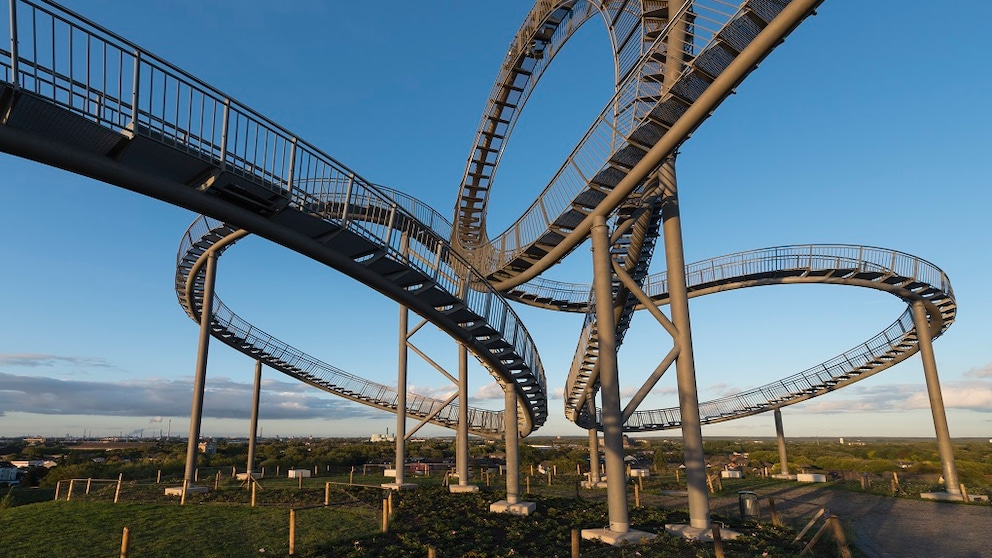
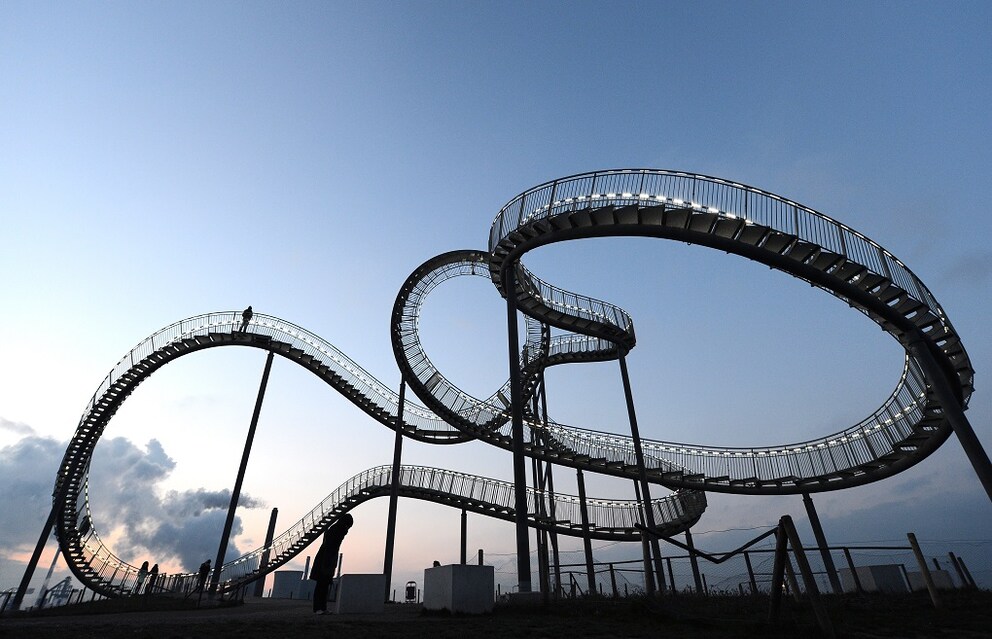
In the Ruhr area metropolis of Duisburg, an unusual sculpture has stood since 2011, gaining fame far beyond Germany’s borders. At first glance, the work Tiger & Turtle – Magic Mountain resembles a roller coaster. And you can explore it on foot. TRAVELBOOK spoke with artist Heike Mutter, who developed the work with her colleague Ulrich Genth, about its significance for her and the region.
Visitors to the Heinrich-Hildebrand-Höhe in Duisburg might feel a sense of déjà vu. The massive sculpture there is familiar even to those who have never visited the Ruhr metropolis. Since its opening, Tiger & Turtle – Magic Mountain, as the artwork is called, has appeared on Windows screensavers, magazine covers, and calendars. The walkable figure, which initially resembles a roller coaster, is so well-known and beloved that it can be considered an unofficial landmark of Duisburg. From the top, you not only get a view of the landscape but also of the city’s history.
With dimensions of 44 by 37 meters and a maximum construction height of 21 meters, Tiger & Turtle – Magic Mountain is, according to the official website of the artist duo Heike Mutter and Ulrich Genth, the largest sculpture in Germany. Since its opening in November 2011, it has literally towered over the Heinrich-Hildebrand-Höhe, part of the so-called Angerpark, which itself rises 50 meters above sea level. During the day, you can enjoy a spectacular view, and at night, the artwork transforms into a unique illuminated object thanks to hundreds of LED lights. But what is the story behind this unusual metal giant?
Demand for Leisure
“I alone could probably give you five different interpretations of what Tiger & Turtle – Magic Mountain is supposed to mean,” Heike Mutter told TRAVELBOOK. “The media often say the tiger represents speed and the turtle slowness. But that’s too simplistic.” It all began when the city of Essen, along with the Ruhr area, was named the European Capital of Culture in 2006. At that time, Mutter and Genth lived in Duisburg as artists thanks to a scholarship. “This included both an apartment and a studio, which was located directly on the grounds of the Krupp-Mannesmann steelworks. We used the studio for many years, even after we had long since moved back to Cologne.” Here, Mutter and Genth came into contact with both the typical Ruhr area industry and the people who worked in it.
Also interesting: Lake View in Zug: Perhaps Europe’s Most Unusual Artwork
In 2005, the metalworks filed for bankruptcy. “During our scholarship period, we were directly confronted with the events on the ‘adjacent site.’ In Duisburg, you can clearly see the connection between work life and leisure. For example, the lakes of the Sechs-Seen-Platte were created by gravel mining in the early 20th century as part of industrial development. In the 1960s, the area was reclaimed and is now a popular local recreation area. In the 1990s, the CentrO (now Westfield Centro) in Oberhausen was built on an industrial wasteland, considered the largest shopping and leisure center in Europe. There are also ski halls and amusement parks–all offerings that show how much leisure is now linked to mass consumption and the economy.”
A Work for Decades
Mutter sees Tiger & Turtle – Magic Mountain as a counterpoint to this. She and Genth won a 2009 competition by the city of Duisburg to design a sculpture for the Heinrich-Hildebrand-Höhe. Their concept of a walkable artwork, Tiger & Turtle – Magic Mountain, convinced the jury. The unique artwork was finally opened on November 13, 2011. “Everyone knows the image of a roller coaster. But we want people walking on the sculpture to think for themselves.”
Nevertheless, Tiger & Turtle – Magic Mountain indeed initially resembles a roller coaster. This is due to the wild swings and curves of the metal construction. There’s even a loop. Unfortunately, due to the laws of gravity, it is naturally not walkable. Visitors can explore the unique artwork on foot over 220 meters and 349 steps. “We wanted to create something that looks like a great experience. And perhaps even evokes childhood memories in people. Still, we want people walking on the sculpture to think for themselves. Fortunately, this has worked wonderfully from the start. The sculpture was very well received.”
Also interesting: London’s Millennium Bridge: The World’s Most Bizarre Art Gallery
Although the two had realized projects before, “This was our first artwork where it was clear it would stand there for the next 30 to 40 years. All the more beautiful that we can still identify with it today.” A special feature for Mutter about her work is the diversity with which visitors can perceive it. “This can happen intellectually, but also physically through walking.” For the two artists, Tiger & Turtle – Magic Mountain was not the only sculpture of this kind they realized. Since 2021, a similar artwork titled SpaceWalk has stood in the South Korean city of Pohang. Those who want to visit the “original” in Duisburg have the opportunity to do so free of charge all year round.