

September 28, 2025, 5:45 am | Read time: 4 minutes
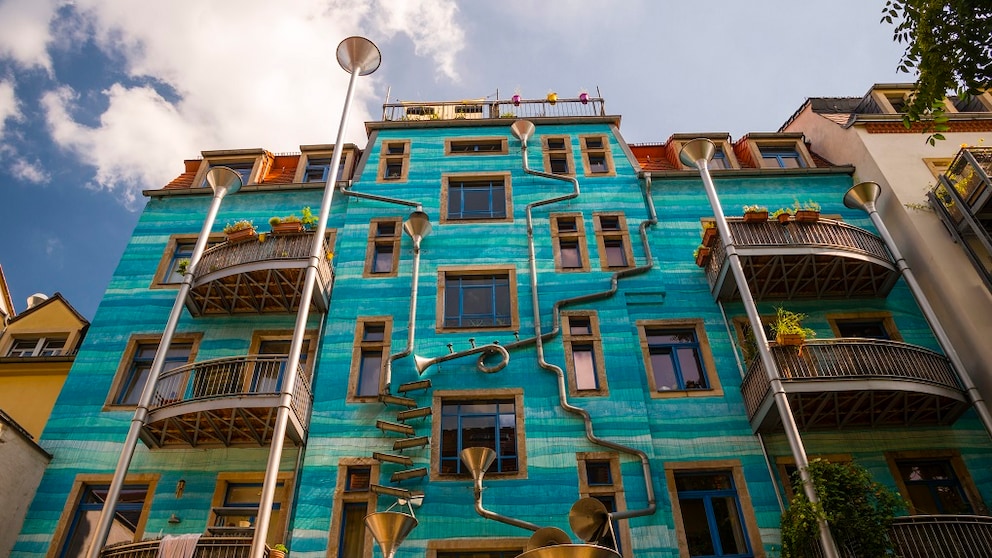
The Kunsthofpassage Dresden has been one of the most unusual attractions in the Saxon capital for more than 25 years. One building in the so-called Courtyard of the Elements is particularly fascinating. When it rains, an artwork of pipes and funnels mounted on the facade creates a unique “music.” TRAVELBOOK spoke with artist Anette Paul, who created the work with two colleagues, about its significance.
The Kunsthofpassage in Dresden is arguably one of the most unusual attractions in the Saxon city on the Elbe. Opened in 1999, the five courtyards with different themes and attractions delight countless visitors each year. Among them is a very special artwork that spans an entire wall in the so-called Courtyard of the Elements. At first glance, it is just an installation of pipes and funnels, reminiscent of Hundertwasser’s works. But when it rains, the creation, designed by three artists, reveals its special magic. The raindrops create a kind of “music.”
The Kunsthofpassage Dresden was created according to the official website to revitalize the then “run-down backyards of Dresden’s Neustadt.” Artists were invited to redesign the once dreary places. “Each courtyard takes on its own theme and showcases it in its facade design.” The five courtyards have since been not only uniquely enhanced but also bear imaginative names. There’s the Courtyard of Mythical Creatures, the Courtyard of Light, the Courtyard of Animals, and the Courtyard of Metamorphoses. Perhaps the biggest draw, however, is the bizarre sound installation in the Courtyard of the Elements.
The Inspiration Came from Russia
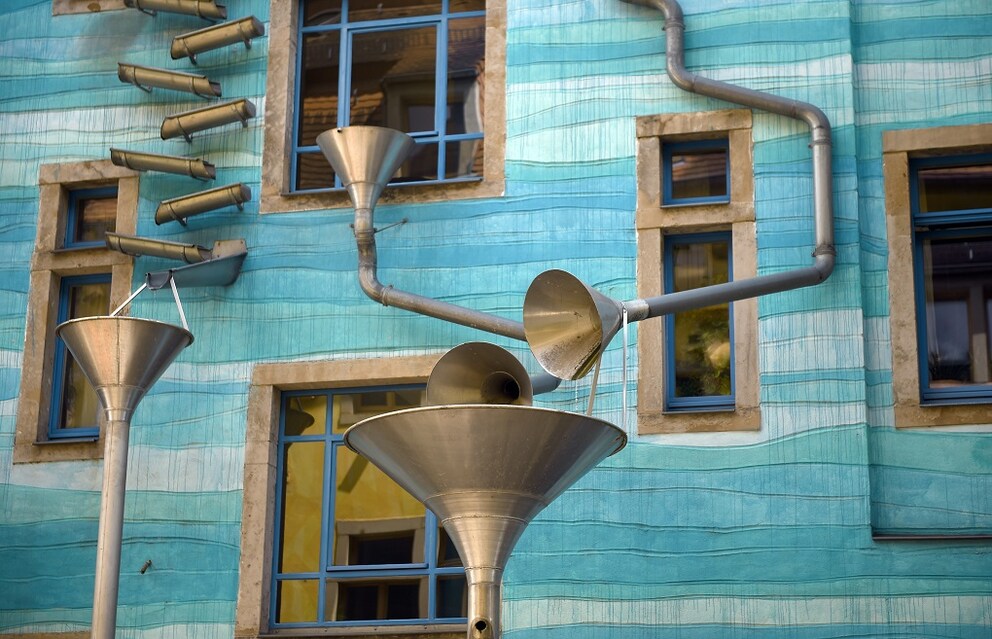
The three artists Annette Paul, Christoph Roßner, and André Tempel created it. TRAVELBOOK reached Anette Paul “in the midst of preparations for an installation,” as she writes in an email. Nevertheless, she takes the time to explain the significance of her sound artwork. The inspiration came to them during a trip to the Russian city of St. Petersburg. “We were impressed by the large rain pipes we discovered there in the winter of 1996.” These pipes produce a unique sound when it rains.
Also interesting: The crazy ball house settlement in the Netherlands
In 1999, Paul and her two colleagues realized their own installation during the redesign of the Kunsthofpassage Dresden. What’s special about it? “The rain flows from the roof into the pipes and from there, like a water feature, into the next pipes or funnels, making sounds along the way.” But is it really a kind of music, as noted on the official Dresden city marketing site? Paul clarifies: “No melody is played, but depending on the weather, the existing sound is amplified and directed: splashing, dripping, rushing, swelling, subsiding, flowing, splashing, spraying.”
“Almost Like a Landmark”

Paul no longer remembers the exact costs of their unique sound installation. “However, it was quite inexpensive to implement because we installed it ourselves.” They only needed the help of a tinsmith, a metalworker, to shape their unique pipes and funnels. Today, the rain instrument in the Kunsthofpassage Dresden is known beyond the region. “It is featured on many calendars and is now almost perceived as a landmark.” According to Paul’s estimate, about 250 people visit her installation daily, totaling around 90,000 annually.
Paul, Roßner, and Tempel have never worked together again, as she says. Each of them has continued to create their own installations over the years. What does Paul associate with her sound artwork in the Kunsthofpassage Dresden? “The rain pipes tell a story here and suggest music.” The facades of the other four courtyards are also very artistically designed and worth a visit, as are the many shops and studios found here.
Also interesting: You can live in this giant shoe
The Kunsthofpassage Dresden opens weekdays at 6 a.m. On weekends, they are accessible from 8 a.m. From Sunday to Thursday, they close at 11 p.m., and on Friday and Saturday, they close at midnight. On the portal Tripadvisor, visitors express their enthusiasm for the location: “A beautiful place for a walk and to pass the time,” writes one. Another says, “The colorful houses are worth a visit. We also liked the small studios and shops.” A third adds, “If you like street art, this is the place for you.”