

October 23, 2026, 1:10 pm | Read time: 4 minutes
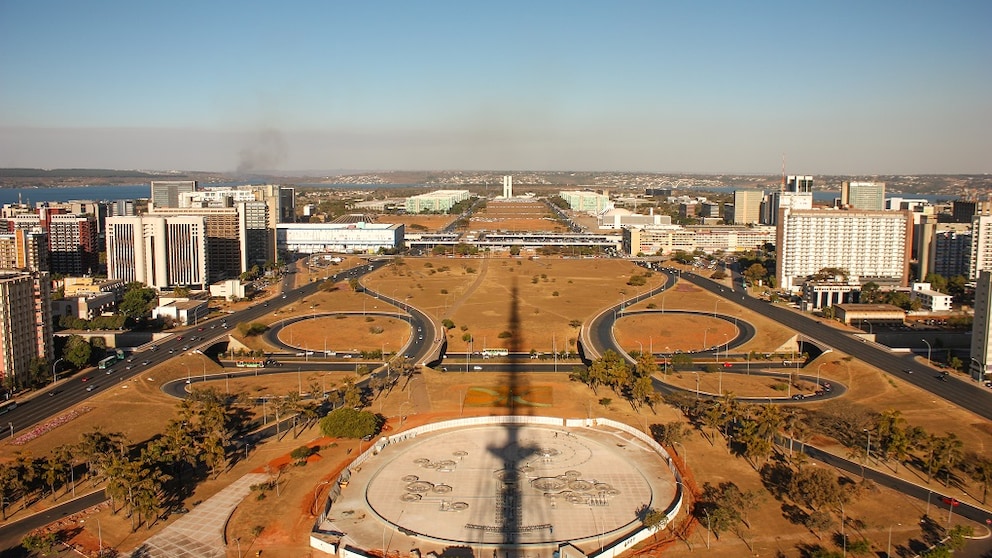
Since 1960, the Eixo Monumental has run through Brazil’s capital, Brasília, as the widest street in the world. At up to 250 meters wide, it is much more than a traffic artery–it has long been a landmark of the bustling metropolis. It also significantly contributed to Brasília receiving a very special honor. TRAVELBOOK explains the “Monumental Axis.”
Anyone visiting Brazil’s capital, Brasília, will eventually be drawn to a landmark along the Eixo Monumental. With six lanes on each side, traffic races through the metropolis along the city’s most important monuments. Running east to west, it stretches across the entire capital and was the centerpiece and one of the most important construction projects nearly 70 years ago when Brasília was literally built from the ground up. But the grand boulevard is much more than that, as it also holds the record as the widest street in the world.
In English, the name Eixo Monumental translates to “Monumental Axis,” and this is quite literal. When architect and city planner Lúcio Costa, along with his legendary colleague Oscar Niemeyer, planned the blueprint for Brazil’s new capital in 1957, they wanted a representative lifeline that would run along the capital’s most important buildings and monuments. Whether they intentionally aimed to build what is now the world’s widest street at a maximum of 250 meters is not documented. However, it is conceivable. The previous record was held by Avenida 9 de Julio in Buenos Aires, which is up to 160 meters wide.
Tourist Attractions
According to “CNN Brasil,” the Eixo Monumental became the centerpiece of the so-called “Pilot Plan” for Brasília. This name comes from the fact that the capital’s layout actually resembles an airplane. The grand avenue divides the metropolis into two “wings” in an east-west direction, so to speak. This planning also aimed to clearly separate the city’s federal administrative center from its urban residential areas. On April 21, 1960, the city’s new main street was inaugurated with a grand ceremony. Since then, life in Brasília has unfolded along its route.
Also of interest: The narrowest street in the world is in Germany
Touristically, many of the most significant attractions are located along the Eixo Monumental. Its wide median strip serves as a stage for fairs, exhibitions, competitions, protests, and a variety of other events. The Square of the Three Powers houses the headquarters of the executive, legislative, and judicial branches of the largest South American country by far. It also hosts various cultural and sports facilities, recreational areas, restaurants, and institutional buildings.

A Very Special Honor
Some of the most famous buildings by Brazil’s star architect Oscar Niemeyer are also located along the Eixo Monumental. For example, the National Congress. Its two dome-shaped buildings house the Federal Senate and the Chamber of Deputies. The Cathedral of Brasília, designed in the form of two hands reaching toward the sky, is one of the country’s most iconic places of worship. The Claudio Santoro National Theater hosts culturally significant events, and the National Museum offers countless exhibits on Brazil’s history and culture. Also noteworthy are the monumental Palácio do Planalto, the seat of the country’s executive branch, and the Itamaraty Palace, where the Brazilian Ministry of Foreign Affairs resides.
Also of interest: Extraterrestrial Highway: The road of aliens in the USA
Ultimately, the Eixo Monumental is also to thank for Brasília receiving a very special honor. As the only metropolis built in the 20th century, it was designated a UNESCO World Heritage site for its architectural uniqueness. The prestigious recognition was granted on December 7, 1987, as noted on the organization’s website. The report underlying the inscription describes Brasília as a “modern, unique, and distinctive city, built from scratch in the 20th century in the middle of nowhere, to become not only a country’s capital but also a great historical example.” It remains so to this day, thanks in part to the widest street in the world.