


January 25, 2026, 9:21 am | Read time: 3 minutes
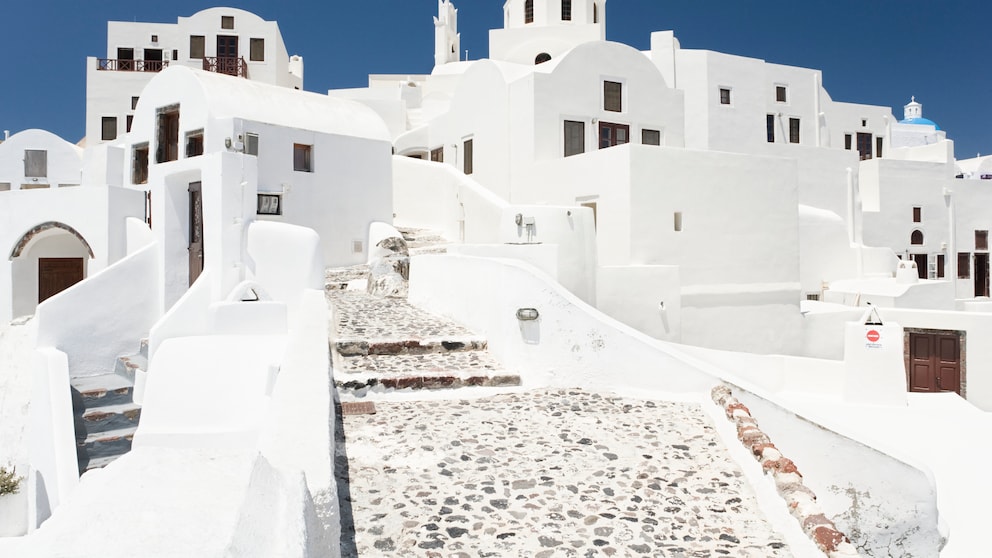
When you think of islands such as Santorini, Paros, or Mykonos, you don’t just think of beautiful bays and crystal-clear seas, but inevitably also the typical architecture with whitewashed houses and blue doors and window frames. But how is it that so many buildings in Greece are painted in white and blue? TRAVELBOOK has the answer.
You might think that the typical painting of houses in Greece has to do with the colors of the Greek national flag, which is also blue and white. In fact, however, there are several other reasons why these colors are predominant in many places in Greece.
As the portal “Greekreporter“, which specializes in Greece, reports, the initial aim was to cool the houses with the white paint. Most of the buildings were made of stone, as wood was hardly available on the rocky Aegean islands. However, the rocky terrain there is relatively dark in color. This posed a problem in the Greek summers. The sunlight that fell on the houses was absorbed by the dark stones. This made it unbearably hot inside. This effect could be mitigated with the white paint.

The Role of Cholera in the Colors of Houses in Greece
According to “Greekreporter,” cholera broke out in Greece shortly before the Second World War during the dictatorship of Ioannis Metaxas. In order to contain the disease, he ordered citizens to paint their houses white from 1938 onwards. The reason: the whitewash used to paint the houses contained lime. Lime is considered a strong disinfectant, which is why houses in the Mediterranean region are still painted with it today. According to the German Lime Industry Association, buildings painted with quicklime hardly ever develop bacteria or mold. From the end of the 1930s, Greek citizens therefore limewashed their houses to disinfect them and contain the spread of cholera.
The question remains as to why windows and doors are so often painted blue. As “Greekreporter” reveals, it is primarily a cost factor. According to the report, fishermen and other sailors in Greece often painted their windows and shutters with the residue left over from painting their boats. Due to its components, blue was usually the cheapest color available.
The blue used for the houses on the islands of Greece consisted of a mixture of limestone and a particular cleaning agent that most islanders had on hand at home anyway. It was therefore particularly easy for them to make blue paint themselves.
Military Dictatorship Enforced Color Scheme on Greek Islands
Gradually, the colors white and blue became the trademark of the Cyclades islands in particular, but also in other parts of Greece. The color scheme also corresponded to the Greek flag, which is also blue and white. During the military dictatorship that took power in Greece in 1967, the typical livery became mandatory, as “Greekreporter” further reports. The regime believed that the colors would inspire patriotism and reflect Greek nationalism. In 1974, a law was passed that required houses on the Greek islands to be painted blue and white.
Although these regulations have since been relaxed, many Greeks continue to paint their houses in the typical colors. After all, they are one of the reasons why many travelers love coming to Greece and why islands such as Santorini and Mykonos are now absolute Instagram hotspots.