

April 12, 2026, 9:16 am | Read time: 6 minutes
For nearly nine centuries, one of Christianity’s most important relics has been located in Cologne. Allegedly, the bones of the biblical Three Wise Men rest here, preserved in a golden shrine. In the Middle Ages, these remains were so famous that they made the Rhine metropolis one of Europe’s most important pilgrimage sites and an exceedingly wealthy city. The veneration was so profound that one of the world’s most impressive churches was built for them.
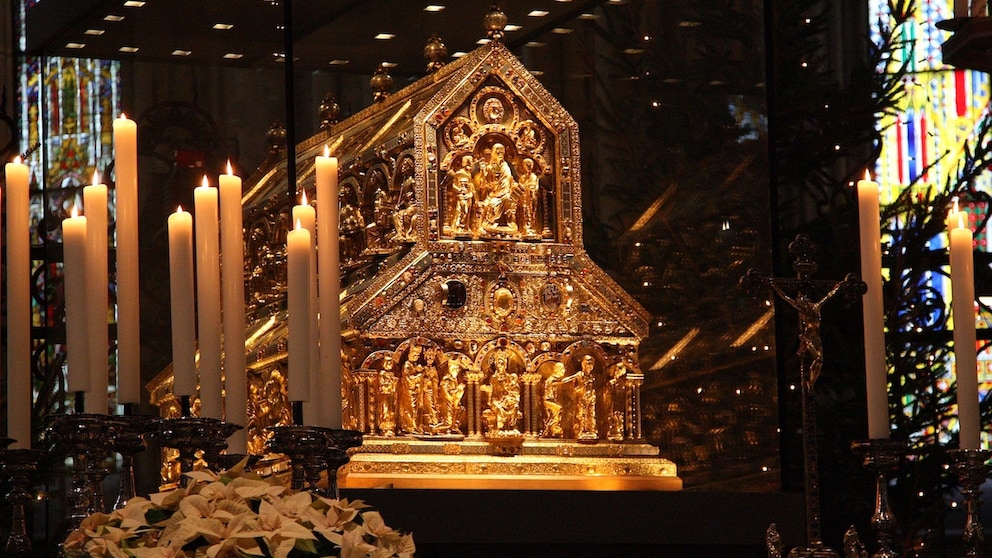
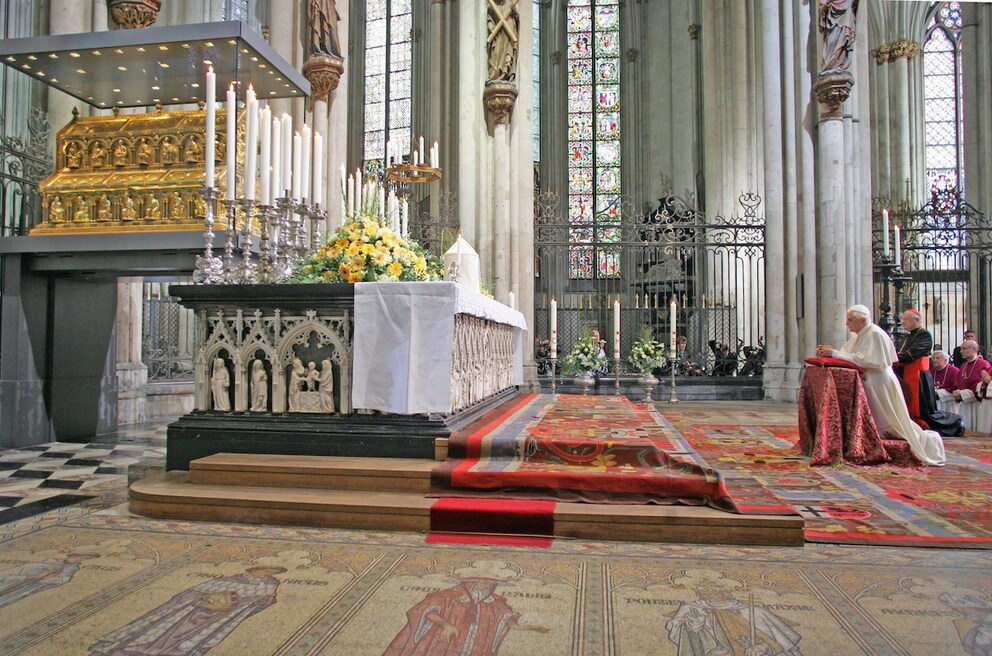
There’s no doubt that a visit to Cologne Cathedral will remain an unforgettable experience for most people, even under normal circumstances. The stone church, constructed over eight centuries, must surely be considered one of the most important in the world. Its special significance is also due to a very special treasure, which today stands behind the medieval high altar at the head of the nave. This is a golden shrine. According to belief, it contains one of Christianity’s most important relics: the bones of the biblical Three Wise Men. But how did the bones come to the Rhine metropolis, and how did the cult around them originate?
It is July 23, 1164, when the Archbishop of Cologne, Rainald von Dassel, enters Cologne with his entourage, cheered by the entire city. The treasurer and military leader of the legendary Emperor Frederick I, also known as Barbarossa, returns victorious from a campaign in Milan. Among the possessions of his retinue is a relic that the cleric requested as war booty from his ruler. Throughout his long journey home, Rainald told people about it, and he himself is quite obsessed with his special “souvenir.” For what he brought back, according to the official site of Cologne Cathedral, will grant the city the status of one of the world’s most important Christian pilgrimage sites in the following years and centuries, and lead to the construction of an incomparably impressive church. Rainald brings the bones of the Three Wise Men to Cologne.
The Saints Go on a Journey
The cult around these biblical figures begins around the year 300 AD. Around 500, they are first referred to as Caspar, Melchior, and Balthasar. In 313, the Roman Emperor Constantine announces the so-called “Edict of Milan.” This elevates Christianity to the status of an equal religion for the first time. Many people convert as a result, including Constantine’s mother, Helena, who is revered as a saint today. According to a historically unverified legend, Helena develops a kind of collecting passion for relics associated with Jesus Christ. In Jerusalem, she supposedly discovers both his tomb and the cross on which he is said to have died. But perhaps her most important find is the bones of the Three Wise Men.
She likely encounters them around 326 in the historical region of Palestine. She initially has them brought to Constantinople, now Istanbul. However, her son gifts the bones to Eustorgio, the Bishop of Milan. According to the story, the bones of the Three Wise Men make the 2,000-kilometer journey on an ox cart. For more than 700 years, they rest here in a church built specifically for them. In 1162, the siege of the city by Barbarossa and Rainald von Dassel begins. It ends with the victory of the German army and the transfer of the relic to Cologne. Allegedly, the bones were disguised as plague victims during the return journey to protect them from robbers. And although, according to “Deutsche Welle,” there were no sources about the existence of this treasure until 1162, it was already widely famous upon its arrival in Cologne.
St. Ursula is the eerie bone church of Cologne

Which of these places is the spookiest in Germany?
A Cathedral for the Kings
What follows is an unprecedented rush to the church in Cologne, where the bones of the Three Wise Men are initially kept. Naturally, they are reputed to have healing powers. Soon, people flock to be near them. As a result, Cologne gains significantly in prestige and wealth. The city quickly becomes one of the most important Christian pilgrimage sites. Over the next centuries, a tradition develops among newly crowned kings to make a pilgrimage to the Cologne relics immediately after their elevation and pay their respects. The demand for the precious relic eventually becomes so great that one thing becomes clear: the Rhine metropolis needs a new, larger, more representative church. Thus, in 1248, the construction of Cologne Cathedral begins. Perhaps Germany’s most important church today is created to provide a worthy home for the remains of the Three Wise Men.
As early as 1190, Rainald von Dassel’s successor, the new Archbishop of Cologne, Philipp von Heinsberg, commissioned the construction of a magnificent shrine for the relic. What eventually emerges over 30 years of work under the master Nikolaus von Verdun and his successors is the largest and most valuable goldsmith’s work of the entire Middle Ages. Adorned with over 1,000 jewels and pearls, according to “WDR,” it features more than 70 biblical and historical figures. Among them is, for example, King Otto IV, who donated gold and jewels for its construction. Not least for this reason, Otto is depicted on the shrine in close proximity to the Three Wise Men. The relic is more than two meters long, one and a half meters high, and weighs 500 kilograms.
Still Revered Today
Even today, the unique treasure has lost none of its allure for believers. Indeed, the shrine of the Three Wise Men is opened once a year. An event that continues to attract people from all over the world. Then, a golden plate is removed, and through a golden grille, three skulls can be seen. This important occasion, celebrated as the “Feast of the Epiphany,” always takes place around January 6, the Day of the Three Kings. A spokesperson for the cathedral workshop told TRAVELBOOK: “The shrine has lost none of its allure over the centuries. It is not only a masterpiece but also the core of the cathedral, around which everything revolves. Without this shrine, the church wouldn’t exist at all.”
Therefore, the rush around the Day of the Three Kings in the cathedral is always particularly high. Once a year in September, the Three Wise Men are also celebrated with their own multi-day pilgrimage, during which everything revolves around them. Among other things, one can walk a pilgrimage path that runs through Cologne Cathedral itself. The various stations can also be traced on the official website of the church. Whether one truly believes that the bones of the biblical figures are in the shrine is, of course, a matter of personal faith. “But that’s exactly why people come here. For them, these are the mortal remains of the Three Wise Men.”