

July 29, 2026, 3:43 pm | Read time: 5 minutes
In the film sets of Christopher Nolan’s “Odyssey” (2026), one can hardly stop marveling at the wild coasts, gigantic fortresses, and mystical islands. You might think the locations are almost too spectacular to be real. Yet, the Oscar-winning director once again relies on authentic and realistic film sets. For the adaptation of Homer’s epic, the footage was shot in some of the most impressive locations in Europe and North Africa.
Greece
Few countries are as closely linked to the story of Odysseus as Greece. After the Trojan War, the hero wants to return home to his wife Penelope and his son Telemachus on the island of Ithaca. It is considered the home of Odysseus and the destination of his long journey, as described by Homer in the “Odyssey.”
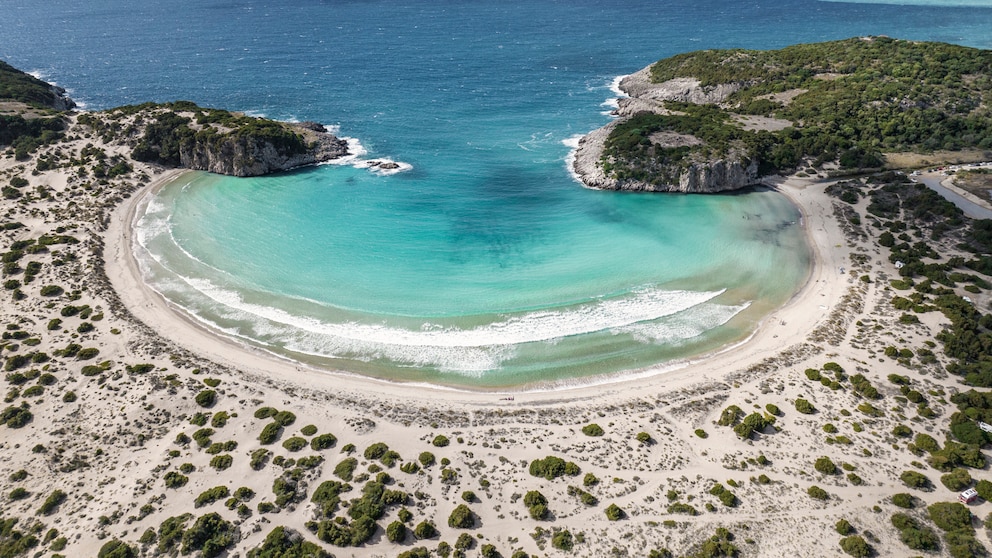
Although filming did not take place on Ithaca itself, it did occur in the Greek regions of Messenia and Laconia on the Peloponnese peninsula. Some key scenes were shot around the beach of Voidokilia (large image above), which, with its nearly perfect curve, resembles the Greek letter Omega. Above the beach lies Nestor’s Cave, representing the encounter with the one-eyed Cyclops Polyphemus. For the filming, the cast and crew transported IMAX cameras weighing up to 330 pounds and an approximately 60-foot-tall Polyphemus figure up the steep rock face. Both locations are accessible to visitors and reachable via hiking trails.
The castles of Methoni and Acrocorinth also served as film sets. Pylos and the Gialova Lagoon played another important role. The port of Pylos was one of the production’s most important logistical sites. A reconstructed ancient trireme, about 121 feet long, was also used there.
Sicily
Sicily also played a significant role in the filming of “The Odyssey.” The central location was the island of Favignana off the west coast of Sicily, part of the Aegadian Islands. Researchers suspect that Homer was inspired by this island group when describing the legendary Siren Islands. Therefore, director Christopher Nolan deliberately chose Favignana as the backdrop for several key scenes.
In the film, the coves Cala Rotonda, Cala Bue Marino, and Cala Rossa impress with turquoise waters, imposing rock formations, and unspoiled coastal landscapes. Many of these places remain scarcely developed and still convey the impression of a pristine Mediterranean landscape. The hilltop fortress Castello di Santa Caterina also served as a film set for panoramic shots.
The former tuna factory Tonnara di Favignana played an important role as well, serving as a production center during filming. Scenes were also shot at the island’s fishing port, which was transformed into an ancient Greek harbor. Today, visitors can explore many of the filming locations and discover some of Sicily’s most beautiful coastal landscapes.
Morocco
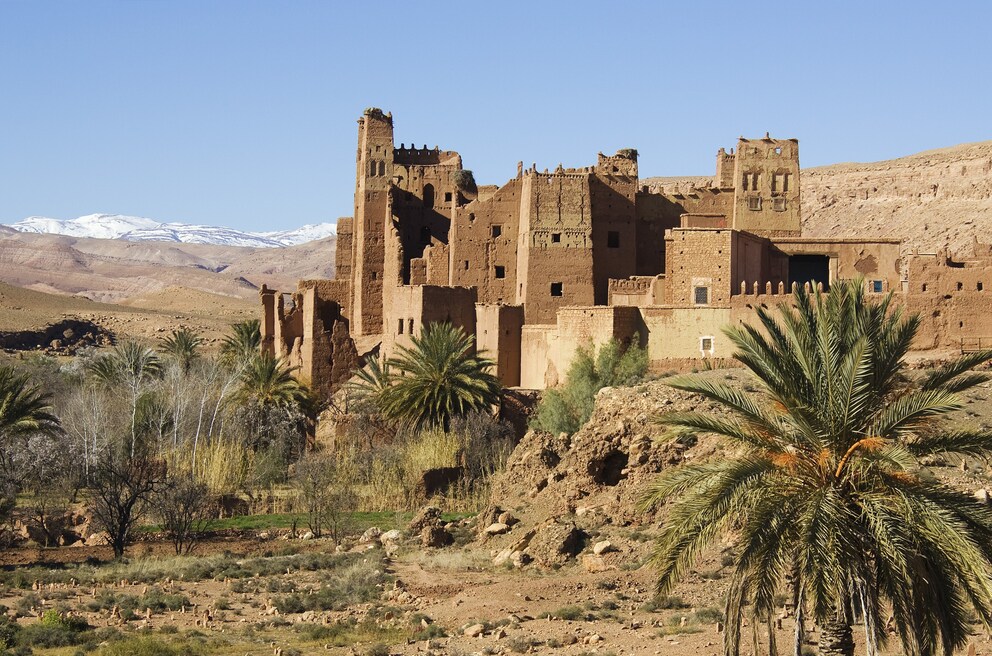
Morocco was also among the most important filming locations for “The Odyssey.” Filming took place in the historic clay settlement of Aït Benhaddou near Ouarzazate, a UNESCO World Heritage site that has already served as a backdrop for films and series such as “Gladiator” and “Game of Thrones.” For the film, the centuries-old fortress city transformed into ancient Troy and provided the setting for some of the most spectacular scenes.
The coastal city of Essaouira on the Atlantic also played an important role. With its mighty city walls, historic harbor, and often strong winds, it offered the perfect setting for the film’s seafaring scenes. The production even erected a large Trojan horse there for several shots.
Additional scenes were shot at the White Dune (Dune Blanche) near Dakhla in southern Morocco. The remote dune landscape between the Atlantic and the lagoon represented the island of Ogygia, where, according to legend, Odysseus was held captive by the nymph Calypso. Like many other filming locations in Morocco, the region impressed with its largely untouched landscapes, unique light, and the ability to depict ancient settings without modern development.
What Happened to the “Blue Lagoon”?
12 of Italy’s Most Beautiful Beaches
Iceland
For the darkest scenes of “The Odyssey,” Christopher Nolan traveled to Iceland. Filming took place around the coastal town of Vík in the south of the island. Its black lava beaches, bizarre rock formations, and moss-covered volcanic landscapes provided a perfect backdrop for the underworld of Hades. In the film, Odysseus descends there to ask the spirits of the dead for directions to his homeland.
The filming took place under the light of the midnight sun, giving the scenes a particularly mystical atmosphere. Today, the region is one of Iceland’s most famous travel destinations. In addition to the famous black beach of Reynisfjara, natural attractions such as the Skógafoss and Seljalandsfoss waterfalls are also nearby.
Scotland
Scotland’s northeast also became part of Nolan’s cinematic odyssey. Filming took place in the region of Moray and along the coast of Banffshire. Rugged cliffs, wide sandy beaches, and historic castle ruins create a scene that leaves viewers in awe.
Among the most striking locations is the ruin of Findlater Castle, perched on a rock above the North Sea. Additional scenes were shot in the coastal town of Portsoy and the harbor of Buckie, where historical wooden ships of the production were located. Scenes of Odysseus and his men on the run were filmed in front of the expansive dunes of Culbin Sands. The nearby Culbin Forest also served as a backdrop for scenes through dense woods. The region is still considered a relatively unknown part of Scotland and offers much unspoiled coastal landscape away from the well-known Highlands.
If you want to see the spectacular settings not just on the screen, a trip to the filming locations is worthwhile.