

November 3, 2022, 4:19 am | Read time: 5 minutes
Münster is the hometown of TRAVELBOOK author Anna Wengel (Chiodo). Here, she offers nine tips on what visitors should see and experience in the provincial capital of North Rhine-Westphalia.
Bells ringing everywhere, medieval cobblestones, and friendly smiling people–that’s Münster for me. It’s also the family hub, home to not always family-friendly youthful memories, and a place of peace. I love my hometown and feel the same excitement as the 5-year-old who once lived here every time I return. And because Münster is so great and, by the way, also beautiful, I’m sharing a few Münster tips here. A visit to this historic city is definitely worthwhile.
All the tips and inspiration from this article are also available in the following podcast episode of “In 5 Minuten um die Welt”–narrated by TRAVELBOOK author Anna Wengel (Chiodo):
Overview
9 Tips for a Visit to Münster
Rent a Bike
Before you do anything, get yourself a bike. Münster is Germany’s bicycle capital and is best explored on two wheels. This way, you can quickly get from A to B and C, as the city isn’t that large and is primarily designed for cyclists.
Also interesting: 5 Dreamy (and Long) Cycling Routes in Germany
Prinzipalmarkt
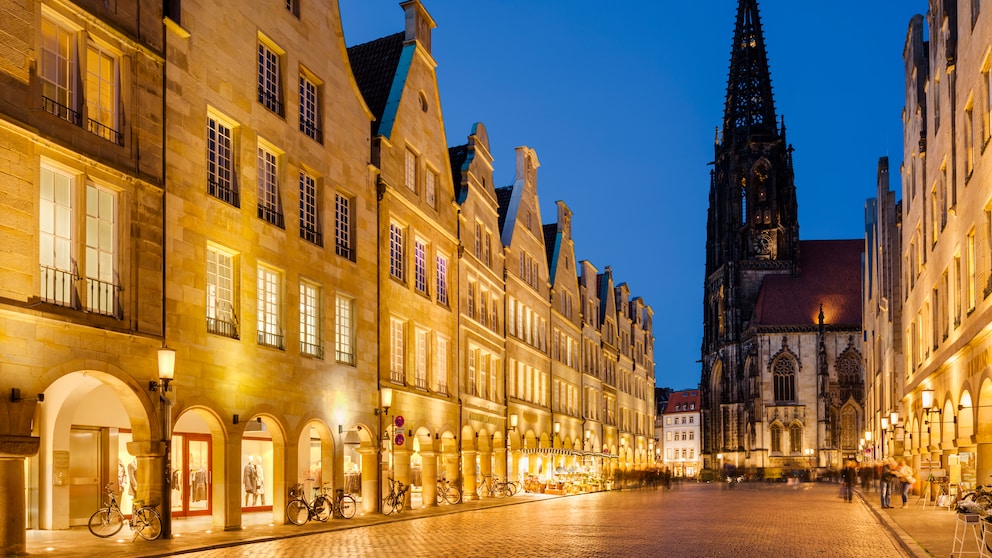
The heart of the city center and a highlight I always look forward to (and a must-see during a visit to Münster): the Prinzipalmarkt. It’s not actually a market but a charming, old street in the middle of the city with cobblestones, plenty of beautiful gabled houses, the old town hall, and at its head stands the Lambertikirche. Incidentally, there are plenty of shops on Münster’s Prinzipalmarkt, though they cater to those with a larger budget. For more affordable shopping in more or less standard stores, you can find the other two main shopping streets, Salzstraße and Ludgeristraße, nearby.
Lambertikirche
Lambertikirche was built between 1375 and 1450 and is especially known for the three iron cages hanging from it. In the mid-16th century, the bodies of the three leaders of the Anabaptist movement were displayed in them as a deterrent. This eerie relic still hangs prominently on the church today. Once you recover from the shudder, you can enter a truly beautiful old church, and I highly recommend a visit.
Cathedral
In Münster’s old town, you’ll also find St. Paulus Cathedral, very close to Prinzipalmarkt and Lambertikirche. It’s definitely worth a visit. The cathedral in its original form dates back to the 13th century, and you can tour the large nave. In front of the main entrance is the cathedral square, where a large weekly market takes place on Wednesdays and Saturdays, drawing what feels like half of Münster–another Münster highlight.
Also interesting: In Münster! A Look Behind the “Tatort” Scenes
Promenade
If you’re in the mood for a bit of walking and nature, I always recommend taking a stroll along the Promenade. Or, of course, cycling. The Promenade forms a green ring around the city center. It’s car-free and lined with plenty of trees.
Aasee
The Aasee, Münster’s city lake, is also lovely. You can’t swim in it, but you can sit by its shore, walk around it, or paddle on it in a pedal boat. A few years ago, there was a swan love story that made the news. A little real swan fell in love with a pedal boat swan and always swam after it. That was at the Aasee.
Kreuzviertel
Kreuzviertel is worth visiting because it’s simply very, very pretty with its tall old buildings and sometimes narrow cobblestone streets. It’s basically Münster’s Prenzlauer Berg. Everything centers around the Kreuzkirche, and there are a few nice cafés, a long-established delicatessen, an ice cream parlor, restaurants, and very beautiful houses.
Harbor
The harbor is a total relic of my youth. Back then, it was still an industrial area with a few restaurants and bars, but it has since completely transformed. The harbor area is now a tidier industrial Münster chic with new buildings and light installations. Personally, I found the old harbor area more charming, but the new harbor, with its many restaurants and bars, has its appeal too. Especially in summer, it’s very nice to sit by the water and watch the hustle and bustle.
Hawerkamp
Even more than the harbor, Hawerkamp was the center of my Münster youth. The old industrial site already housed the alternative clubs Sputnikhalle and Triptychon back then, and they’re still there today, but have been joined by several others. Additionally, the graffiti-covered site features artist studios and various art projects. Hawerkamp remains the alternative Münster and is definitely worth a visit.
What to Do When It Rains?
It really does rain often in Münster. So it’s best to pack rain gear in advance. But don’t let the rain deter you, as there are plenty of indoor activities in Münster. For example, you can visit the various churches, especially the aforementioned ones–the Cathedral and Lambertikirche–as well as the Überwasserkirche around the corner and several others. Or you can go to a museum, such as the Picasso Museum or the LWL Museum. There are also many nice cafés. I think none of the old-established grandma cafés are left, but there are some nice standard and now a few hipster cafés.
Also interesting: Opening of Germany’s Tallest Wooden Observation Tower Delayed