

October 21, 2026, 2:54 pm | Read time: 5 minutes
What truly defines a genuine trendy neighborhood? Creative cafes, a young crowd, alternative culture? Travel company Tui has found a much more concrete answer to this question and presents it in a new ranking of Germany’s coolest trendy neighborhoods. TRAVELBOOK reveals the categories used to determine a neighborhood’s “coolness” and which city particularly shone.
According to the ZDL online dictionary, the term “trendy neighborhood” emerged in the 1980s as a designation for districts where many young, creative, and trend-oriented people settled. These neighborhoods are characterized by a vibrant cultural and gastronomic scene. Tui is now attempting to quantify this urban lifestyle.
But what young people currently find interesting and cool is hard to quantify. The travel company has chosen a creative approach: Instead of relying on classic factors, the ranking is based on current trends. This aims to reveal what defines the urban lifestyle in 2026.
TikTok Hashtags, Pilates Studios and Pistachio Ice Cream …
And how do you recognize current trends? Naturally, through social networks. That’s why TikTok plays an important role in the ranking. Tui analyzed how often individual neighborhoods were mentioned with hashtags on the platform in August 2026. The neighborhoods examined are from last year’s ranking, which identified the hottest trend districts for 2025 using different criteria.
But TikTok alone isn’t enough. The number of bars per 10,000 residents was also considered. A logical indicator–after all, a lively nightlife is part of the image of a trendy neighborhood. As a gastronomic trend factor, ramen and Japanese restaurants were used, with their numbers calculated based on Google Maps entries and adjusted for the population.
The exercise offerings are somewhat surprising: The number of Pilates studios is also included in the evaluation. Secondhand and vintage stores, which have been booming for years and are now a typical feature of trendy neighborhoods, are also considered.
And because food and drink are also part of the urban lifestyle, Tui selected two more specific indicators: the average price for pistachio ice cream, which became a real trend product in 2026, and the price for a Negroni. Whether a neighborhood’s coolness can truly be measured by cocktail and ice cream prices is debatable. However, the unusual methodology certainly brings a smile.
Coolest Trendy Neighborhood: The Belgian Quarter in Cologne
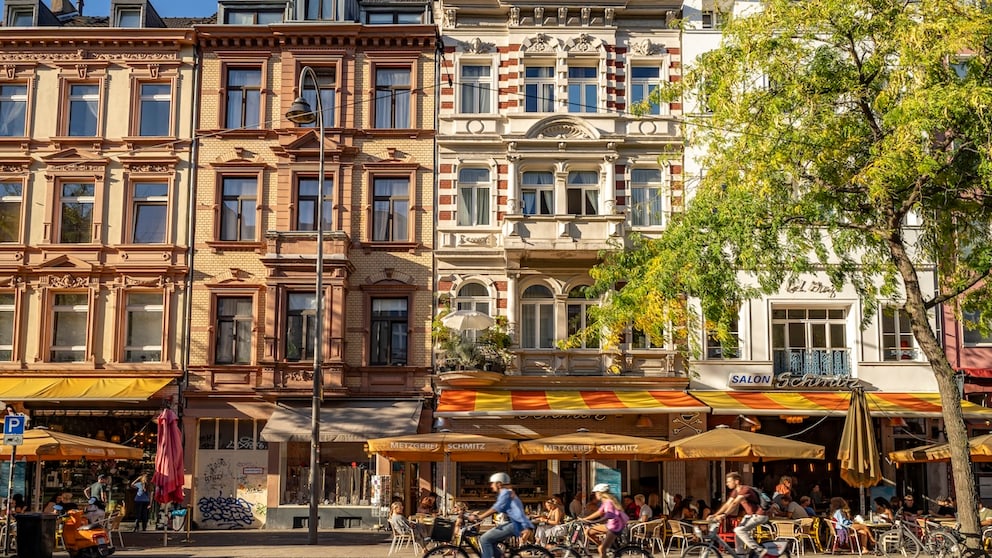
The Belgian Quarter in Cologne secures first place in the ranking with 81.4 out of 100 possible points. The neighborhood owes its name to streets named after Belgian cities and regions like Brussels, Antwerp, or Limburg. Locals often simply refer to it as “the Belgian” or “Veedel”–the Cologne word for neighborhood.

For years, the quarter has been considered one of the most creative and lively parts of the cathedral city. Between Art Nouveau buildings, small boutiques, galleries, cafes, and bars, a scene has developed that is known far beyond Cologne. Cultural events and concerts also shape the neighborhood. The Belgian Quarter fully plays to its strengths in the ranking criteria. Nowhere else are there so many vintage and secondhand stores per capita. The Cologne Veedel also reaches the top spot for the density of Pilates studios. Additionally, there are numerous bars and solid placements in the other categories.
The large photo at the top shows Aachener Straße in Cologne–the center of Germany’s seemingly coolest Veedel.
Also interesting: 11 of the Best Sights in Cologne
Munich’s Glockenbachviertel in Second Place
The Glockenbachviertel in Munich shows that you don’t have to break records in every category to secure a top spot. Instead, the district consistently achieves strong scores, landing it in second place in the ranking. The number of bars, vintage stores, and Pilates studios is consistently high, without reaching the extreme values of other neighborhoods.
At the same time, the Glockenbachviertel is prominent enough to be recognized as a trendy address, but not so heavily represented on social media that it relies solely on hype. The Munich prices are particularly noticeable: A scoop of pistachio ice cream here costs an average of almost three euros. This makes the neighborhood one of the most expensive in the ranking, but still below the value of Stuttgart’s Bohnenviertel in fourth place.
This Is Officially the Coolest Neighborhood in the World

This German Street Is Among the Coolest in the World
Third Place for a Surprising Trendy Neighborhood in Berlin
Berlin-Mitte lands in third place as the highest-ranked neighborhood in the capital. This may surprise some, as names like Kreuzberg or Neukölln usually come to mind first when talking about Berlin’s trendy neighborhoods. Mitte is often underestimated and generally perceived as “downtown.” In reality, Berlin once again shows that the city consists of many small centers. Almost every neighborhood has its own cultural and gastronomic hub, its regular cafes, bars, and meeting points.
In the ranking, Mitte benefits mainly from its balance. While other neighborhoods excel in individual categories, the district reliably scores points in almost all areas. This is especially true for gastronomy, nightlife, and social media presence. Berlin remains the undisputed TikTok capital of the ranking: Kreuzberg and Neukölln achieve by far the most hashtags, but other Berlin neighborhoods also ensure that the capital is omnipresent on social platforms.
The Top 10 Coolest Neighborhoods in Germany
- Belgian Quarter (Cologne) – 81.4 points
- Glockenbachviertel (Munich) – 78.6 points
- Mitte (Berlin) – 74.3 points
- Bohnenviertel (Stuttgart) – 70.0 points
- St. Georg (Hamburg) – 68.6 points
- Old Town (Düsseldorf) – 67.1 points
- Heusteigviertel (Stuttgart) – 62.9 points
- Unterbilk (Düsseldorf) – 62.9 points
- Maxvorstadt (Munich) – 62.9 points
- Charlottenburg (Berlin) – 61.4 points