

December 14, 2022, 5:07 pm | Read time: 5 minutes
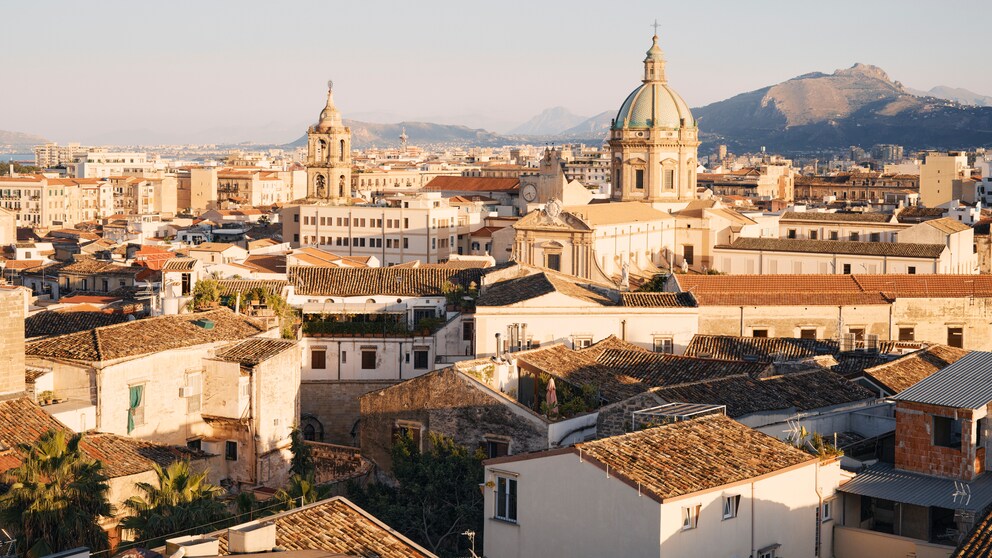
The decaying beauty of southern Italy is almost symbolically reflected in Palermo with its historic markets, palaces, and churches. The most impressive view is from above the city.
Every day, Marco Sorrentino climbs eighty steps of a narrow spiral staircase to reach the roof of the medieval tower San Nicolò de Bari. The former watchtower with its adjoining church is located in the heart of Ballarò, a historic district known throughout Italy for its colorful market. “This is the navel of Palermo, if not the entire Mediterranean. Everyone passed through here at some point,” says Sorrentino, referring to the city’s nearly 3,000-year history and the many cultures that have shaped it.
The young man, who has his office on the ground floor of the tower, gazes over Monte Pellegrino, the sea, the palaces, and churches that rise from the maze of alleys. Diagonally across from the tower, the dome of Carmine Maggiore, tiled with yellow, blue, and green majolica, gleams in the sunlight–for many, it is the most beautiful church in all of Palermo.

Also interesting: The 8,000 mummies in Palermo that seem almost alive
More Nationalities Than at the UN
Ballarò at the foot of the tower is a district that has welcomed immigrants from all over the world for decades. Sorrentino jokes, “There are more nationalities here than at the UN in New York.” Ballarò is also the district of young people and students; it is livelier and more bustling than the other two historic districts, Il Capo and La Kalsa. Here, local painter Igor Scalisi Palminteri has immortalized himself with his street art, which incorporates religious motifs, on many house facades.
Not far away, at Piazza Casa Professa, stands the church Chiesa del Gesù. It is the largest Baroque church in Palermo, yet it receives little attention. Despite its multicolored marble mosaics and magnificent frescoes, hardly any tourists visit, laments Father Walter Bottaccio. The competition from the many other must-see attractions in the city is too great.
When a View Becomes Addictive
Just a ten-minute walk away, on a hill once settled by Phoenicians, Arabs, and Byzantines, lies Palermo’s highlight: the Norman Palace (“Palazzo dei Normanni”) with its magnificent Palatine Chapel. The radiant mosaics, which also incorporate gold leaf, depict scenes from the Creation, the Old and New Testaments.
A masterpiece is the honeycomb-shaped wooden ceiling, elaborately painted by Egyptian artists at the time. “Many Palermitans get married in the chapel, but it now takes a long time to get an appointment,” says art historian Giovanni Masaniello. The palace, built by Norman King Roger II, is also the seat of the Sicilian regional parliament today.
Since 1790, one of its towers has also housed an astronomical observatory, whose dome is visible from afar. From up here, you have the best view over the city and the Bay of Palermo. “This panorama is addictive,” says Laura Daricello, a research associate at the National Institute for Astrophysics INAF.
The observatory was built during the reign of the Bourbons, who ruled in Naples and Palermo and promoted the sciences. It is the tallest building in the old town. From up here, the massive Palermo Cathedral, also built in the Arab-Byzantine style, seems within reach. In the morning, visitors already parade in single file on a narrow walkway on the roof. In the background rises the Teatro Massimo, the largest opera house in all of Italy.

Mystras – Greece’s Impressive Ruined City
Ostuni — an Insider Tip in the South of Italy
Oasis of Calm with a Sweet Secret
Hardly visible from above is the city’s hub: Quattro Canti (English: “four corners”). It is framed by four imposing facades, which with statues of Spanish kings testify to the former rule of the Iberians in Sicily.
Here on the square, at the intersection of the two grand streets Via Maqueda and Corso Vittorio Emanuele, many people gather day and night. Those seeking peace are in luck. The Santa Caterina Monastery is just a few steps away.
Behind the simple facade await a courtyard with a bubbling fountain, a monastery church, and a rooftop terrace. For almost 700 years, nuns of the Dominican order lived here in seclusion and created a small paradise for themselves.
The Sicilian festive cake Cassata and numerous other recipes live on in the monastery confectionery “I segreti del chiostro” (English: The Secrets of the Cloister). The tour through the monastery passes by the former sleeping quarters of the nuns and finally leads to the rooftop terrace.

The Fountain of Shame
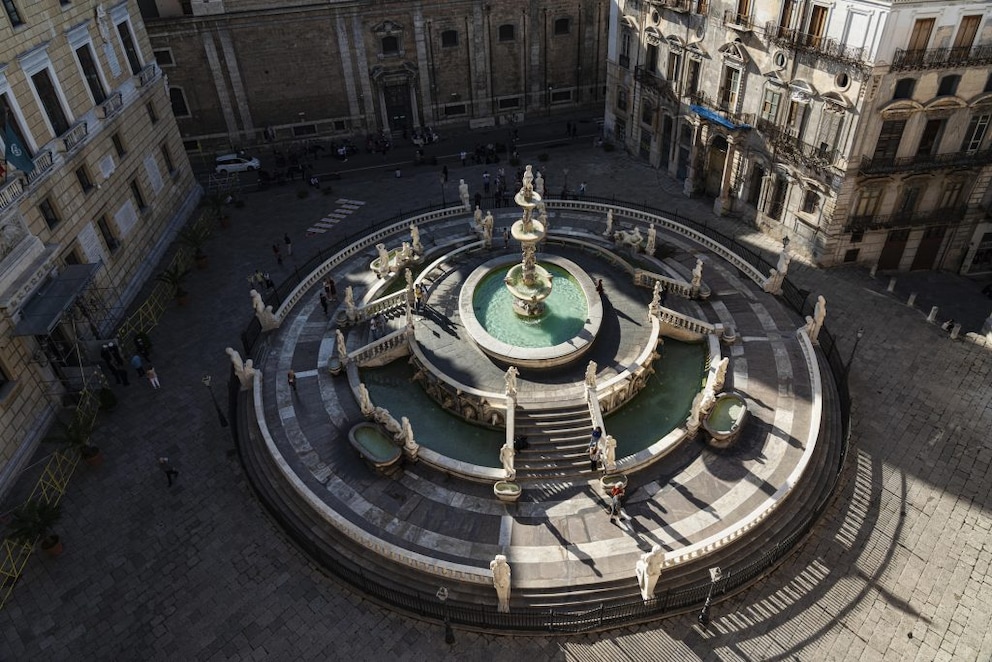
From up here, you have an overview of the most important monuments in the city center. Among them is the Fontana Pretoria: Its sculptures of naked river gods and nymphs once caused a stir in Palermo and earned it the name “Fountain of Shame.”
Almost next to it, the two adjacent churches Martorana and San Cataldo form an impressive duo. They perfectly stage themselves against the mountain backdrop. This view, too, is addictive.
With material from dpa