

September 30, 2026, 3:03 pm | Read time: 7 minutes
Recently, our author traversed the tiny state of Liechtenstein on foot in just four days. Along the way, he was repeatedly surprised by things in the Alpine micro-nation–and not always in a positive way. Here, he reveals his list of the most astonishing things he encountered on his tour.
In my life as a world traveler, there are few things I love more than discovering a new place. And if it’s an entire country I’ve never traveled to before, all the better, all the more exciting. So, I was full of eager anticipation when I recently embarked on a hiking trip to Liechtenstein. Walking through the entire country in just a few days is possible in this mini-state. Along the way, I saw and experienced many things that surprised me about the small Alpine nation–and unfortunately, not always in a positive sense. Here is my list of things that truly astonished me.
Liechtenstein Is Named After a Person
How to etch your name into the collective memory of history is something a certain president in the U.S. is currently demonstrating in a rather embarrassing way. You simply name things after yourself. But an entire country? Even I, as a seasoned traveler, had to chuckle. Liechtenstein was originally the name of a family, one of the wealthiest during the Habsburg dynasty. Since the 10th century, the present-day state had various owners. In 1699, Prince Adam I. Andreas of Liechtenstein first purchased the Lordship of Schellenberg, and in 1712, the County of Vaduz. On January 23, 1719, Emperor Charles VI merged these into a new country, the still-existing Principality of Liechtenstein.
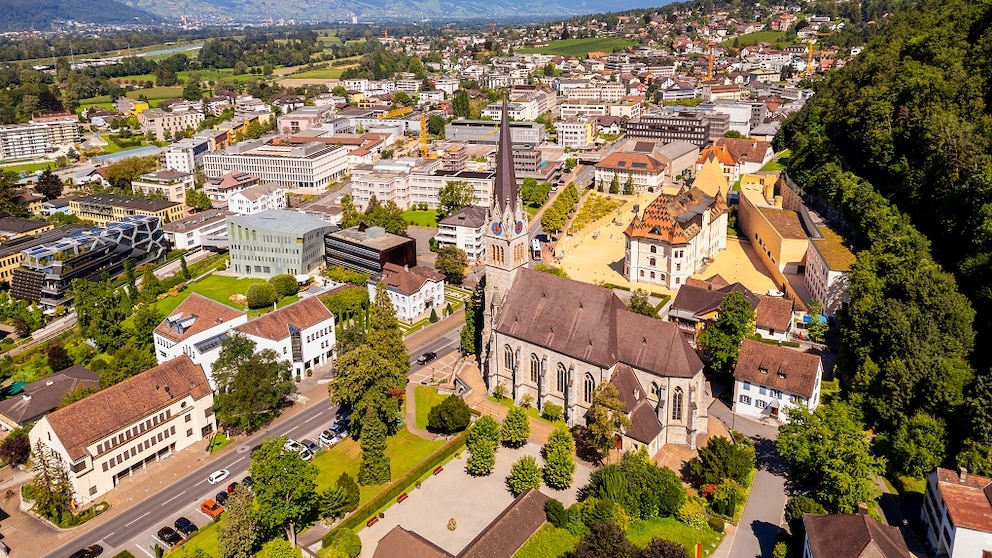
Even more peculiar: Until 1928, the principality had a foreign administrator, and the ruling noble family preferred to live in Vienna until 1938. Since then, they have resided in Vaduz Castle, spectacularly located on a hill above the capital of the micro-nation. Since 1989, Prince Hans-Adam II has ruled his country. On my hike, a few locals laughingly told me that he is usually not at his castle but in the woods, where he loves to roam lightly dressed. After that, I kept an eye out around Vaduz on my tour, but I couldn’t spot any “suspects.” Recently, Liechtenstein made headlines again: It was announced that female members would now be considered in the line of succession. Progress doesn’t always happen overnight.
Liechtenstein Is Incredibly Small for a Country
My venture in Liechtenstein says it all. The opportunity to walk through an entire country in a maximum of five stages and a few days is something you won’t find anywhere else in the world. I even mistakenly thought beforehand that the country was a city-state. Liechtenstein covers an area of just 160 square kilometers. For comparison: Berlin is more than five times larger at 891 square kilometers. My home district of Spandau alone is already more than half the size at nearly 92 square kilometers. The capital, Vaduz, has fewer than 6,000 inhabitants, more than three times less than Greenland’s capital, Nuuk. Despite its small size, there are 11 Liechtenstein municipalities. Depending on their altitude, they belong to the Oberland or the Unterland. Liechtenstein is the sixth smallest country in the world.
Also interesting: This hidden country seems like something out of a fairy tale
The Liechtenstein Trail Is Incredibly Poorly Marked
Imagine wanting to celebrate the 300th birthday of your principality in a truly fitting way. And on this honorable day, inaugurating a hiking trail that is unique worldwide because you can walk through an entire country on it. Wouldn’t you do everything possible to make it not only as attractive as possible but also sensibly marked? Well, I must unfortunately say from experience that the creators of the Liechtenstein Trail only moderately succeeded in both. At best. Especially in towns, the signage for the route is sometimes so confusing that I, a seasoned hiker for years, got hopelessly lost multiple times. It somehow seems as if the initiators lost interest at some point in properly marking the trail.
You miss your turn because the signs in the town are barely visible. Or they are missing altogether. You are led through an entire village completely on asphalt, even though there is nothing to see there. Sometimes signs even point in two directions at once, turning the further path into a tiring guessing game. At first, I thought my daily disorientation was because I was doing the trail in the opposite direction from what the official website recommended. But within four days, I met several other hikers at different stages of frustration who, like me, had already gotten lost multiple times.
The Liechtensteiners Are Extremely Friendly and Knowledgeable
This brings me to my next surprise, and it’s an entirely positive one. Nowhere else in the world have I met so many capable and knowledgeable people when I was once again unsure of where to go. And that was indeed the case at least once every day. Regardless of age, my conversation partners always seemed to know where I should head next. “Oh yes, the sign is missing up ahead,” “The old Roman road is back there”–I always received expert information that reliably kept me from losing my mind. Because nothing frustrates a hiker more than unclear signage.
Moreover, the Liechtensteiners were incredibly friendly. When I asked a gentleman to refill my water bottle, he gave me two more. Evian brand, appropriately, as the country is one of the richest in the world. In a bakery, the saleswoman packed a sandwich for free in my shopping bag. Two seniors invited me to the terrace of their long-closed restaurant when I asked about the possibility of having a cold beer somewhere. In Vaduz, I was served a delightful cheese fondue, even though it was usually only available for two people. And during a particularly frustrating detour through a town due to poor signage, a young man promptly drove me to the correct connection point.
Also interesting: Tips for a short trip to Gibraltar
Liechtenstein Has No Airport, No Highway, No Military
If Liechtensteiners want to fly on vacation, they have to go abroad. The nearest airports are in Friedrichshafen, St. Gallen, or Zurich. There is also no highway, but in my experience, people drive as fast as possible anyway. Unfortunately, a significant part of the Liechtenstein Trail runs right next to roads. In just about an hour and a half, the bus on line 11, coming from Feldkirch, Austria, traverses the entire country to the terminus in Sargans, Switzerland. Liechtenstein is also one of only four countries in the world without its own military. The last time it was a battleground was in 1799 when Napoleon’s troops marched through, looting and pillaging on their way to Austria.
In the Heart of Europe: This Hidden Country Feels Like a Fairy Tale
Why hardly anyone wants to visit this country in Europe
In Liechtenstein, License Plates Are Black
One thing I immediately envied the Liechtensteiners for is their cool black license plates on every vehicle. This makes the country the last European state to retain this unusual color. The front always features the abbreviation FL for “Fürstentum Liechtenstein.” While other countries switched to white or yellow plates for supposedly better readability, Liechtenstein has kept the black since its introduction in 1916. The proportion of high-priced luxury cars is particularly high here, as is the number of electric cars.
Also interesting: Saterland in Lower Saxony: Europe’s smallest language island
Liechtenstein Sometimes Feels Like a Model Landscape
Due to the country’s small size, it sometimes felt to me, especially from a height, like a quaint model landscape. On a special evening, at 1,000 meters altitude, I imagined just that and watched for hours as the small trains passed by and the lights glittered in the valley. Even the city center of Vaduz feels like a miniature version of a “real” metropolis. In just about 10 minutes, you can walk through it, chuckling at the parliament building that looks like the gingerbread house from Grimm’s fairy tales. My colleague Lena Braun has already dedicated an entire article to this phenomenon at TRAVELBOOK.