

October 1, 2026, 3:38 pm | Read time: 6 minutes
Aldi, Lidl and others are popular internationally. But why? How is it that Australians, Americans, Portuguese, and others often rave about these discount stores? An attempt at an explanation.
Time and again, I’ve been asked somewhere in the world where I’m originally from, and when I answer “from Germany,” a nearly blissful smile spreads across the face of the person I’m speaking with. Well, not always, of course. But in many cases, I get one of these responses: “Oh, Michael Schumacher,” “Autobahns without speed limits,” or “We loooove Aldi.” I always grin, no matter the reason given for the fondness for Germany. But most of all when the local discount stores are the reason for the expressions of love. What do people find so great about Aldi, Lidl, and others?
Rush on New York’s New Aldi Store
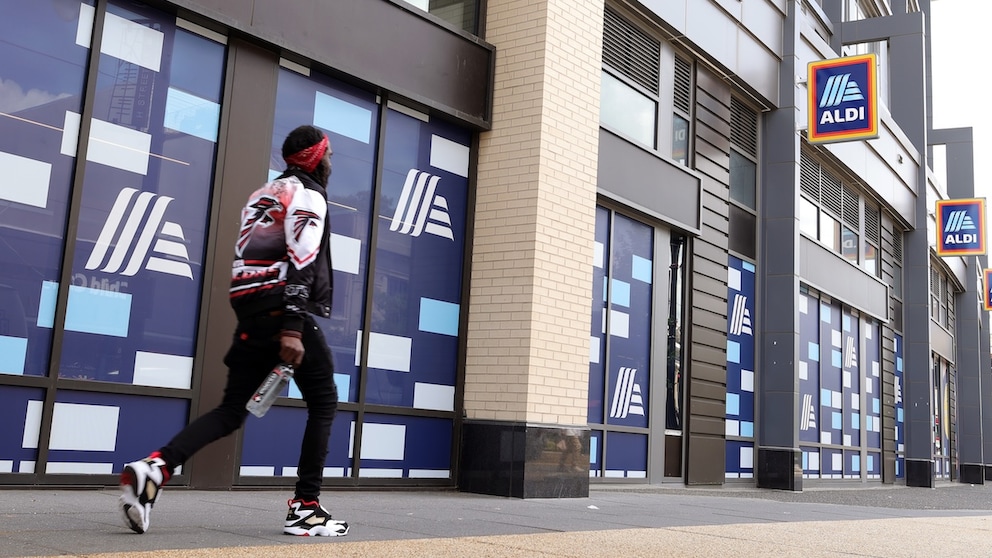
My personal experiences align with the discount store news of recent months. For instance, the tabloid “New York Post” reported last June that more than 500 people lined up before the opening of the new Aldi store at Times Square to get a glimpse of the newly opened supermarket. Aldi is popular, writes the “Post,” because it offers “groceries at lower prices than other major supermarkets in the area, such as Target.”
Low Prices Are the Main Reason for the Love of Discount Stores
I get a similar answer from my Australian husband when I ask him why he used to like going to Aldi in his hometown of Melbourne. He explains: “The reason I found Aldi so great in Australia was that everything was so much cheaper there. When I was into bodybuilding, I bought things like frozen vegetables in large quantities there. The quality was similar to Australian supermarkets, but everything was significantly cheaper.”
The fact that the love for Aldi and Lidl in the U.S. is primarily about price is also confirmed by the news program “ZDF heute.” The products of the German discount supermarkets are cheaper compared to American ones. Since the coronavirus pandemic, food prices in the U.S. have risen by 30 percent, writes “ZDF heute” on its online platform. Accordingly, many people are paying more attention to price. The permanent low-price concept of Aldi and Lidl is well received.
So much so that according to the news program, Aldi Süd plans to open around 180 more stores in the U.S. this year. This will bring the total number of Aldi stores in the United States to 2,800. For comparison: Germany’s Aldi Süd stores number about 2,000, and Australia has around 600 Aldi stores. Worldwide, the Aldi empire has more than 12,000 supermarkets. Of these, about 6,520 stores in 11 countries, spread across four continents, belong to Aldi Süd. These are found in the U.S. and Australia, among others, as well as in the United Kingdom, China, Switzerland, Ireland, and Italy. Aldi Nord states it has around 5,500 markets worldwide in eight European countries, including Spain, Portugal, France, and the Netherlands. Lidl also seems to be similarly successful abroad. The discount chain claims to be present with around 13,000 stores in 32 countries.

Where to Find Authentic German Flavors in London

10 Things I Miss in Germany After My Trips to Japan
The German Discount System
But how do the discounters manage to keep their prices so low? According to “ZDF heute,” it’s primarily due to the concept. On the one hand, Aldi and Lidl primarily offer private labels. These are often modeled after more expensive brand products but do not carry their names. This saves money. Additionally, the simplicity of the supermarkets plays a role. The setup is basic, the staff is significantly reduced, and compared to supermarkets in the U.S. or Australia, the German discounters are often much smaller and therefore more straightforward in their offerings.
This “German system” once puzzled my husband. In Australia, he’s used to cashiers not only standing behind their registers but also packing the goods. The supermarket system in the U.S. is similar. “The process at Aldi was initially very foreign to me because there were no bags. I got free boxes to pack my things in because there were no bags. I’m not even sure if you could buy them back then,” my husband says. However, it wasn’t just the lack of bags. “Everything went super fast there, everything was scanned at lightning speed. I wasn’t used to that. Other supermarkets in Australia are much slower,” he says. He always found it funny “how much the Australian Aldi adhered to the German process, such as the staff always sitting at the registers. I always wondered why they did that–at Safeway, Coles, and all the other supermarkets in Australia, the cashiers stand.” Overall, “shopping at Aldi was a completely different experience than in all other Australian supermarkets.”
Aldi Adapts
On the other hand, I notice once again how different perceptions are. Starting from the “German system,” I occasionally find it interesting to take a look at the Aldis around the world to see where the differences lie. (Though for some reason, I want to note that I usually consciously avoid German supermarkets because I find the local ones more exciting.) However, when I lived in Portugal for a while, I went to Aldi more often because I wanted or needed to save money, but also because I found that many of the products there were at least similar to those at Intermarché. Often, they were even the same, but at significantly lower prices. For example, I bought shrimp in bulk at Aldi, which were just as good as those from Intermarché but cost about half as much.
Enthralled by the endless selection of American mega-supermarkets, I’ve never been to an Aldi or Lidl there and therefore can’t assess them. According to “ZDF heute,” the experience there is similar to mine in Australia and Portugal: You can find some products that you know from German Aldis. However, many products are adapted to the respective country where the store is located. “ZDF heute” writes that the American Aldi offers many local products like bagels and mac and cheese, but the most noticeable thing there seems to be the significantly larger package sizes. And, of course, customers also pack their purchases themselves here–or help themselves to the various cardboard boxes.