

November 25, 2026, 4:33 pm | Read time: 10 minutes
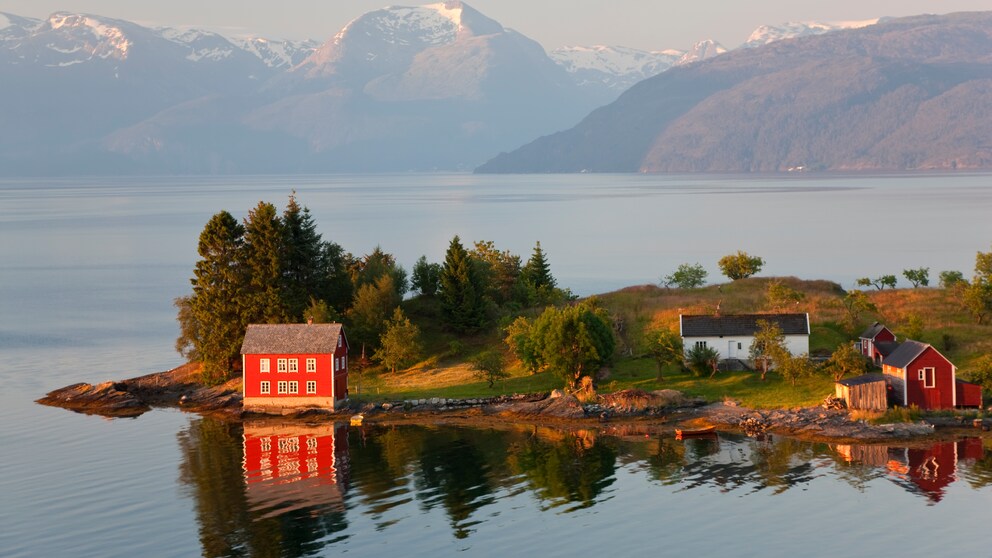
Norway has always been a dream destination for TRAVELBOOK author Franziska Diez. Long, winding fjords embraced by high, green hills, vast, white snow landscapes, and a great diversity of species. The dream of a road trip through this vast country seemed unattainable without a driver’s license. But is that really true? Our author tried it out–and reveals how a road trip in Norway is possible without a car, but by train and ferry.
Norway had long been on my travel wish list. But over our planned tour loomed the question: How can we organize a two-week tour in one of the most expansive countries without a car and on a tight budget? The simple answer is Norway’s excellent public transportation. And so began our outdoor journey through southern Norway, only by train and ferry.
Starting Point in Norway’s Metropolis
The capital welcomed us at the end of August with drizzling weather, a brisk 16 degrees, and the cries of seagulls in the sky. We had previously reached the city easily by train from the airport. We booked all our tickets for travel in Norway through the Norwegian app “Vy.” Our experiences with it were consistently positive. There were no issues with route planning or payment. Our accommodation was located in the north of Oslo and was well connected to the city center by tram.
For our first hike, we took the subway and then a bus to the Øyungen hiking area. This expansive area circles the lake of the same name. Already on the bus, we noticed that the other passengers were mainly Norwegians, and we were pleased to have found a spot away from tourist hotspots. We chose a footpath that led steeply upward alongside the paved route. We then followed a path of tree roots protruding from the ground, almost forming a staircase. If someone is not very sure-footed, they should follow the paved path to the lake. You can still enjoy the impressive nature that way. I can say this with certainty–because the paved path would later serve as our return route.
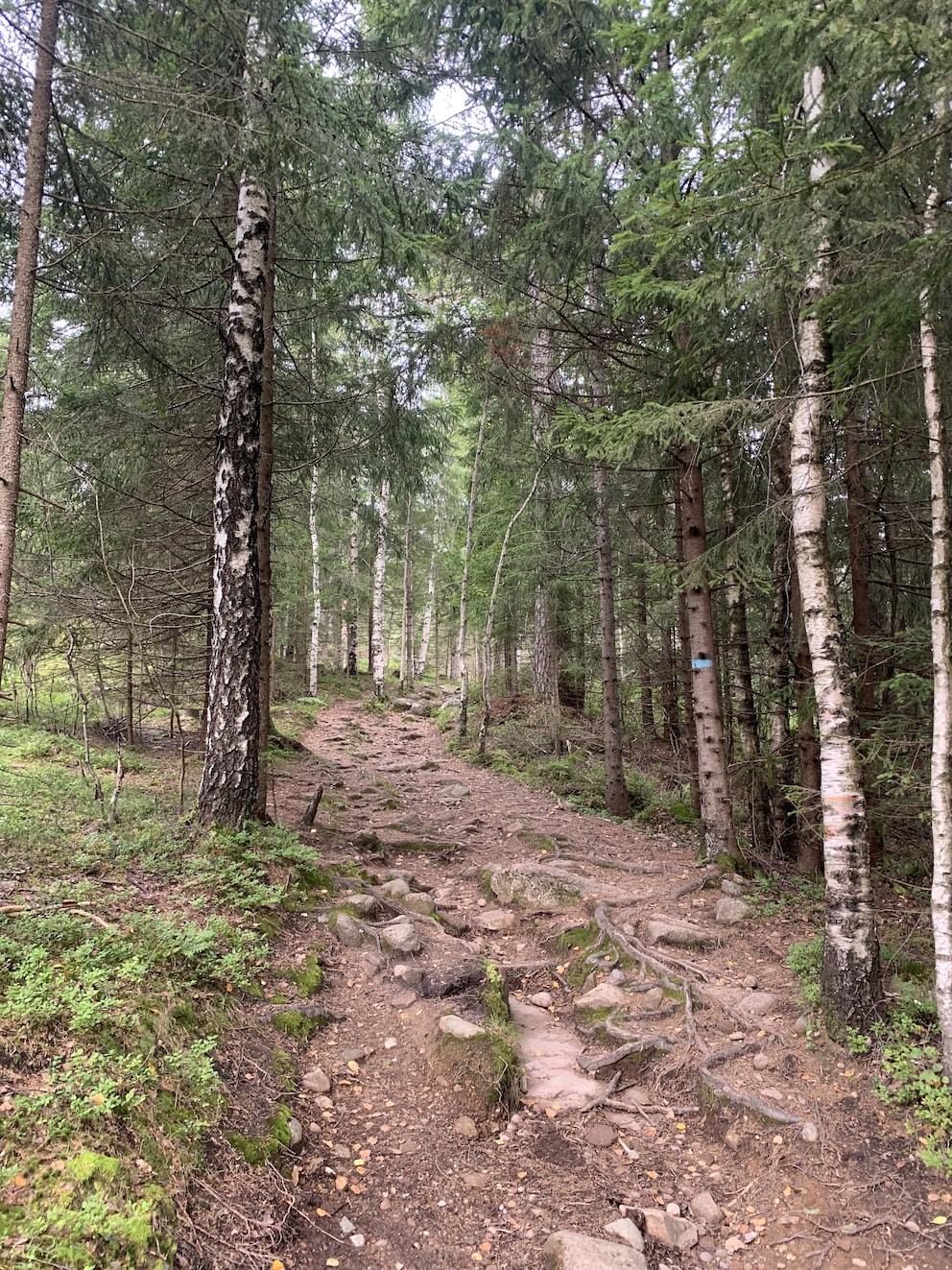
Our path wound between tall trees and mossy ground. It led us over small streams where we could refill our bottles with fresh water. Flowing water in Norway is usually safe to drink in nature. We climbed several rocky hills in two and a half hours and hiked down steep slopes again. The first stage ended with an icy and therefore very brief swim in Lake Øyungen.
200 Kilometers West and 850 Meters Up
With the Bergen Railway, we rattled out of the big city into the green towards Bergen. However, our journey was not to end here. Our destination was Myrdal, where we transferred to the Flåm Railway. Before that, a six-hour journey awaited us, with impressive landscapes passing by. We discovered gentle hills surrounded by water and small islands within. Further out, there were wide, moor-like, and low-bushed meadows with wooden huts. And especially towards the end of the journey, misty water surfaces accompanied us, with snow-covered mountains rising in the background.
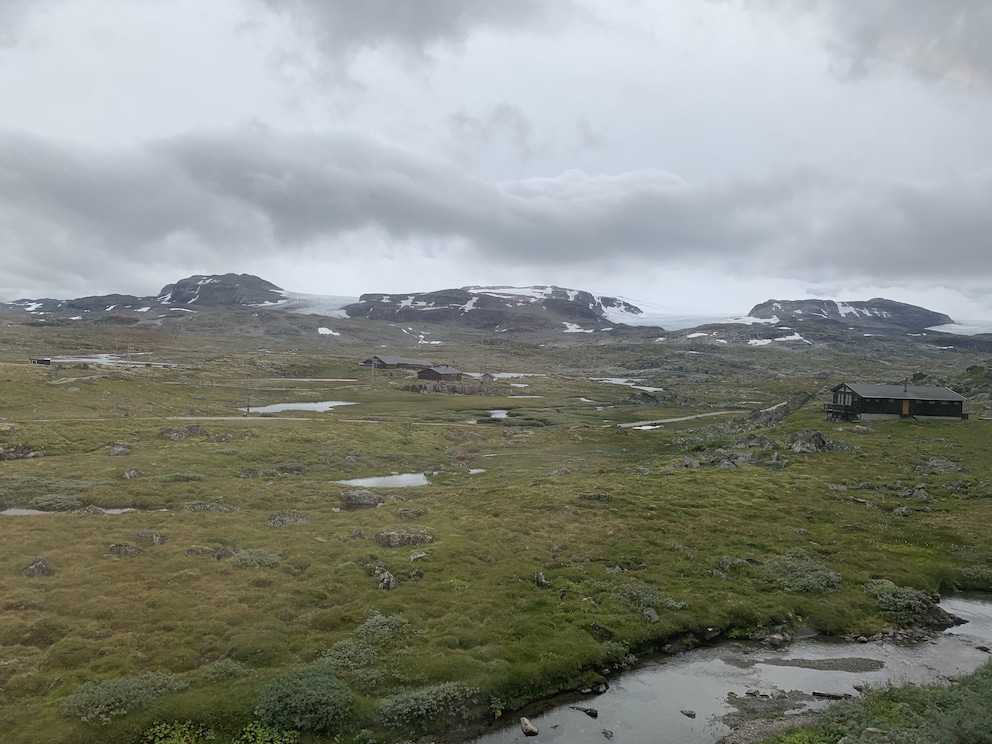
The closer we got to Myrdal, the closer the mountains came. Just before Myrdal, we could see small streams originating from the snow on the peaks, winding down in curvy paths, and flowing into a lake. Upon arriving in Myrdal, we were overwhelmed by the new impressions. On one hand, the sudden, harsh cold compared to Oslo surprised us. But the mountains towering around us, seemingly within reach, also took our breath away. From this idyllic place, the Flåm Railway took us down to Flåm.
Tourist Hotspot Flåm
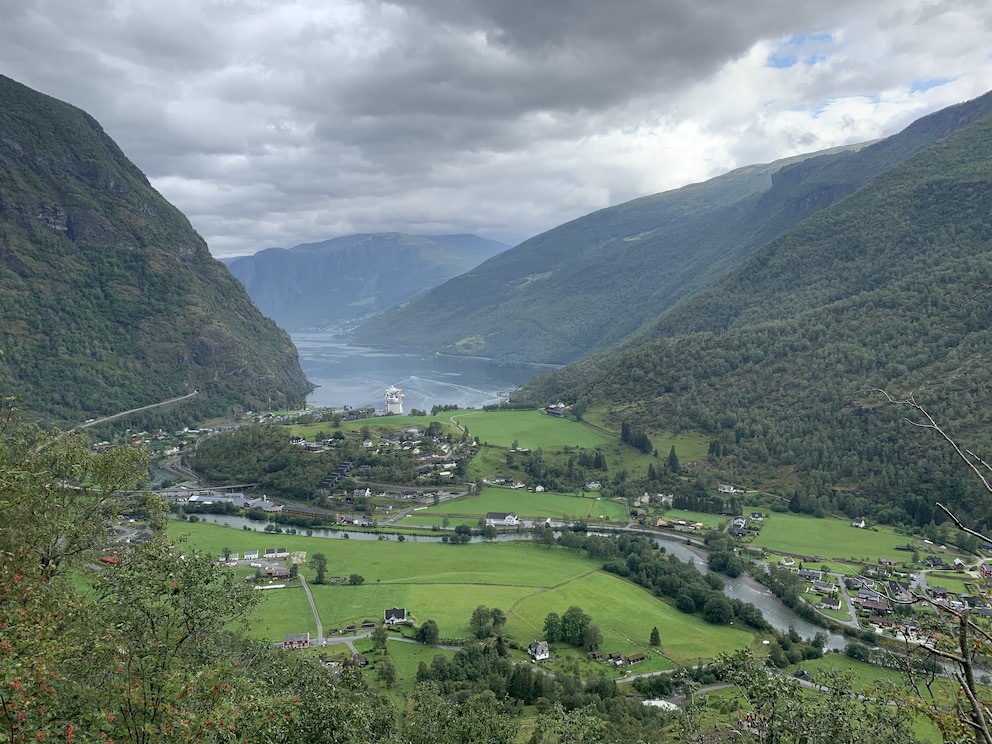
The village is nestled deep at the foot of the mountains and offered us a breathtaking view of waterfalls and lush green meadows. But the view also fell on the ocean, which pushes into the narrow bay of Flåm. Since the place is very small, we were only on foot here. We spent one night at the small, cozy campsite with homemade stone oven pizza.
The next day, the climb to the Brekkefossen waterfall awaited us. We were lucky to start early, leaving the cruise guests who arrived an hour later behind us. On the way to the mountains, we encountered cute Highland cows and calves, which brought a smile to our faces despite the rainy weather. Then many steps awaited us, which made our legs and feet tremble. About 300 meters in elevation later, we stood in front of an impressive waterfall and had a wonderful view of all of Flåm. Although you follow a paved path for the ascent, I would only recommend this hike if you are sure-footed. Climbing the steps was quite challenging, and some turned back after a few steps.
From the official path, you can climb further up, but it requires skill, endurance, and some fitness–especially if it has rained. The narrow paths are winding, sometimes made of stone, sometimes of earth–when wet, it quickly becomes slippery. In some places, you have to climb large stones to reach the next passage. Looking to the side can be quite dizzying when you see how deep it goes down. After about an hour and a half, we started the return journey. There we met the cruise guests who were making their way to climb the steps.
Ferry Rides Along the West Coast
With the Mini Ferry to the Rainiest City
From Flåm, we took a small ferry in the afternoon to Bergen, one of the rainiest cities in the world. The view throughout the entire trip was overwhelming. We traveled through beautiful fjords and marveled at the mighty mountains around us. It was especially exciting to discover the small houses standing at the foot of the large mountains, which are rightly a well-known photo motif. Our accommodation was quite close to the center, so we could reach it on foot. However, anyone walking in Bergen must expect a constant ascent and descent, as the city’s name suggests.
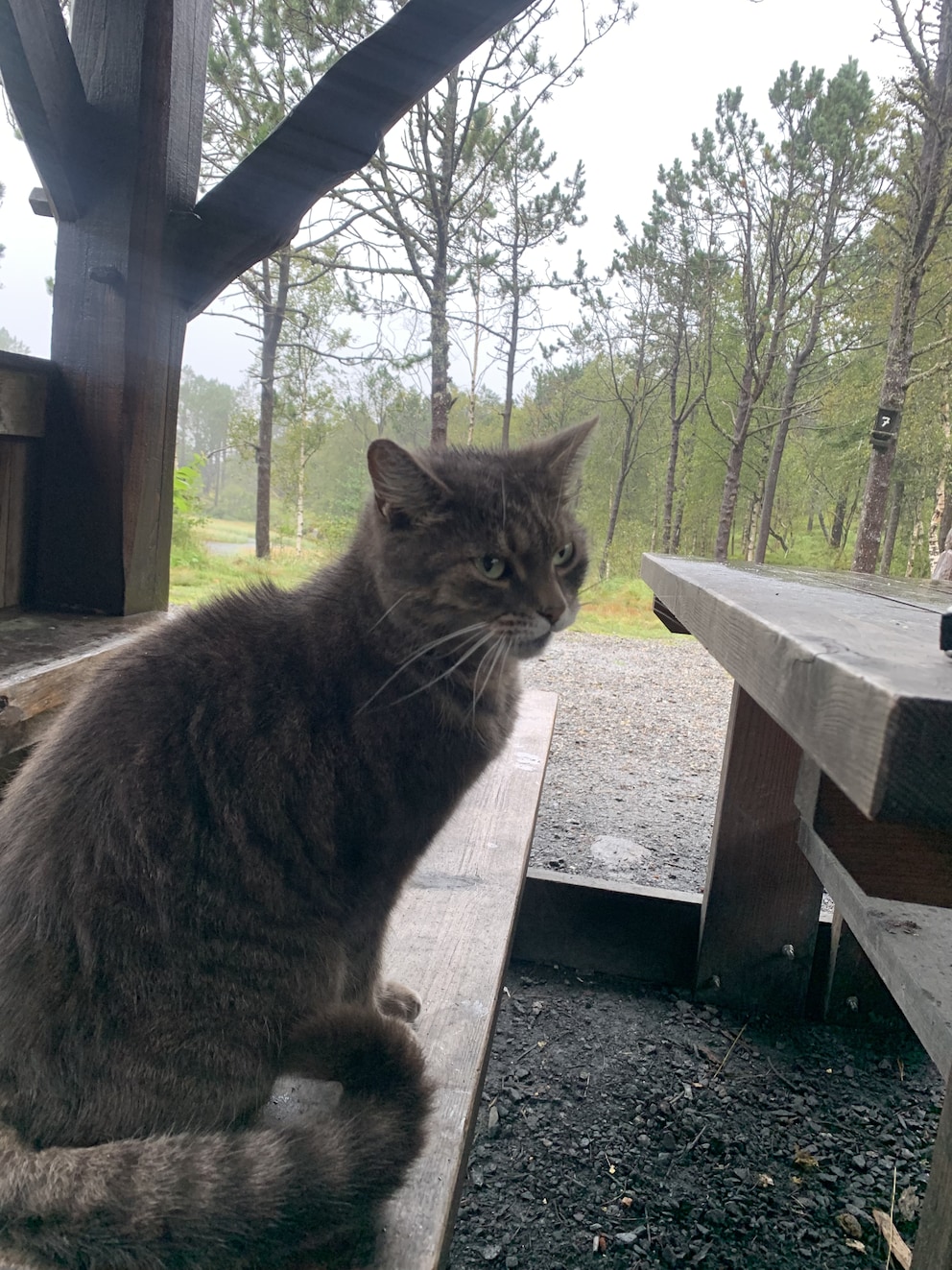
Being without a car was no problem here either. The bus took us from our accommodation to Beistølen north of Bergen’s center, where we started our hike on the Fløyen. The path is also suitable for not-so-sure-footed hikers, as it is mostly paved. The ascent is also usually not particularly steep. We took a few detours to small ponds and paused in a typical rain shelter. Here, a friendly cat kept us company and enjoyed being petted.
At the viewing platform over Bergen, rain and fog unfortunately obscured the view of what is certainly an impressive panorama. From there, we took the Fløibanen down and spontaneously took the bus to the “Nordnes Sjøbad” outdoor pool. Here we could warm up in the sauna with chatty Norwegians and tourists alike. Then we jumped from a diving board directly into the open sea with 12-degree cold water. After this cold shock, we let ourselves warm up again in the heated pool with warm seawater.
With a Large Ferry into Colorful Alleys
From Bergen, we took a huge ferry, which could also carry cars, to Stavanger. This city immediately captivated us, as our accommodation was very close to the famous colorful district of Øvre Holmegate. It is known for its cobblestone streets, where houses in various colors are nestled together. Around the district, you will find cozy pubs, cafes, and small shops. Surprisingly, we discovered some Mexican snack bars and restaurants, mainly offering tacos.
The background is that in the 1960s, Texan workers imported the Mexican national dish, tacos. By now, it has developed into a Norwegian national dish.
Originally, we also wanted to go hiking near Stavanger or try another outdoor activity. However, after the previous days, we were so exhausted that we only focused on exploring the city.

This Might Be the Most Relaxing Family Travel Destination
Why I Never Wanted to Go on a Cruise–But Still Enjoyed My Mini-Cruise!
Kayaking in Southern Norway
With renewed energy, we took the train to Kristiansand, which was to be a complete contrast to Oslo, Bergen, and Stavanger. Kristiansand struck us as a completely normal city where people live. While all the other places offered so many special features for tourists, this city allowed us a glimpse into the normal, bustling everyday life of Norwegians.
However, this does not mean that Kristiansand does not host any tourist groups. At the harbor, a cruise ship unloaded a load of vacationers who promptly stormed the fish market. Our vacation apartment was in a district of Kristiansand that we could only reach by bus. But again, everything went smoothly, including punctuality.
To conclude our trip, we definitely wanted to go kayaking and fulfilled this wish on the Gillsvannet. This small lake is not far from Kristiansand, yet somewhat remote from the city’s infrastructure. This made us a bit skeptical about whether we could reach it without a car. But as in Oslo, a bus took us easily to the stop right in front of the canoe rental. Next to the lake is a fjord–the waters are separated by a spit of land. Since we were beginners, the responsible kayak renters did not want to let us paddle directly on the fjord.
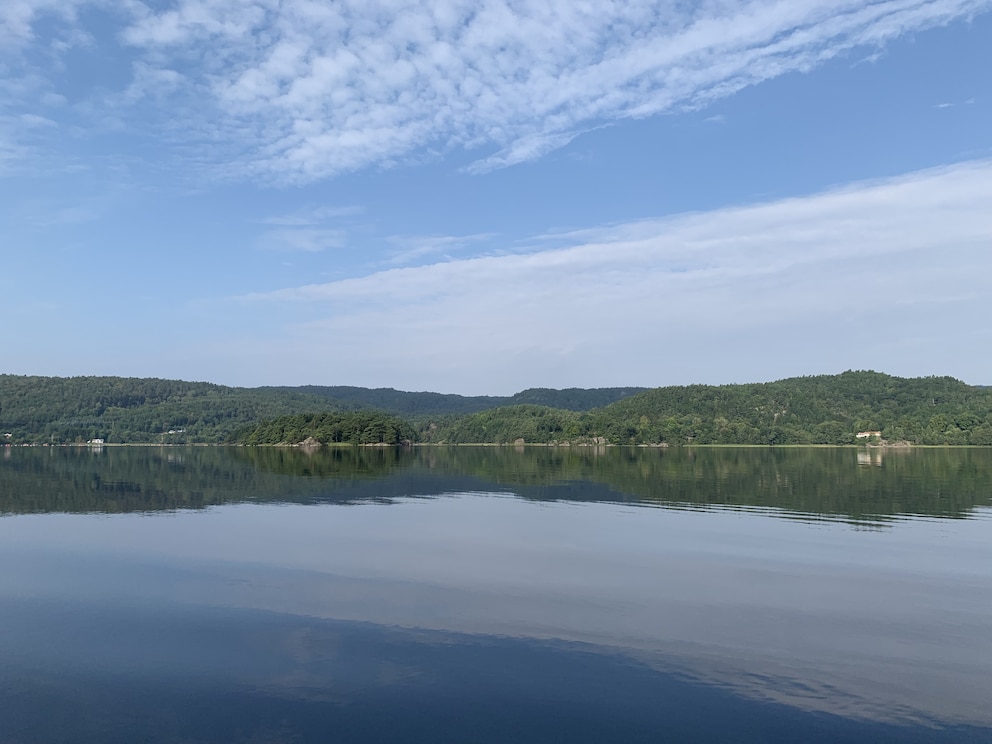
After a brief instruction, we explored the crystal-clear lake by kayak. We found a beach where we took a break and had a small snack. Then we landed on one of the small islands and explored it. That was easier said than done, as the shore was lined with dense bushes, trees, and rocks. In trying to get back into the kayak, I performed an involuntary and incomplete Eskimo roll. After a few more rounds and a total of four hours on the lake, we headed home.
Outdoor Tours Without a Car Are Possible
From Kristiansand, we took the return flight home. The airport conveys as down-to-earth an impression as the country did throughout the trip. It is very small and simple, in keeping with the Janteloven–a social norm in Nordic countries that prioritizes modesty and equality and is skeptical of boasting or status.
We flew back with unique experiences in our luggage. Our phones, on the other hand, were full of countless photos of the incredible natural spectacles we were able to witness. We certainly took memories of a very special time with us, one we had long looked forward to. As you can see, it is possible to organize a tour in a vast country like Norway without a car.
Moreover, we managed to combine city exploration with outdoor activities. By the way, we booked the flights, accommodations, and major train and ferry routes in advance. In total, we paid just under 1,000 euros per person for two weeks. This trip turned out to be cheaper than a similar trip with a car.
This is mainly due to the excellent and very reliable public transportation in Norway and the easy use of it via app. But certainly also because the south is somewhat more concentrated than central and northern Norway. If the next car-free road trip is realized in one of these areas, you will hear about it here on TRAVELBOOK.