

November 26, 2022, 6:13 am | Read time: 4 minutes
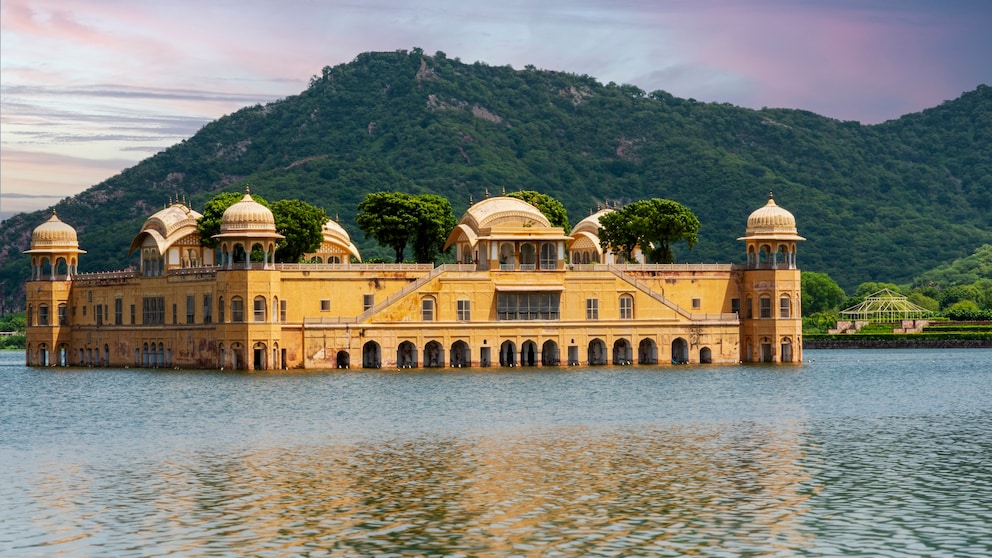
In the middle of an artificial lake in the Indian city of Jaipur lies one of the country’s most spectacular palaces: the Jal Mahal. The name translates to “Water Palace,” and legends surround its creation. The remarkable aspect: Most of the impressive building is submerged beneath the water’s surface.
It can safely be said that India is not lacking in spectacular palaces. Foremost among them, of course, is the Taj Mahal in the city of Agra. Yet perhaps the most extraordinary of them stands in Jaipur, in the province of Rajasthan. Once built by a great ruler, here lies the Jal Mahal. Translated, this name means “Water Palace”–because the impressive structure stands in the middle of a lake.
More precisely, in Lake Man Sagar, as reported by the official tourism site of the city of Jaipur. However, the Jal Mahal does not stand on an island but actually in the water. Like a mirage, it rises from the waves, which have forever buried much of the palace beneath them. Only one of its five floors still rises above the water level of Man Sagar. Built from red sandstone, it has withstood the elements here for centuries.
Creation and Submersion
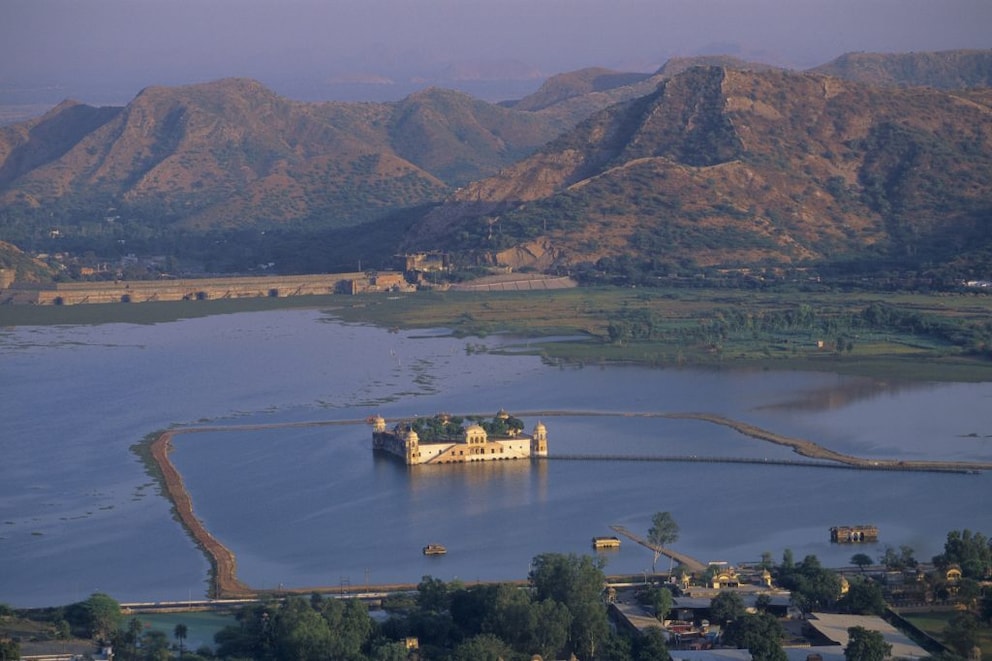
Who exactly built the Jal Mahal and when is unclear today. However, several legends surround its creation. One story, also supported by other sources, claims that Maharaja Madho Singh had the palace built around 1750. However, he did not use the magnificent fairy-tale castle as his seat of power but as a lodge for his hunts. His son, Madho Singh II, gradually expanded it after taking power.
Also interesting: Indian temple guards a billion-dollar treasure
But why is the magnificent Jal Mahal today figuratively up to its neck in water? The Man Sagar Lake is responsible for this. It was created only as part of a dam construction in the area, which was intended to combat a devastating drought. Exactly when this happened can no longer be clearly verified. According to Atlas Obscura, Man Sagar was created as early as the late 16th century, even before the palace was built. Why it was allowed for the water to bury much of the palace is also not (any longer) understandable.
Popular Photo Spot

But how has the Jal Mahal managed to withstand the forces of water for so long? Well, its construction is absolutely astonishing. Although, according to the official tourism site of Rajasthan, it has been largely submerged for about 250 years, it still stands. This is due to its construction, which combines meter-thick walls with a special mortar. These have so far largely prevented water from penetrating the lower floors of the building. And so today, only the top floor rises from the Man Sagar Lake.
Also interesting: World’s highest railway bridge is complete
Yet it is precisely its current appearance that has made the Jal Mahal perhaps Jaipur’s greatest tourist attraction. The palace is now a popular photo spot, with around 134,000 posts under the hashtag #jalmahal on Instagram, for example. It used to be possible to get very close to the “Water Palace” by boat and even enter it. However, it is now closed to tourism. According to various sources, there are plans to make the building accessible to visitors again in the future.
Also interesting: This is the original Taj Mahal
However, only a few, well-heeled guests will be able to do so, as a luxury restaurant is reportedly planned here. The former rooftop garden, where some trees still remain today, may also be renovated. Various sources online mention this, but a current Google search yields nothing concrete. The best views of the building are from the shore, where the Jal Mahal majestically reflects in the water. Especially in the evening or at night, when it is illuminated.