

December 4, 2025, 6:55 am | Read time: 7 minutes
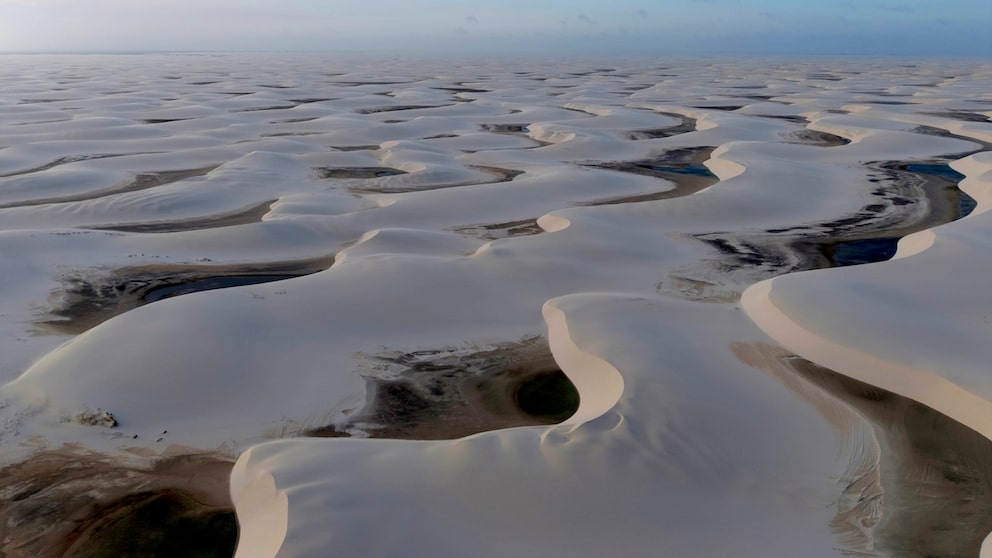
Lençóis Maranhenses is the name of the fantastic dune landscape in northern Brazil–translated: “Bedsheets” of Maranhão. From above, the dunes look like giant white sheets draped over the land. From here, the “Rota das Emoções” leads to the legendary beach of Jericoacoara. And this tour lives up to its name: On the Route of Emotions, a variety of feelings are indeed unleashed. A journey according to the emotional barometer.
When Buna talks about his homeland, his eyes get misty. That wouldn’t be surprising if it were on the other side of the world and he had to miss it painfully. But no, Buna is not far from his beloved home. He stands right in the middle of it.
More precisely: in the small garden of his guesthouse, the Rancho do Buna, which he established here in Atins a few years ago. It’s decorated with palm leaves and mangrove roots, sometimes serving as tables. We suspected that on the “Route of Emotions,” feelings are abundant and varied. But what do you call what is currently overwhelming the massive man before us? Homesickness at home? Love of homeland? The happiness of a Maranhense?
Marveling at the Desert
Even if you can’t name Buna’s feelings, you can at least understand them. Because the place where he lives is uniquely beautiful. Lençóis Maranhenses is the surreal dune landscape in northern Brazil–translated: “Bedsheets” of Maranhão. From above, the dunes look like giant white sheets draped over the land, creating slight dents like sheets on a recently used bed. The Lençóis Maranhenses are an unreal natural beauty: blown together by the wind, filled with water by the rain, and viewed with wonder by visitors.
One could wander through the sand forever, climb up dunes and slide down again, jump into the water and let oneself drift. And theoretically, one could: The dunes stretch up to 40 kilometers from the sea inland, 80 kilometers along the coast. In 1981, 155,000 hectares of sand mountains were declared a national park.
However, only a small part is accessible to tourists: The two lakes in the southeastern tip, Lagoa Azul and Lagoa Bonita, and a part in the north, where the last dunes rise before the sea–and where Buna runs his guesthouse. By now, we are quite indifferent to his feelings; we have enough of our own to deal with: We are fascinated, surprised, and overwhelmed, amused and–happy.
However, that is about to change.
Along the “Rota das Emoções” on the Coast
The “Rota das Emoções” connects the tourist highlights of the northern Brazilian coast–the Lençóis Maranhenses, the Parnaíba River Delta, and the beach of Jericoacoara, all exciting places. But the journey between the stops is an adventure that releases many emotions. Sometimes on bumpy roads, sometimes across the dunes, rarely on proper roads.
To Parnaíba, we take a Jeep, which teaches us the other side of the Rota das Emoções: “Com emoção,” say the providers of Jeep tours when things get a bit daring. And so we fly over bumps, race through rivers and sand mountains, and battle with various emotions: euphoria and worries, fear and adrenaline rushes, confidence and doubt. When we finally reach our destination, only one feeling remains: relief.
Also interesting: 15 Things to Avoid in Rio de Janeiro
In the Third Largest River Delta in the World
The Delta do Parnaíba is supposedly the third largest river delta in the world. In a small boat, we head to the mouth of the Parnaíba River in the Atlantic. The boat leisurely chugs through narrow waterways. Mangroves line the banks: with roots like branches, as if the tree had been stuck into the water crown first.

But then the boat leaves the protected waterways, heads out to the open sea–and the boat starts to rock quite a bit. “Com emoção,” once again. Waves constantly splash overboard, and the boat tilts significantly. Yet we arrive unscathed. Before a headland, we climb onto a pristine, deserted beach, where all worries are immediately forgotten–and make room for entirely different feelings.
On the Way to the Legendary Beach Jericoacoara
For the journey from Parnaíba to Jericoacoara, we take public transportation. Buses don’t run in the sand, but Jeeps with bolted boards on the loading area do. There are no backrests, and we helplessly search for support. With us on board: 18 locals and two white chickens in a cage.
But instead of feeling like real locals, we feel strangely close to the poultry: squeezed into an unfamiliar situation, phenotypically a bit lighter than the rest; and we also cluck excitedly when the driver takes a sand bump with verve and lets us hop off the bar–in a language that no one but us understands.
After a few stops, more Jeep rides, and an adventurous river crossing on tiny rafts that seemed barely up to the tons of vehicles and released certain feelings not only in the car owner, we reach our destination: Jericoacoara. Je-ri-coa-coa-ra. The name doesn’t exactly roll off the tongue. “It’s simple: Je-ri-coa…,” the nice man at our Pousada teaches us, “oh, just say Jeri. Everyone does.” And we should relax. Everyone does that here too.
Also interesting: Brazil–12 Reasons Why the Long Journey Is Worth It
Nothing is easier. Because hustle or speed is stifled in the sand anyway. It doesn’t just lie on the beach here but covers the entire place, even spreading into the shops–and slows down anyone who wants to move a bit faster.
Bob, the Australian, doesn’t even try. He stands in front of a bar and points to the dogs in the shade, which one would call street dogs if, yes, if there were streets here. Look, says Bob, how healthy they look. And that it always says something about a place, how the dogs are doing. “This,” Bob concludes, “is a good place.”
This becomes clear to the traveler at the latest when the sun is about to dip into the sea on the horizon, and suddenly the sluggish mass stirs. Then the sporty head to the volleyball nets, and the romantics to the dune. With ice-cold beer bottles in hand, they climb the big sand hill to secure a spot right at the edge–and thus the best view of the beach. On the Capoeira fighters, the riders, the fishing boats–the sun on the horizon. Lovers embrace, friends toast, someone plays music.
Finish line of emotions.
Also interesting: Ilha Grande–On This Dream Island, Brazil’s Nightmare Began

Can You Identify What This Award-Winning Landscape Photo Depicts?
Jalapão in Brazil Is One of the Best Hidden Gem Travel Destinations in Central and South America
The “Rota das Emoções”
The Alliance: Since 2005, the three states of Maranhão, Piauí, and Ceará have jointly marketed their tourist natural wonders–the Lençóis Maranhenses, the Delta of Parnaíba, and the beach of Jericoacoara–as the “Rota das Emoções.”
Package or Individual: Tour operators offer corresponding tours. But you can also just rent a Jeep and set off. Those who like adventure take public transportation.
Important to Note: The distances should not be underestimated; it sometimes takes days to get from one stop to the next. Good travel planning, especially of the accommodations, is advisable. There are not Pousadas and hotels everywhere, and often they are in a very simple condition.
The Highlights of the “Rota das Emoções”
São Luís: Arrival via São Luís airport and start of the tour. The city is known for a very lively reggae scene and the charming center, which has been a UNESCO World Heritage Site since 1997.
The Lençóis Maranhenses: Brazil’s desert is about 250 kilometers southwest of São Luís. It stretches about 80 kilometers along the coast and 10 to 30 kilometers inland.
The Parnaíba River Delta: The third largest river delta in the world–after the Mekong and Nile–has a diameter of about 100 kilometers.
The Beach of Jericoacoara: The beach is legendary, once a hippie paradise, now a holiday resort. Jericoacoara is 300 km west of Fortaleza.
Fortaleza: Capital of the state of Ceará and a tourist center with numerous beaches and hotels. The tour ends here, with a return flight from Fortaleza airport.