

December 25, 2020, 6:21 am | Read time: 3 minutes
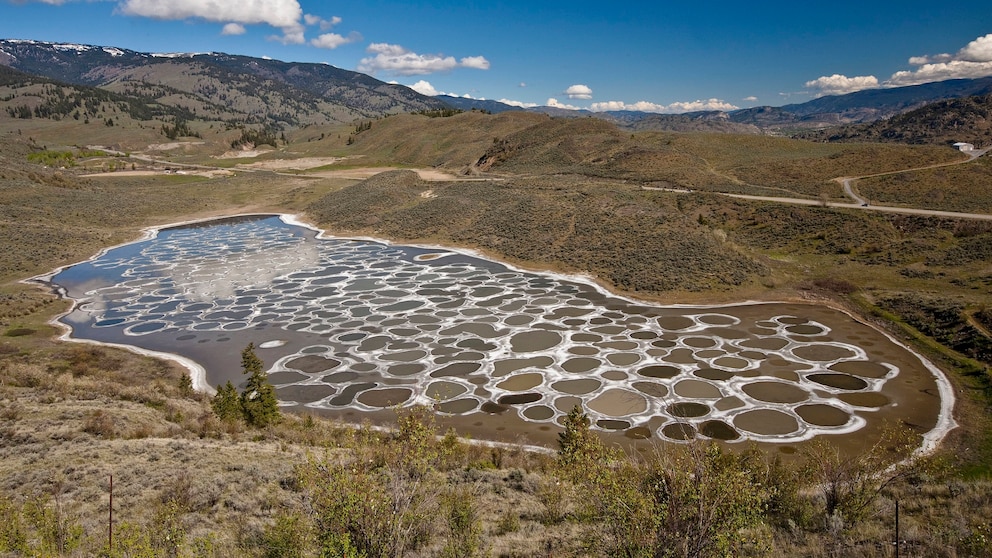
For the Indigenous people of Canada, it is sacred: The Spotted Lake is a unique natural phenomenon–every summer, hundreds of small, multicolored pools form here. Its composition even makes it interesting for Mars researchers.
Near the small town of Osoyoos in the province of British Columbia lies one of Canada’s greatest natural wonders: The Indigenous people of the Okanagan tribe call it Kliluk, but it is better known today as Spotted Lake–a lake where a fascinating spectacle occurs every summer. The water almost completely dries up, leaving behind hundreds of small, multicolored pools.
According to the beliefs of the Okanagan, there is a pool for every day of the year, but according to the New York Times, there are probably around 400 in total. Their color is also explained by the lake’s composition, as it has no natural inflows or outflows and is fed only by precipitation, groundwater, and meltwater. The minerals contained in these waters have been washed into the lake since ancient times, causing the colors that make Spotted Lake so unique.
Space Research at Spotted Lake

The Okanagan have been using the minerals from Kliluk for ceremonies for thousands of years, including the healing mud found on its shores and the salt it contains in very high concentrations. The lake is so unusual that space researchers have been interested in it since 2012: They hoped to learn something about the composition of now-dry lakes on Mars (if they indeed exist) through their studies.
Also of interest: Lake Hillier in Australia–the mystery of the pink lake
A doctor from Brown University discovered that the mineral composition in Kliluk was similar to that in the so-called Columbus Crater on the Red Planet–indicating there was indeed a body of water there in the past. However, the researcher could not draw any valid conclusions from his studies. Nevertheless, Spotted Lake continues to amaze scientists, as there is indeed life here, including an alga that feeds on the mineral salt.
An Offering for the Lake in Canada
Since Kliluk is sacred to the Okanagan, it cannot be visited freely–according to CBC, the Indigenous people acquired both the lake and 22 hectares of surrounding land in 2001. The water is now fenced off, and anyone wishing to approach it needs permission from the Indigenous people–and also from the lake itself. For example, one can make a small offering to Kliluk or walk around it as a sign of respect.
According to the New York Times, the best time to observe the phenomenon of the countless small pools is in late July. Those without permission to approach the sacred waters can at least catch a glimpse of Kliluk from a distance. From Osoyoos, you need to drive about ten kilometers west on Highway 3.