

October 5, 2025, 5:53 am | Read time: 5 minutes
In Thuringia’s state capital, Erfurt, stands one of the most unusual structures in all of Germany: the Krämerbrücke. Not only is it the longest inhabited and built-upon bridge in Europe, but it will also celebrate its 700th anniversary in 2025. The structure itself is likely even older and is now one of the biggest tourist attractions in the central German metropolis. TRAVELBOOK extends heartfelt congratulations on this impressive anniversary.
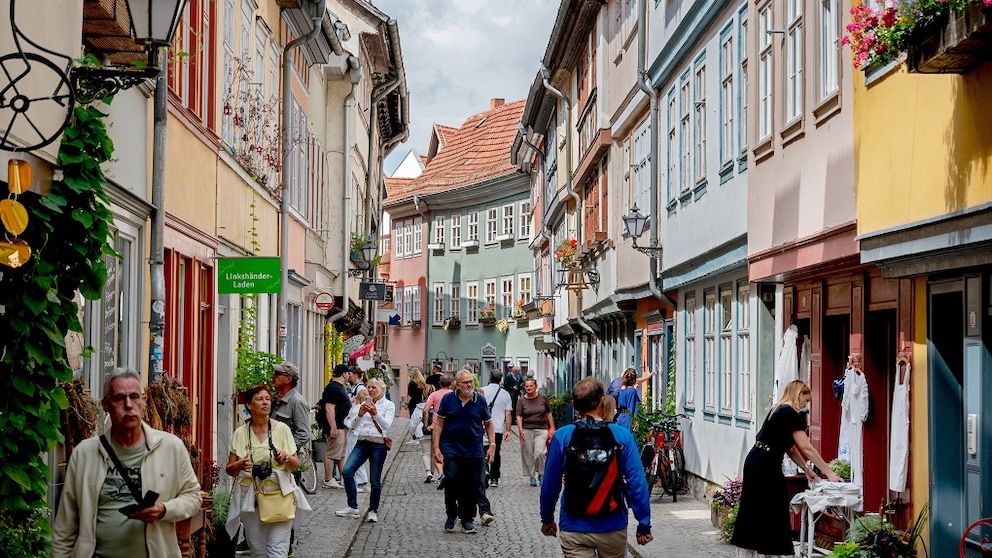
In the Thuringian state capital of Erfurt, Germany’s most famous bridge has stood since 1325. Throughout its storied history, it has withstood multiple fires, served as an important trade center early on, and narrowly escaped demolition. In 2025, the Krämerbrücke will celebrate its 700th anniversary, though it is actually much older. Surrounded by UNESCO World Heritage sites in Erfurt’s old town, it remains one of the undisputed visitor highlights, staying true to its roots. As it has for centuries, numerous shops still line Europe’s longest built-upon and inhabited bridge.
According to the official Krämerbrücke website, maintained by the city administration, the viaduct’s history began nearly 1,000 years ago. Early on, a wooden predecessor of the current bridge was built over the Gera River to facilitate traders’ journeys. At that time, several significant trade routes converged in Erfurt. Mathias Kabisch, marketing director of Erfurt Tourism and Marketing GmbH, told TRAVELBOOK: “Erfurt was also on the Via Regia, one of the most important medieval trade routes. With the bridge’s construction, the first merchants and traders, known as ‘Krämer,’ settled in the area and even on the bridge itself. It is from them that the bridge gets its name.”
High-Quality Goods, Not “Kram”
The term “Krämer” has nothing to do with the modern association of the word “Kram” (junk); quite the opposite. “The word is not derogatory but indicates high-quality small, luxury, and gourmet goods. The Krämerbrücke has remained true to this tradition. Unique items can still be found here.” The structure was first documented in 1156 as “pons rerum venalium,” or “bridge of offered goods.” Even then, stalls and sales stands were present. In 1325, the stone version of the monument was built, which continues to captivate visitors from around the world. The city of Erfurt had previously acquired the bridge from monastic ownership.
Also interesting: The world’s largest brick bridge is in Germany
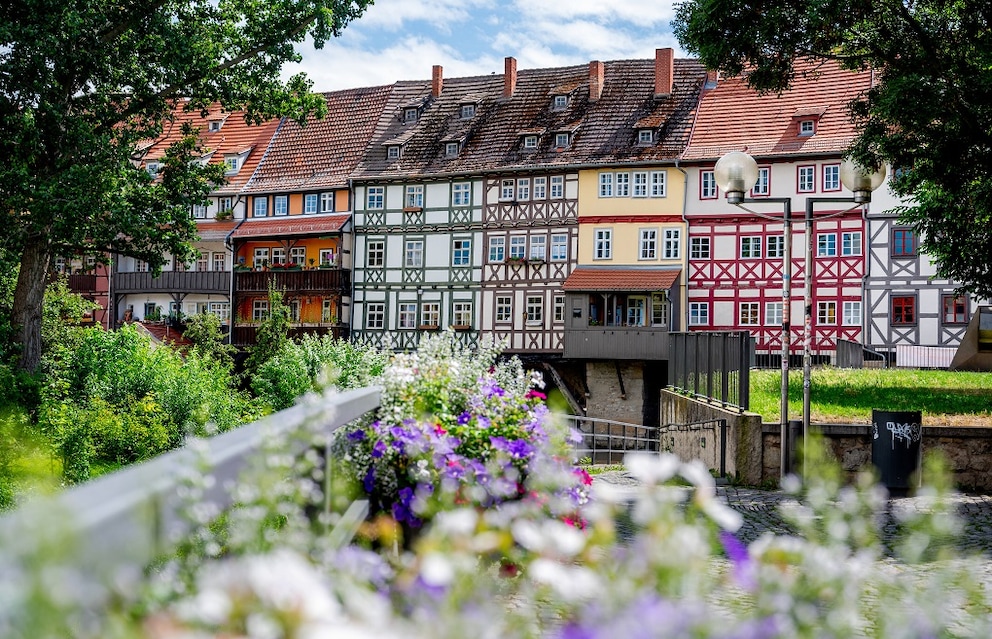
The Krämerbrücke quickly became the landmark of Erfurt, which it still is today. Built from sandstone, 125 meters long and 19 meters wide, its six arches have spanned two arms of the Gera River for seven centuries. Historically documented is the fact that only the finest goods were traded here, including spices, gold, silk fabrics, dyes, glasses, Venetian glass, coral, figs, raisins, rice, and licorice. Severely damaged by fire for the first time in 1472, the first houses were subsequently built on the Krämerbrücke. It then became not only a trade center but also permanently inhabited.
Almost Demolished

Initially, there were 62 houses here, but due to several more fires, their number was reduced to the current 32 by the 18th century. Of the churches originally located at the two bridgeheads, only the Ägidienkirche remains today. The Benedictine Church was demolished in 1810. In the 19th century, Erfurt developed into a large city by the standards of the time, and this nearly led to the Krämerbrücke’s demise. “In 1895, there was consideration of building a larger bridge at the same location due to increasing traffic. Fortunately, many people advocated for the bridge’s preservation, leading to the construction of the larger Rathausbrücke right next to it.” A wise decision, as the structure is now, alongside the cathedral ensemble, THE landmark of the city. Of the up to 14 million day visitors annually, a large portion wants to see Europe’s longest inhabited bridge.
Also interesting: The world’s longest pedestrian suspension bridge tested
Even today, modern “Krämer” can be found here, offering a wide variety of goods and services. You can get an overview on the official website or, even better, by taking a live walk. Those wishing to sell here must officially apply to the foundation. Curiously, “Many guests come to the tourist information directly at the Krämerbrücke and ask where the bridge is located. Due to its construction, they don’t realize they’ve already walked over it.” According to Kabisch, the best view of the structure is from the side. A great view of the monument and the city can be enjoyed from the 33-meter-high tower of the Ägidienkirche.
And of course, the people of Erfurt will especially celebrate their Krämerbrücke in 2025 with numerous events, concerts, and other activities. The corresponding calendar can also be viewed on the website. Additionally, every year on the third weekend in June, the Krämerbrücken Festival takes place. “It is the largest old town festival in all of Thuringia. For three days, there is celebration.” The Krämerbrücke is always freely accessible, and entry is free. But you will surely find a very special and personal souvenir here that will remind you of your visit to Europe’s longest inhabited bridge.