

September 20, 2025, 5:04 am | Read time: 7 minutes
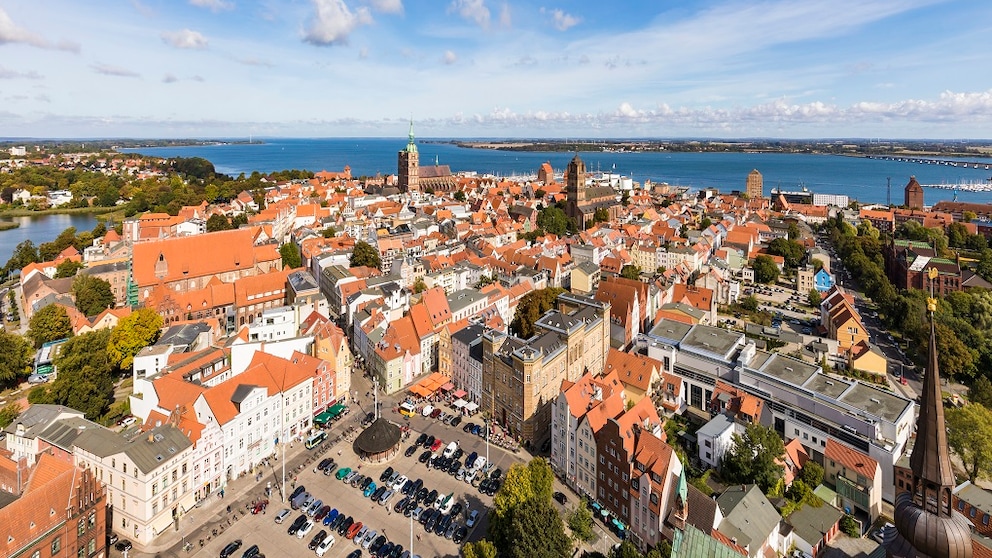
Founded as early as the 13th century, the old Hanseatic city of Stralsund in Mecklenburg-Vorpommern still impresses today with numerous buildings and sacred structures that testify to its time as a wealthy trading center. The architecture is so authentic and unique that UNESCO granted Stralsund’s old town World Heritage status in 2002. Yet, it can be quite tranquil here, as TRAVELBOOK author Robin Hartmann recently discovered during a visit. A beautiful day between brick Gothic, beach, and fish sandwiches.
After a little more than three hours of travel, during which our train rattled through the East German province, past places like Altentreptow, Sternfeld, and Utzedel, we finally arrive at our day’s destination: Stralsund Central Station, the gateway for a lovely day I want to spend with my girlfriend in the old Hanseatic city. Actually, it’s just a few hours, so we set off purposefully. With us are surprisingly few of the people who boarded in Berlin; already a sense of discovery sets in. You might imagine the faint smell of salt in the air, as city dwellers don’t get to the sea every day. And soon we’re on our way to Stralsund’s old town.
We pass over the Tribseer Damm by the not-so-small “Kleiner Frankenteich,” and soon the old ring wall of Stralsund, founded in the 13th century, comes into view. As early as 1234, it was granted city rights, making it the oldest city in all of Pomerania today. For several centuries, this was an important center of the Hanseatic League, that once mighty trade alliance whose reach extended far beyond today’s German borders. Thanks to the remarkably well-preserved buildings and sacred structures from that time, UNESCO granted Stralsund’s old town World Heritage status in 2002. And now we’re walking right into it.
A City Takes a Siesta
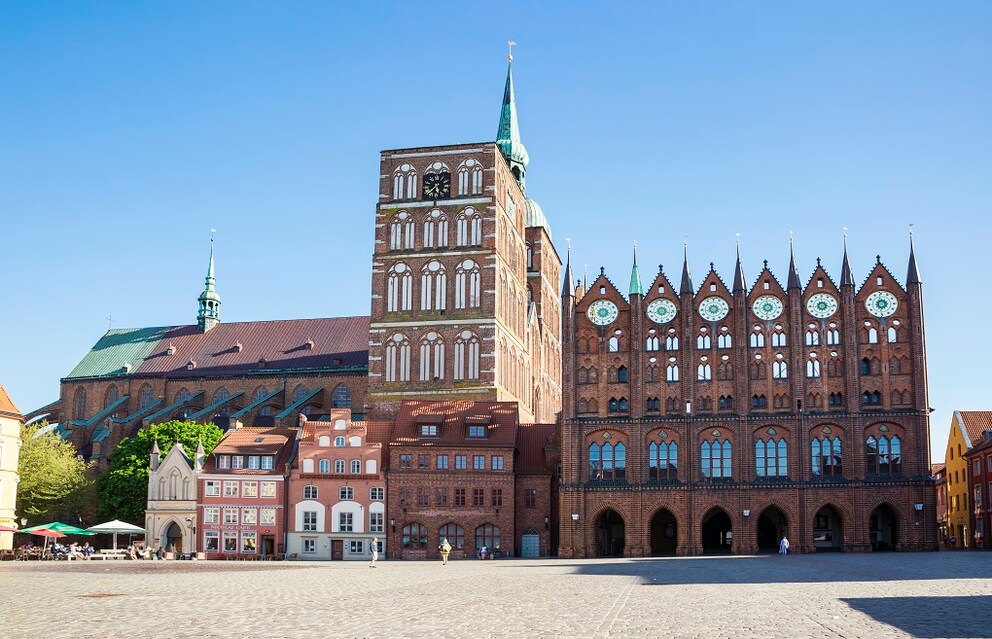
The small streets and narrow cobblestone alleys here know only one speed from the start. Slowly, attentively, in the few hours in Stralsund, we want to soak up as much as possible. And that’s not so easy, because the entire old town seems to have fallen into an early, collective winter sleep. No matter where you look, shops, galleries, bakeries, everything is closed. Sure, it’s a Sunday, but we expected a bit more for curious tourists like us. Even restaurants like the very venerable-looking “Zur Kogge” sometimes take several hours for lunch breaks. There are also noticeably few people on the streets–a UNESCO World Heritage site simply takes a siesta.
Also interesting: Neustrelitz: The World Natural Heritage Gem at Berlin’s Gates
However, I quickly realize that this is actually something nice. Here you have a city whose eventful history goes back centuries. And there is plenty of beautiful architecture to discover, especially the sometimes massive churches and the town hall, all built of red brick. And yet, the place is not desperately trying to please visitors with an overabundance of sightseeing and shopping opportunities. Because they will come anyway, especially in summer, that’s for sure. And so we stroll through the impressive archway gallery of Stralsund’s over 700-year-old town hall, built between 1300 and 1310. Only at the Stralsund Chocolate House are we a bit sad that it, of course, is also closed.
6 of the Most Beautiful Christmas Markets in Mecklenburg-Vorpommern
Why This Small North Sea Town Is Definitely Worth a Visit
Fish Sandwiches and the Sea
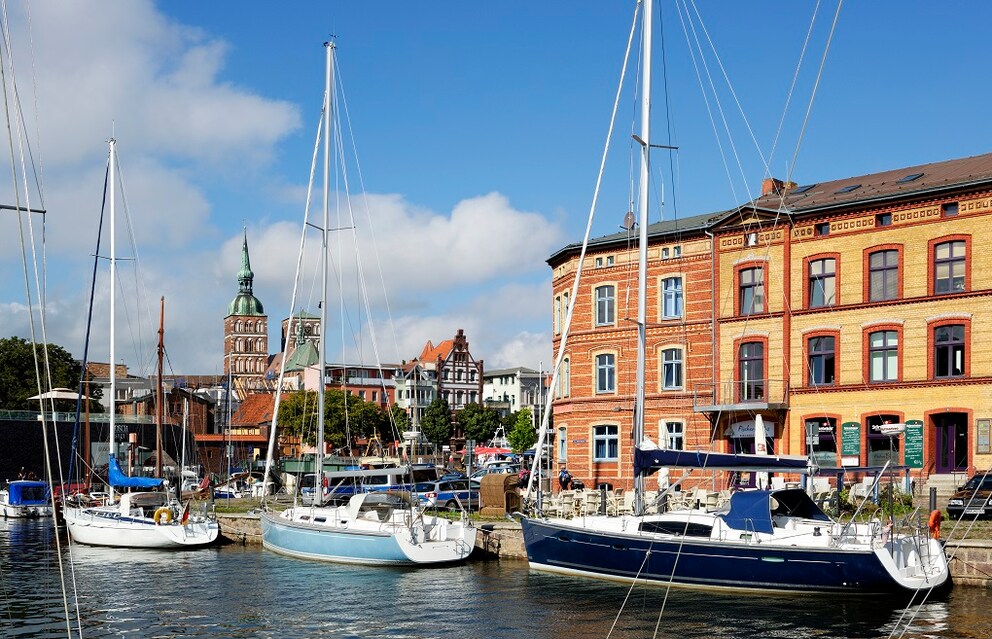
My girlfriend had only one destination in mind from the start, namely the sea, never far from the old town. The place is located on the Baltic Sea, but in a strait, the Strelasund. This also separates the mainland from the neighboring Rügen, Germany’s largest island. You can reach the other shore by car over the Rügen Bridge, which is about four kilometers long. Trains also run, and within an hour, you can be at any connected location on Rügen from Stralsund. Due to this special location, the Baltic Sea here is not wild but sometimes feels like a particularly large lake. During our stay, there was no significant wave action, which makes a stay at the small city beach particularly attractive for families. The water is also shallow for a long time, so even small guests can swim safely–supervised, of course.
Also interesting: Wernigerode: The German Hogwarts in the Harz
But first, we find out where all the people in Stralsund are. Namely, on the harbor island, where numerous cutters and shops offer the freshest from the Baltic Sea. And here my moment comes, because a visit to the sea is only half as nice for me without eating at least one fish sandwich. We buy the first one at the boat snack bar “Free Willy,” which calls itself a “pleasure cutter.” You can leave it at that, the line is long, the fried fish absolutely crispy and delicious. A bag of fish and chips from the “Fischhalle” follows, drowned in remoulade sauce. At the counter, a photo of a seagull with the caption: “I want to talk to you about your fish sandwich.” The animals are notorious for snatching the “catch” from unsuspecting guests.
Old Harbor Taverns and Sailing School Ships

On the harbor island is undoubtedly Stralsund’s biggest visitor magnet, the Ozeaneum. On an area of 8,700 square meters, guests can expect several exhibitions and numerous aquariums in a futuristic building, the largest of which holds 2.6 million liters of water. It is just one of several locations of the German Oceanographic Museum, which has been based in Stralsund since 1951. Viewing animals in captivity is not for me, though, and we want to finally find our peace at the Baltic Sea beach. We pass by a true curiosity, the harbor tavern “Zur Fähre.” This can be traced back to 1332, making it one of the oldest of its kind in Europe. Of course, it is closed, but the good soul on site lets us take a quick look into the wood-paneled, sailor-memorabilia-adorned tavern room.
On the promenade, my gaze briefly lingers longingly on the ferry docks. With ships, you can cross from Stralsund’s harbor island to Rügen and also Hiddensee, which I imagine very romantically (and mentally note as one of my next adventure short trips). Another, which no longer sails, is the sailing school ship “Gorch Fock,” anchored in Stralsund since 2003. Built in 1933, it is now a very special museum. But we finally stroll, accompanied by numerous other strollers and cyclists, to the beach. It is perhaps only 300 meters long, and despite windy weather and a sky accented with heavy clouds, sunbathers are bustling here. It takes us a few tries to spread out our blanket, and then we doze a bit in the sun. A flock of geese dominates the shore area, willingly letting themselves be fed by the human guests.
Also interesting: Quedlinburg: Germany’s World Heritage City
Numerous sailboats cross the Strelasund, and once the ferry to Hiddensee slowly passes by. Otherwise, there is much peace and the view into the magical, wide blue before us. I eventually dare to venture into it again, but don’t swim for long due to the temperatures. Still, now it’s a proper Baltic Sea day, only the beach chairs are missing. At a book phone booth, I take three works home for reading, my personal memento of our beautiful day in Stralsund. And soon we have to head back, facing a three-hour train ride under an almost cloudless sky. The thought of returning to Stralsund soon travels home with us. But next time, please, on a day when at least the chocolate shop is open.