

April 15, 2026, 2:55 pm | Read time: 4 minutes
How long are the coastlines of England, the U.S., or Australia? We don’t know. Or not exactly. Why? TRAVELBOOK explains the coastline paradox.
If you ask Google about the length of the United Kingdom’s coastline, the top answer is: “Common estimates range from about 12,500 km to over 18,000 miles (about 30,000 km) when including all islands and bays.” That’s an extraordinarily large discrepancy. Comparing official database figures shows a similar picture: The CIA World Factbook, before its shutdown, listed the British coastline at 7,723 miles (12,429 kilometers). This is supported by CountryData.info. According to a BBC article, the World Resources Institute measures it at 12,251 miles (19,716 kilometers). Meanwhile, the British Ordnance Survey states the mainland coastline is just under 11,073 miles (17,820 kilometers), as confirmed by various sources.
Similar discrepancies exist for Australia’s coastline, with figures ranging from 25,760 kilometers to 36,700 kilometers. Even more significant are the figures for the U.S. coastline: The CIA World Factbook and CountryData.info put it at 19,924 kilometers, while the National Oceanic and Atmospheric Administration, or NOAA, states it as 153,646 kilometers (95,471 miles).
There seems to be no consensus here. But why is that? In a word: coastline paradox.
What Is the Coastline Paradox?
The Encyclopædia Britannica defines the coastline paradox as “a mathematical concept that states the measured length of a coastline is not a fixed value but varies depending on the measurement scale and the associated level of detail.” The smaller the scale used, the more details become visible to the measurer. The result: a longer coastline. The problem of the immeasurable coastline lies in the measurement itself.
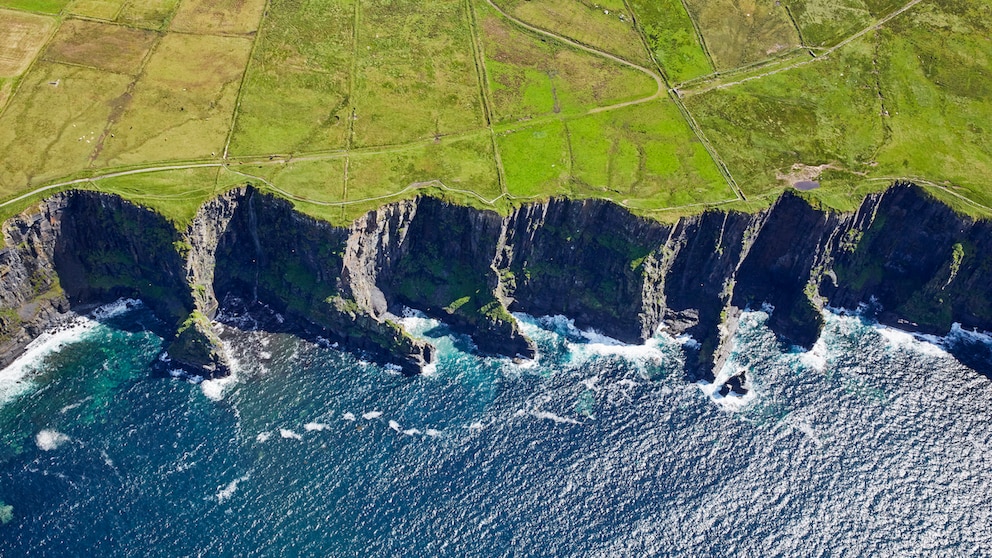
According to Britannica, the paradox arises “because coastlines do not have straight lines.” Bays, peninsulas, headlands, and other curves and twists complicate measurement. And: The more detail you go into, the more curves, twists, small islands, and so on become visible—and the measured coastline length correspondingly longer.
The “problem” was also confirmed by Victoria Braswell, a member of the Royal Geographical Society, according to the BBC: “The problem is that no one knows exactly how long the coastline of England is, or that of the United Kingdom, or most coastlines worldwide.” According to the researcher, “it all depends on how you measure.”
Border Length as a Cause of War?
The Encyclopædia Britannica explains that the phenomenon of the coastline paradox was first noticed in the 1920s. An English mathematician named Lewis Fry Richardson had researched the hypothesis that the likelihood of war between neighboring countries depended on the length of their border. He surprisingly found that countries reported their borders differently. For example, Spain reportedly stated its border with Portugal as 987 kilometers, while Portugal put the border length at 1,214 kilometers. He found similar discrepancies in other countries, such as Belgium and the Netherlands, which, according to the BBC, had a border length discrepancy of 69 kilometers.
According to the BBC, countries measured their borders and coastlines at the time with rulers placed along the borders on a map. Richardson realized that the finally measured length depended on the rulers used. Because: Borders and coastlines are not linear. If you use a shorter ruler, more curves are captured. According to Britannica, the Polish-born French-American mathematician Benoît Mandelbrot expanded on his colleague’s work with an essay on the coastline of Great Britain. Through detailed research, he also concluded that the length of a coastline depends on the measurement.
The phenomenon known as the “coastline paradox” affects many borders and coastlines worldwide, especially those with many jagged edges and twists. It is assumed that in the future, thanks to artificial intelligence, better, that is, more accurate data can be obtained. But how far should they go? What exactly counts as the coast, every bend and twist, every stone, every grain of sand? The measurements could go on indefinitely. And how often should a coastline be remeasured? After all, coastlines are constantly changing due to erosion. The question of exact measurement ultimately comes down to a uniform definition of the coastline.