

November 7, 2026, 12:22 pm | Read time: 4 minutes
Where in Germany is life relaxed, and where are people particularly stressed? This has now been determined by a stress index from the online pharmacy CanDoc. The city where people are most stressed might surprise some.
Stress is a part of everyday life in many German cities for many city dwellers. Traffic noise, concrete jungles, fine dust, and stressed people nearby all contribute externally. Internally, work demands, packed schedules in leisure time, racing thoughts, and little exercise add to it. This is not new. There is growing awareness that stress is unhealthy, and terms like work-life balance are becoming popular, with yoga, retreats, and wellness treatments becoming dear to stressed city dwellers.
But where in Germany are city dwellers particularly stressed? And which cities are the most relaxed? The online pharmacy CanDoc has now found out through a stress index. Thirty German cities were examined based on nine factors: availability and accessibility of green spaces, environmental factors such as street noise, fine dust, and the number of tropical nights, meaning nights when the temperature does not drop below 68 degrees Fahrenheit. Also considered were average annual working hours, local health care, and preventive services such as wellness centers, relaxation and stress management courses, and the number of psychotherapists.
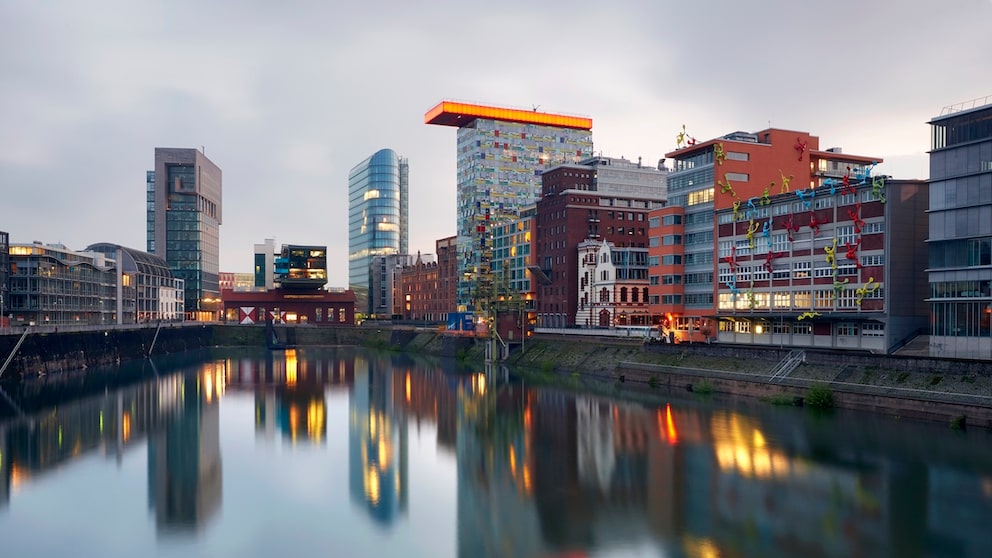
Düsseldorf is the Stress Capital
This result might surprise some. But indeed, the Rhine metropolis ranks last among the 30 cities in CanDoc’s stress city ranking–with zero points. For comparison: the second most stressed city, Stuttgart, has at least 23 out of 100 points. Why is Düsseldorf so stressful? As the ranking shows, there are not just one but several reasons that counteract relaxation in everyday life.
For example, nearly one in three Düsseldorf residents is exposed to nighttime street noise of more than 55 decibels–by far the highest value in the city comparison. On average, in eleven nights per year, heat may add to the reasons for possible sleeplessness. Additionally, there are very few options available for poorly or interruptedly sleeping Düsseldorf residents to cope with their stress. There are just five relaxation and stress management courses per 100,000 people in the city. Natural stress management through nature is also quite limited in Düsseldorf: 32 percent of the city consists of green spaces, but only 63 percent are well connected. Only Mannheim has fewer. On the other hand, wellness centers are overrepresented. There are 13 per 100,000 people in the city, surpassed only by Cologne with 41–and this wellness city is not too far away.
Another stress factor in Düsseldorf is working hours: on average, a Düsseldorf resident spends 1,357 hours per year working. Only one city works more: Frankfurt am Main, with 1,395 annual working hours.
Also interesting: How travel can help with everyday problems

In this European capital, people sleep the best, according to analysis.

Surprising! This Is the Greenest City in Germany
Augsburg is Germany’s Most Relaxed City
At the top of the ranking is Augsburg with 100 out of 100 points. The Bavarian city has 41 percent green spaces, to which 72 percent of its residents have easy access, reaching them within 300 meters. However, this is not the end of the line. In 18 of the 30 cities, this value is even higher. For Augsburg’s unbroken relaxation factor, this alone does not seem decisive, as Augsburg residents apparently need less additional relaxation. Only 15 percent are disturbed by noise at night, and it is tropically warm on just six nights. And if they are stressed, there are 14 relaxation and stress management courses and five wellness centers available per 100,000 people. A factor that accounts for 25 percent of the rating is working hours–and with 1,275 annual working hours per average employee, it is also comparatively low. Only in Aachen and Bochum is less work done.
These are Germany’s Most Relaxed and Stressed Cities According to Can Doc
- Augsburg (100 points)
- Bielefeld (96 points)
- Münster (93 points)
- Kiel (90 points)
- Aachen (90 points)
- Wuppertal (79 points)
- Bochum (76 points)
- Bonn (73 points)
- Bremen (68 points)
- Braunschweig (64 points)
- Wiesbaden (56 points)
- Berlin (55 points)
- Chemnitz (55 points)
- Nürnberg (55 points)
- Cologne (53 points)
- Leipzig (52 points)
- Hamburg (51 points)
- Karlsruhe (51 points)
- Hanover (48 points)
- Mönchengladbach (48 points)
- Munich (47 points)
- Dresden (46 points)
- Mannheim (40 points)
- Dortmund (37 points)
- Essen (35 points)
- Gelsenkirchen (32 points)
- Duisburg (27 points)
- Frankfurt am Main (25 points)
- Stuttgart (23 points)
- Düsseldorf (0 points)
Also interesting: Vacation trend Quietcation–7 places where there’s just peace
Criticism of the Ranking
The ranking by CanDoc can only be understood as a rough guide, as the list of evaluated factors to assess a city’s stress level is sparse. For example, factors such as average income, childcare options, or daytime noise levels are missing. Additionally, a self-assessment would be important. A survey of residents about their perceived stress level and their assessment of the city they live in would be valuable, as there are interpersonal aspects that influence stress levels, such as the tone at work or on the street, alongside influences like noise and nature.