

May 13, 2026, 1:24 pm | Read time: 5 minutes
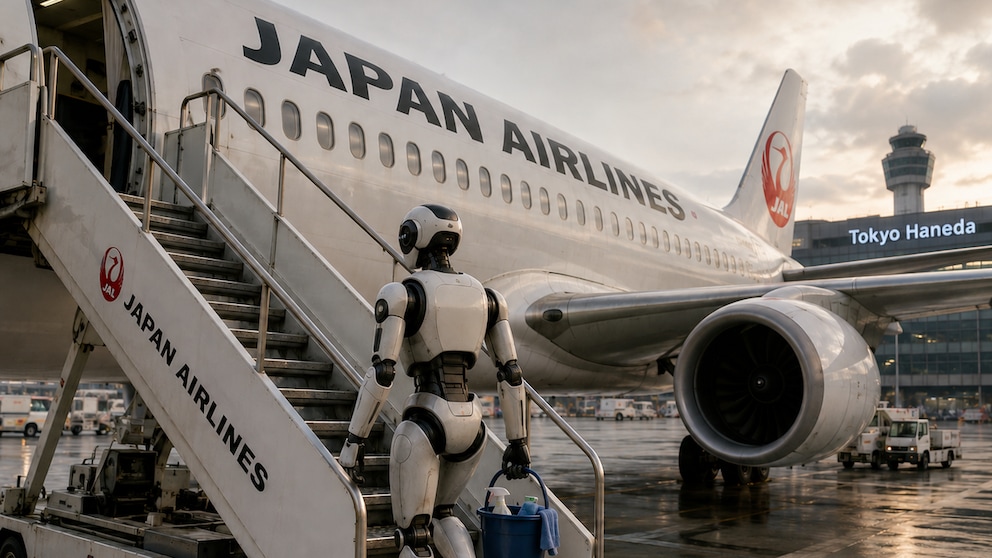
Will humans soon be replaced by robots at Japan’s airports? The Japanese airline Japan Airlines (JAL) is testing, together with a partner company, how humanoid robots could take over tasks in ground handling in the future.
So far, humans clean airplanes after a flight. People load the various pieces of luggage that vacationers and other travelers want to take with them. This could change in the future. The airline Japan Airlines, together with its partner GMO AI & Robotics Corporation (GMO AIR for short), is launching “a demonstration project for the use of humanoid robots at airports starting in May 2026,” as stated in a joint statement. The test site is Tokyo Haneda International Airport.
Humanoid Robots in Ground Handling
The humanoid robots, or robots in human form, are to be used in this test for various tasks in ground handling at the airport. These include moving luggage and cargo as well as transporting heavy items. Additionally, the human-like robots are to clean the aircraft cabins. They will take over several tasks of the ground staff at the airport, which have so far been performed by human hands.
The robots themselves are already close to the image of future human-like robots that many might have in mind. They have two arms, two legs, a head, and a body. According to Japan Airlines, they even have “a range of motion and adaptability comparable to humans.”
Previously Limited Work Areas for Robots
The use of robots and other automated machines at airports is not entirely new, as there have been robot projects in the past at various locations. Even now, one might pass by an automatically cleaning machine at the airport. Elsewhere, a robot answers pressing questions about airport operations. At Munich Airport, for example, a robot dog was tested about two years ago, which, according to the Fraunhofer Institute, “patrolled autonomously through the warehouse.” Robots have long been present at airports, firmly integrated into operations or as various emerging test projects.
However, according to Japan Airlines, areas like ground handling have so far fundamentally “taken place in environments that heavily rely on human labor.” This includes “operating ground support equipment (GSE) in confined areas around aircraft.” According to the airline, “traditional, fixed automation systems and robots with only one function” have struggled to adapt to existing infrastructures and complex workflows. This is changing now with the new humanoid robots. “Thanks to their human-like form, they can be used without significant changes to existing airport facilities or aircraft structures,” the partner companies write.
Thus, the human-like robots in Tokyo are taking life with machines to a new level. Not only do they already resemble humans much more closely, but they can also climb stairs, open doors, or operate tools. Accordingly, humanoid robots can take over many tasks at the airport that were previously reserved for humans. Or that at least required modifications to the infrastructure to be taken over by a machine. Japan Airlines and GMO Air explain: “By combining state-of-the-art AI technology with the unique flexibility of humanoid forms, the project aims to realize a sustainable operational structure through labor savings and workload reduction.”

Robots Provide Entertainment on This Cruise Ship

Why Airlines Are So Strict About Luggage Weight
Robots to Compensate for Labor Shortages
The background of this current test run with the human-like airport robots is a combination of various factors: Tourism in Japan is booming, while the society is aging, and the number of working people is declining. This development poses a problem, especially for ground handling. “For ground safety, such as aircraft handling and baggage/cargo handling, highly skilled employees are needed who are also physically very resilient,” the partners explain. They want to fill the resulting gap in the workforce with the use of humanoid robots. To address the problem, they jointly decided “to explore the potential of humanoid robots for labor savings and workload reduction in ground handling,” the statement says. This does little to help the fact that Japan is one of the most rapidly aging societies in the world. However, it could significantly ease work at the airports of the highly popular Asian country.
Only Robots in Airport Service in the Future?
Currently, the new robots and associated systems, according to Japan Airlines and GMO AIR, are still in the early stages. No robot is cleaning an airplane here yet. Rather, the initial focus is on visualizing and analyzing processes at airport locations “to identify areas where humanoid robots can be safely deployed,” as the partnered companies write. Subsequently, repeated operational checks are planned “to simulate real airport environments.” The current pilot project is set for the next two years, with various phases.
The pilot project by Japan Airlines and GMO AIR is certainly forward-looking. The collaboration between humans and machines is already almost indispensable, and such automated processes and the replacement of human labor with machines are likely to increase in the future. Whether this is good or bad remains a matter of personal judgment.
For those who fear a reality where robots almost completely replace human labor, a pause is warranted here. What is being tested in Japan and may bring significant changes to the entire aviation industry (and beyond) is still in its infancy. The industry is far from being operated completely by fully autonomous robots. Many systems still require human control and supervision. Additionally, security issues play a significant role at airports. Japan Airlines states: “The goal is to establish a sustainable operational structure through labor savings and workload reduction by supplementing human tasks with humanoid robots.” With their pilot project, the partners aim to “create an environment where humanoid robots can be safely and effectively used in airport operations.”