

May 28, 2026, 8:23 am | Read time: 7 minutes
Summer vacations are just around the corner, bringing with them expected airport chaos. And it has already begun. A new reason: the European Union’s new automated digital border control.
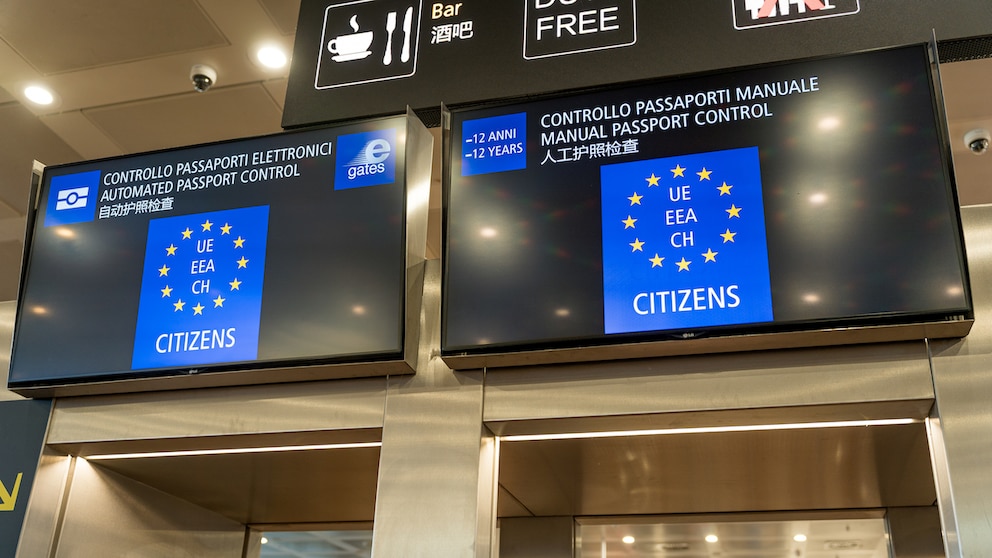
Long hours of waiting in airport lines have been common since 9/11, and especially since the COVID-19 pandemic and the subsequent surge of travelers to popular destinations. Thousands of people crowd small and large airports, particularly in the summer, sometimes leading to chaos and turmoil. This is not new. However, the current cause of delays and missed flights is: the introduction of the European Entry/Exit System (EES). In theory, this only affects non-EU citizens, so neither Germans nor most European neighbors. But due to the massive chaos now unfolding at airports, it affects them, too.
What Is EES?
“The Entry/Exit System (EES) is an automated IT system for recording non-EU nationals who are admitted for a short stay,” explains the European Union about the new system. It records those crossing the external borders of the 29 participating European countries. The “short stay” refers to a stay of up to 90 days within 180 days. EES applies to all third-country nationals, regardless of whether they need a visa to enter. This includes Britons, U.S. citizens, Australians, and many others. Cyprus and Ireland, despite their EU status, do not participate in EES and continue to manually stamp passports.
With EES, travelers scan their biometric passports independently at a self-service system. A biometric passport is required. The EES kiosk records biometric data such as fingerprints and facial images, as explained by Lufthansa. It also records the name, passport data, and the place of entry and exit from the Schengen area. An EES database stores the data. Additionally, the system records previous entry refusals. If someone has exceeded the allowed stay or is on a criminal record list, the EES kiosk detects this and reports it to border officers. At border control, the recorded data is checked, and if there are no issues, the traveler is allowed to enter or exit.
What Is EES Good for?
According to the EU information page, EES has several advantages, one of which is the modernization and increased efficiency of border controls. If it works correctly, it should facilitate and speed up these processes.
Besides efficiency, EES is about security within the European Union. Thanks to the electronic system, entries and exits in the Schengen area can be better tracked. Another important aspect is covered: “By using fingerprint and facial data, it prevents people from exceeding the allowed stay, using false identities, or abusing visa-free entry,” explains the EU. Ultimately, EES provides border protection officers and law enforcement agencies access to important travel information, helping them “identify security risks and advance the fight against serious crime and terrorism.”
Queues at Airports
After multiple delays, rocky starts, and technical difficulties, the EU’s new entry and exit system was gradually introduced last October. Since April 10, 2026, it replaces “the stamping of passports and enables the automatic detection of people who have exceeded the allowed stay,” according to the European Commission. However, the implementation of the new system is not without problems—and it has seemingly led to few accelerated controls, if one believes the horror stories of up to seven-hour waiting scenarios circulating on social media.
Since the start of EES, travelers in Europe have reported chaotic scenes, hours of waiting without a system, and missed flights. According to the British “The Times,” severe IT failures have been reported in France. At the heavily frequented Paris Charles de Gaulle Airport, systems failed, and passports had to be processed manually, resulting in long queues. In Greece, there are reports of more than two hours of waiting time. The country even plans to suspend EES for Britons until September. In the British cities of Dover and Folkestone, there were reportedly such significant technical problems that the entire system was shut down.
The aviation industry, according to The Times, advocated for an extension of the six-month transition period, partly because April 10 fell during the Easter holidays. It warned of such bottlenecks, especially at hubs like Amsterdam, Barcelona, and Paris.
Hours of Waiting in Portugal
During peak travel periods like the upcoming summer holidays, Europe’s airports become crowded. Many of the smaller ones are hubs but are not designed for such long queues. An extreme example is Portugal. Social media has recently been filled with reports of sprawling queues and especially long wait times. Some travelers reportedly have to wait up to seven hours at Portuguese airports in Lisbon, Porto, and Faro. The queues sometimes extend into the duty-free area. There are also images from Faro Airport showing crowds on the stairs before the controls.
This video from CNN is particularly striking:

Various media report that the current queues are due to problems with the new entry and exit system EES, including technical defects. However, it is not just the new systems that are pushing the small Portuguese airports to their limits.
Is EES the Only Cause of the Chaos?
A report from the Portuguese news site “The Resident” explains that the problem, according to the police in Porto, is not solely EES but rather a combination of technical and computer-related issues and the high number of non-EU citizens among the passengers. An example was the Sunday a week ago, when around 69,000 such passengers passed through the three Portuguese airports, Porto, Lisbon, and Faro. On that day, there were waiting times of up to 130 minutes in Porto. In Lisbon, travelers had to wait up to 110 minutes, and in Faro up to 100 minutes. However, the police dismissed reports of up to six-hour waiting times.
The Portuguese Secretary of State for Infrastructure, Hugo Espírito Santo, stated in an article on the platform “Essential Business” that the sprawling queues are not just a problem in Portugal: “We must recognize that this is not a Portuguese problem, but a European problem at the moment,” said the Secretary of State. Amsterdam, Milan, Munich, and Tenerife are experiencing similar conditions. He expressed his dissatisfaction with the situation and said they are working on a solution to the problems. This includes more personnel and technical resources at the airports.
According to “Essential Business,” the European Union denied that the queues at Portugal’s airports were caused by EES. The processing time per passenger is reportedly just over a minute. Often, the waiting times are not related to the system but to other factors.
Portugal, according to “The Times,” has started turning off the EES machines when the queues become too long.

New Journey Pass to Replace Traditional Boarding Passes–and Much More

Why More Countries Are Eliminating Passport Stamps
What Solutions Are There?
Turning off the EES kiosks is a temporary solution, and according to the British “Times,” many airports now have a legal clause allowing them to conduct manual border controls when technical systems fail or operations are severely disrupted. The European Union has stated, according to the newspaper, that EU countries needing more flexibility this summer can use a transition period until early September.
But what other measures are there in connection with the EES problems in the middle of summer? One option, according to various media, is the “Travel to Europe” app developed by the EU border protection agency Frontex. This was tested as a pilot project in Sweden and Portugal and can be used voluntarily there. With the app, travelers can register in advance with their personal data and travel information, potentially reducing wait times at security checks. Travelers then access their registration at the EES kiosks via a QR code, as reported by the media company “Travel Tomorrow.”
First Successes
Despite all the difficulties the new system may have caused so far, there have already been some successes, according to consistent media reports. “The Times” writes that in its first six months of operation, from October to March, EES caught 4,000 people who had overstayed their allowed time. Additionally, nearly 66 million entries and exits were recorded, along with 32,000 entry refusals. More than 800 of them were classified as security risks for the European Union.
EES is not the end of new entry scenarios: Also planned for this year is the introduction of the repeatedly postponed new ETIAS travel authorization in the fourth quarter.