

October 20, 2026, 3:18 pm | Read time: 3 minutes
The cabin crew is responsible for passenger catering, among many other important tasks. To access this service outside official onboard service times, passengers often use the call button at their seat. This button is frequently referred to as the service button and used as such, but that doesn’t quite do justice to its original function. TRAVELBOOK spoke with a flight attendant about this.
“The popular call button, a disaster!” – that’s how our insider, a flight attendant with a major German airline, responds to our inquiry. She doesn’t question the button’s purpose itself. Yet, it apparently causes minor disruptions in the crew’s daily work.
The actual function of the passenger call button
The call button is intended to allow passengers to attract the attention of the cabin crew when needed. It is primarily meant for emergencies and situations where passengers require assistance. “For example, if passengers are sitting by the window at night, have difficulty getting out, and need something,” explains the flight attendant.
But you’ve probably experienced it being used for drink orders—and perhaps have even used it yourself without a second thought. The passenger call button? For most passengers, it’s just the “service button.”
Lufthansa Temporarily Closes Restrooms on Certain Aircraft

How Do I Become a Flight Attendant?
Unfavorable placement
According to our insider, the frequent use of the call button is partly due to its placement. In many Boeing models, it is located directly on the armrest, sometimes even on the remote control. “Passengers constantly press it by mistake,” reports the flight attendant. She also mentions small children who press all the buttons out of curiosity, “ringing the whole plane.”
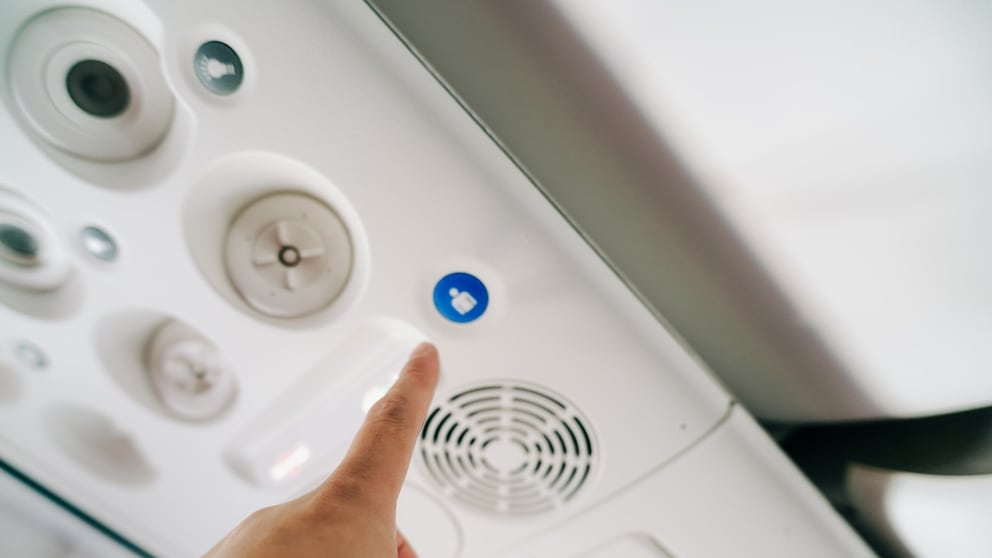
It’s a bit different with Airbus aircraft, where the call button is located on the ceiling (see large photo above). At least small children can’t reach it there. Adult passengers, especially in higher travel classes, have fewer issues with it. Particularly in business class, passengers seem to use it quite naturally for service requests, the flight attendant reports.
Former emergency call button has “evolved”
One can imagine that it can be annoying for the crew in their already busy onboard routine when the call button, originally intended for emergencies, is increasingly used for service requests—especially when multiple calls come in quick succession. Nevertheless, this usage has become established over time, and for some airlines, it is now part of the onboard routine. For instance, “20 Minuten” reported that passengers on Swiss are indeed allowed to use the button for service requests.
Our flight attendant, who does not work for Swiss, and her colleagues generally accommodate passengers’ requests. However, if they could express a wish themselves: “Please limit orders to service times if possible. And if you’re not sitting by the window and can easily get up, feel free to come to us if you need something.”
That would not only be polite, but you would also benefit: Stretching your legs a bit, especially on a long-haul flight, can never hurt.