

September 28, 2026, 8:34 am | Read time: 5 minutes
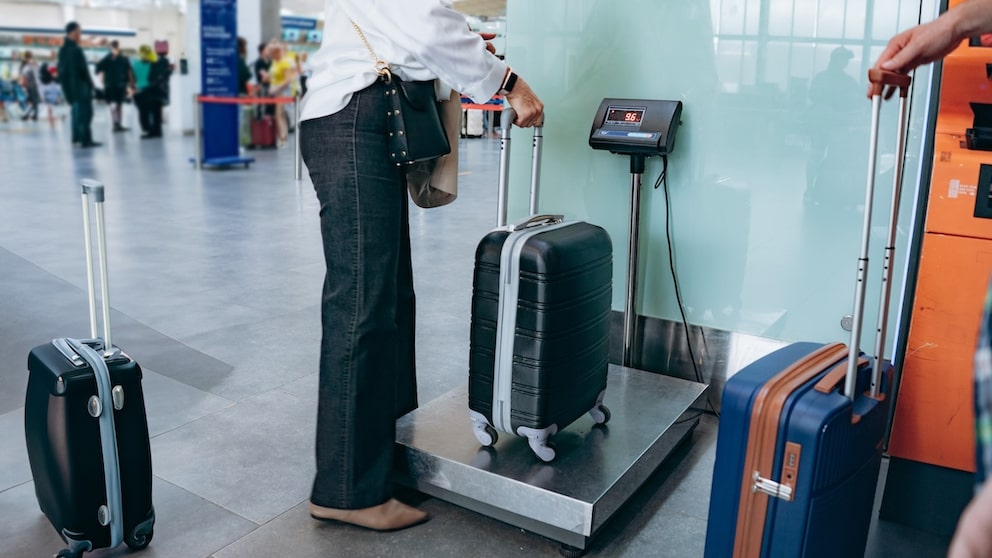
For many people, it’s probably the least favorite part of travel preparation: weighing the luggage again. Naturally, you want to take as much as possible–but the suitcase weight must not exceed certain limits. But why is that? And why do a few hundred grams often make such a big difference? Often, it’s also a financial issue when you have to pay fees for excess baggage. TRAVELBOOK has found out why airlines are so strict about luggage weight.
How heavy suitcases can be varies by airline
It’s advisable to check the baggage regulations of the responsible airline before a flight. The allowable weight limits can vary. This involves, among other things, the question of how much weight an aircraft can have at takeoff. Various factors play a role in this calculation.
Each aircraft must not exceed a certain maximum mass at takeoff. This includes the weight of passengers and their luggage–but not only that. The aircraft itself has its weight, and then there’s the fuel, crew, catering, cargo, and so on. In the end, the entire load must remain within certain limits.
Airlines pay attention to luggage weight–but don’t weigh everyone
Airlines typically don’t weigh each passenger individually. Instead, they can rely on standard weights set by the European Union Aviation Safety Agency (EASA) for calculations. For aircraft with at least 30 seats, a standard weight of 84 kilograms per adult person currently applies–including carry-on luggage. Alternatively, separate standard values for men and women can be used: 88 kilograms for men and 70 kilograms for women.
Now, you might think: The average body weight of people has changed in many industrialized countries over the past decades. For example, adjustments were indeed made in Australia to account for this.
Should the (increasing) passenger weight influence the values?
As a former pilot–an Australian–explains in more detail on the news portal “The Conversation,” the calculated standard weight at the beginning of her career in 1998 was 77 kilograms per passenger, without carry-on luggage. Today, different values apply depending on the aircraft type and seating capacity. For aircraft with 150 to 299 seats, they are, for example, 81.8 kilograms for an adult man and 66.7 kilograms for an adult woman.
Why haven’t adjustments been made in Germany and elsewhere in Europe? This is due to the results of a study by EASA from 2021/22. The agency found that the average weight of the passengers studied apparently hasn’t changed significantly. At least, the difference from the previous study was not statistically significant.
Regulating luggage weight brings airlines money
It’s no secret that baggage fees are also a source of income for airlines. Especially with low-cost carriers, flights are often offered at a low base price, while additional carry-on or checked baggage costs extra.
Also interesting: Ryanair’s imaginative interpretation of the term “carry-on luggage”
Some airlines or their ground service providers even offer financial incentives for employees who identify oversized carry-on luggage. TRAVELBOOK delves into this here. At Ryanair, it’s said to be around 1.50 euros per identified case. Swissport employees, who work for Easyjet at British airports, are said to receive about 1.38 euros as a “finder’s fee.”
Despite extra charges for excess baggage, weight limits apply
The fact that passengers pay for overweight luggage and can still take it with them might initially seem contradictory given the safety background described above. But don’t worry, this model doesn’t override the aircraft’s safety limits. The baggage fee is primarily a tariff regulation of the airline. For safety, the technical limits of the aircraft apply regardless.
EASA requires airlines to ensure that the allowable takeoff mass is adhered to before departure. If the aircraft is overall too heavy, the load must be adjusted accordingly.
Ryanair’s Imaginative Interpretation of the Term “Hand Baggage”

In These Cases, Your Luggage May Be Left Behind at the Airport
Bulky, heavy carry-on luggage hinders the process
Heavy luggage can certainly complicate the process at the airport. And not just for the individual, who might even miss their flight due to problems with baggage check-in. Users share such experiences on the platform “Reddit.”
The IATA describes aircraft handling as a tightly coordinated process. Delays in baggage handling or loading can affect other steps and thus delay the entire turnaround of an aircraft, meaning the ground time between arrival at the parking position and departure again. It’s no surprise: The many suitcases must logically not only be accepted and transported but also stowed in the aircraft according to loading instructions and, if necessary, considered in the weight calculation.
Consider how much you can lift when packing
As a solo traveler, you shouldn’t max out the weight limit for luggage if you can’t handle it yourself. It’s not fair for various reasons to rely on cabin crew for help. For one, the crew has important tasks to ensure safety on board and also needs to take care of your catering.
Additionally, lifting passengers’ carry-on luggage is not part of flight attendants’ official duties. This also means that if they get injured while handling a suitcase, they wouldn’t be insured–it wouldn’t count as a work accident.
Since they are very helpful in case of doubt, it still happens that flight attendants assist passengers in stowing their luggage. A study from last year shows that handling overhead bins and luggage is one of the physically demanding tasks in the daily work of flight attendants.