

November 14, 2025, 5:17 pm | Read time: 3 minutes
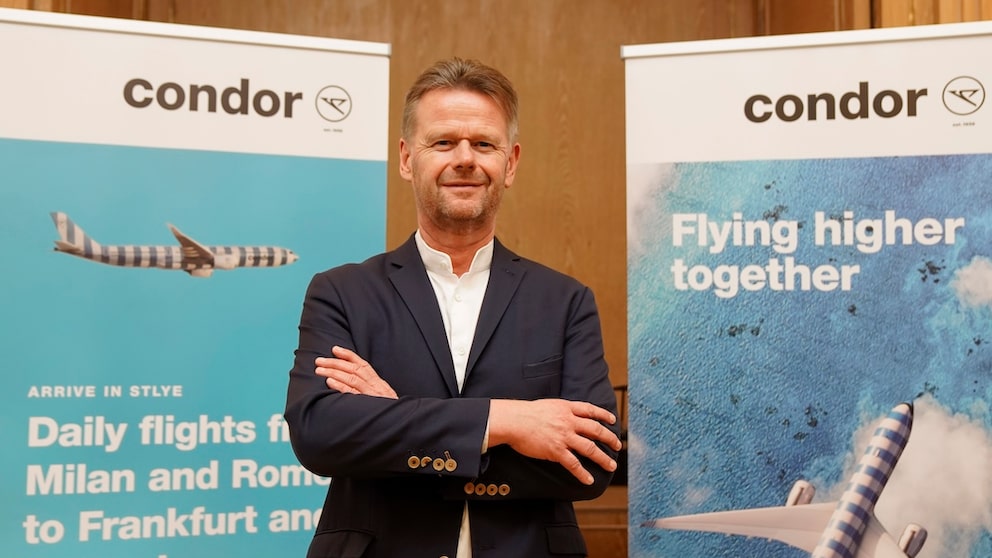
High operating costs are increasingly challenging German airlines. While some competitors like Ryanair have already scaled back their presence in Germany, Condor is now also taking action–with a strategic shift abroad. Why the holiday airline is focusing on international feeder flights and what the future holds is explained by CEO Peter Gerber in an interview with BILD.
Condor commissioned a market study whose results are thought-provoking for the entire industry. According to the study, price is the decisive factor for many customers when booking flights: 63 percent of respondents choose based on the final price–including flight and all fees.
The increased costs are also clearly noticeable to travelers, according to the study: 82 percent are aware of the price increase, and 62 percent find current flight prices rather expensive or even very expensive. Additionally, competition in the German aviation sector is viewed critically. According to the survey, 46 percent of respondents consider competition in German aviation to be weak.
Margins in Aviation Remain Low
Condor, like Lufthansa, has increased ticket prices. However, large profit margins are still not achievable, CEO Gerber explains to BILD: “Across the industry, the profit per passenger is 5 euros.” Only in certain regions of the world, such as the Middle East, can higher margins be achieved–around 20 euros per passenger are possible there.
To remain competitive, Condor is responding with targeted expansion abroad. Starting in 2026, new feeder flights to Frankfurt from Barcelona, Venice, and Budapest will be offered. “We see demand for our long-haul connections there. We would like to fly more, but it has to be profitable,” says Gerber.
Also interesting: What the Eurowings CEO demands from the federal government
The airline also aims to attract customers abroad with attractive entry-level prices. In the winter season, a flight from Berlin via Frankfurt to Paris costs only 62 euros–a price level usually offered only by low-cost carriers like EasyJet. Air France charges around 90 euros per route for the direct connection. Insiders believe that Condor could fill this gap with low occupancy.
Seeking Partners: Collaborations Instead of Dependence on Lufthansa
Another reason for the new plans: Lufthansa is no longer required, following a ruling by the Düsseldorf Higher Regional Court, to grant Condor preferential access to its feeder network. As a result, Condor must create its own alternatives. Majority shareholder Attestor is currently exploring strategic partnerships with other major airlines. Members of the Oneworld alliance, such as American Airlines, are particularly in focus. Gerber remains cautious: “Condor could manage on its own, we are not under time pressure.”
A first step has already been taken: Condor is already cooperating with Alaska Airlines, also part of Oneworld, on domestic connections in the U.S. However, Condor does not yet operate its own frequent flyer program–customers can earn miles with either Alaska Airlines or Emirates. A closer collaboration with Emirates seems unlikely: The Gulf airline pursues an independent strategy. Although there is a cooperation with Condor, Emirates wants to design its strategy and route network independently and flexibly. A more comprehensive alliance is therefore not on the table.