

September 28, 2026, 11:22 am | Read time: 5 minutes
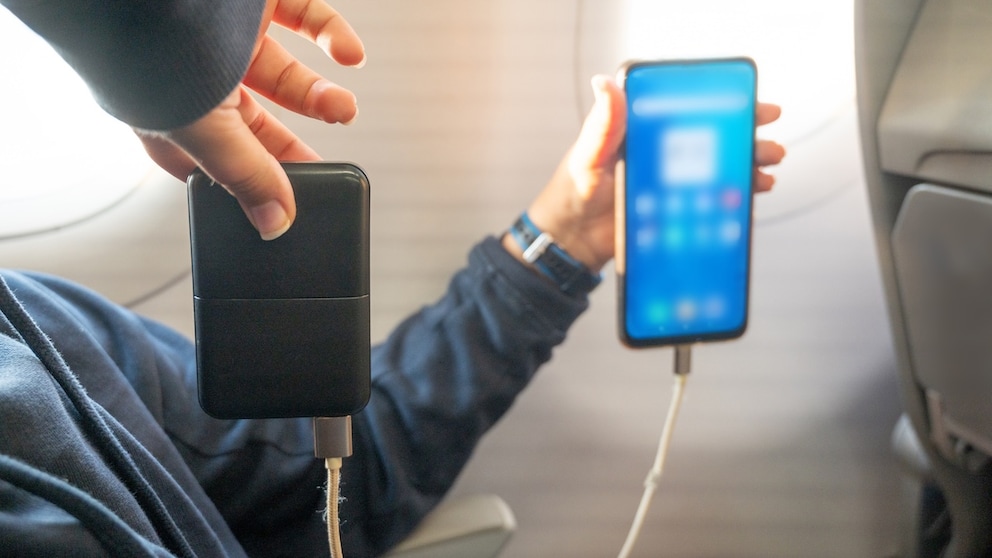
A power bank is handy for travel but can pose a risk on airplanes. Incidents involving burning lithium batteries occur repeatedly on board. Therefore, special regulations apply to these mobile energy storage devices. It’s crucial not only where the power bank is transported and its capacity but also whether the battery might already be damaged before the flight.
Power Banks Belong in Carry-On Luggage
Flames, smoke, and intense heat: If a power bank catches fire during a flight, it can quickly lead to a dangerous situation. In a recent case, flight attendants secured a burning device in a fireproof container. The plane with 204 people on board was able to land safely.
Incidents with burning power banks occur repeatedly. Recently, a Lufthansa flight from Frankfurt to Lisbon was diverted due to a power bank fire on board.
Power banks and other batteries with lithium-ion technology are generally not allowed in checked luggage in the cargo hold. The reason: If a battery problem occurs there, it is not directly accessible to the crew, and a fire could spread. Therefore, power banks belong in carry-on luggage.
This applies not only to classic power banks with USB connections. Other batteries, e-cigarettes, or wireless earbuds with charging cases may also be subject to these regulations. Travelers should check with their airline before departure to see which specific rules apply.
Also interesting: How many batteries can I take on the plane?
These Damages Can Make a Power Bank Dangerous
Power banks typically use lithium-ion batteries. If their cells are damaged, overheated, or a short circuit occurs inside, the temperature can rise significantly in a short time.
Particularly critical is the so-called thermal runaway. This process triggers further chemical reactions within the battery due to rising temperatures. These reactions generate additional heat, which can intensify the process. In the worst case, hot gases escape, the power bank starts smoking or catches fire. The resulting heat can also spread to adjacent battery cells.
Possible triggers include mechanical damage from falls or crushing, extreme heat, manufacturing defects, or electrical faults.
How to Recognize a Defective Power Bank
Not every damage to a lithium battery is visible from the outside. However, there are some signs that users should look out for.
If a power bank has fallen multiple times and shows visible damage, it can be a warning signal. Even if the device heats up unusually during operation, there may already be internal damage.
Caution is also advised if the casing is deformed or discoloration is visible around the connections. A power bank that has been exposed to high heat should also be critically examined.
If there is suspicion that a power bank is damaged, it should be properly disposed of.
How Large Can a Power Bank Be on an Airplane?
Power banks have capacity limits that can vary by airline. Ryanair, for example, allows a maximum of two power banks per person, while Wizz Air allows only one.
The Lufthansa Group permits two devices per person, each with a capacity of up to 100 watt-hours. Up to 160 watt-hours are possible with prior approval. Power banks with a higher capacity must remain on the ground.
The energy a power bank can store is usually indicated on the device. However, instead of watt-hours, it often shows a measurement in milliampere-hours.
The capacity can be simplified using the following formula:
Watt-hours = milliampere-hours × voltage / 1000
Lithium batteries for smartphones typically operate at a voltage of 3.7 volts. For a power bank with 10,000 milliampere-hours, the calculation is as follows:
10,000 × 3.7 / 1000 = 37 watt-hours
A power bank with 10,000 milliampere-hours and 3.7 volts is well below the 100 watt-hour limit.

Where Charging Power Banks Is Now Banned–and What Travelers Need to Know
Airlines Tighten Rules for Carrying Power Banks After Accidents
Airline Can Prohibit Use
Just because a power bank is allowed on a plane doesn’t mean it can be used during the flight. The International Air Transport Association (IATA) has established guidelines for transporting batteries on airplanes. However, the specific regulations of individual airlines may differ.
Some airlines only allow the transport of the power bank but prohibit its use during the flight. Smartphones, tablets, or headphones cannot be charged using the power bank.
Charging the power bank itself via a seat power outlet may also be prohibited. According to the TÜV Association, some airlines require that the power bank remains accessible throughout the flight. It cannot be stored in the overhead compartment, for example.
The operation of necessary and approved medical devices is allowed. Therefore, anyone wishing to use their power bank during a flight should check the airline’s regulations before departure.
Pay Attention to Labels and Safety Features
When purchasing a new power bank, TÜV Süd recommends not just focusing on the lowest price. The CE mark on the device should be the minimum requirement.
The GS mark can provide additional guidance, indicating an independent technical inspection. Missing or incomplete information about the manufacturer or technical data should be a warning signal. Especially with very cheap offers in online shops, displayed seals are not always reliable.
Optimal devices have safety features against overcharging, deep discharge, and overheating. Particularly with inexpensive power banks or devices from online retailers, these safety mechanisms may be lacking.
With material from dpa