

September 22, 2025, 3:12 pm | Read time: 4 minutes
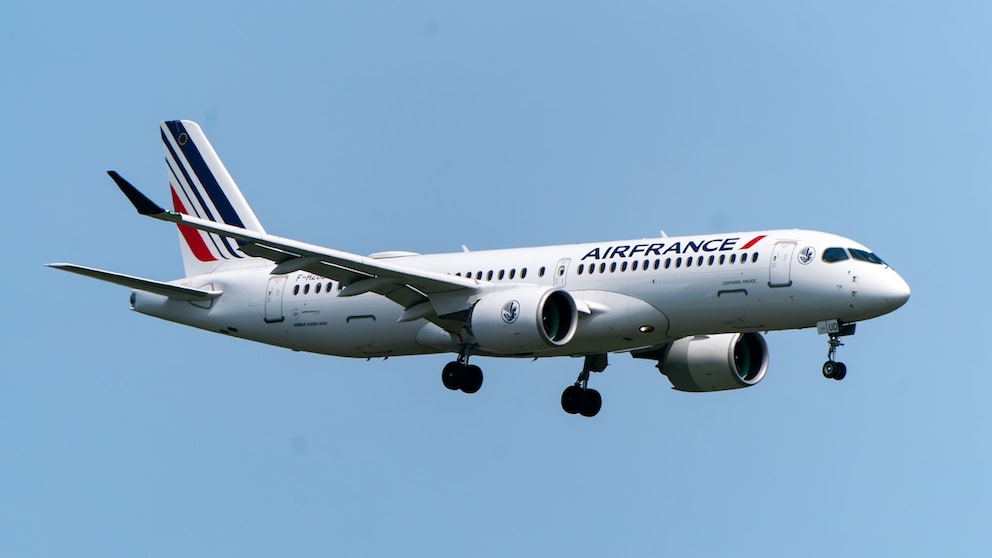
Recently, Air France was honored as the second-best European airline. No question, it’s one of the top carriers. However, when booking certain routes, it’s advisable to choose the competition. TRAVELBOOK explains why the French airline takes several hours longer to reach some destinations in Central Africa compared to many other airlines.
Air France is considered a premium airline. The consulting firm Skytrax has repeatedly awarded it four stars for high comfort and excellent service on board. In the ranking of the best European airlines, it recently secured a respectable second place. However pleasant the travel experience may be, one would likely prefer not to spend several extra hours on an Air France plane. Yet, on a route from the French capital to Bangui in Central Africa, that’s exactly what would happen, as suggested by a screenshot from the flight tracking app Flightradar24, posted on the user platform “Reddit.” The image shows that flight AF757 takes an L-shaped course from France over Spain, Morocco, and Mauritania before heading east over Guinea. You don’t need to be a geography or aviation expert to notice: That’s a significant detour, adding extra flight hours. But why is it taken?
Expert Explains Air France Detour to Central Africa
TRAVELBOOK consulted aviation expert Cord Schellenberg. He attributes the extended flight time with Air France to various destinations in Central Africa primarily to geopolitical conditions, in connection with the Chicago Convention on International Civil Aviation. This agreement stipulates that each state has full and exclusive sovereignty over the airspace above its territory. “If governments of different countries are in conflict,” Schellenberg explains, “they can prohibit aircraft from the other country from using their airspace.”
You guessed it: The core of the “problem” is the French origin of the airline. Some background information is available on the online portal “Fokus Afrika.” In Mali, Burkina Faso, and Niger, military regimes have been in power for several years following coups. Many of these governments have significantly cooled their relations with France. Niger has closed its airspace to French airlines, meaning Air France cannot even fly over it, whether to land or just pass through. Mali and Burkina Faso have gone a step further, temporarily revoking Air France’s operating license. The airline is therefore unable to offer flights to airports in these countries.
In April 2025, further restrictions were added in Algerian airspace. Due to tensions between Algeria and Mali, French aircraft are no longer allowed to pass through. As a result, Air France loses an important shortcut to sub-Saharan Africa. In short, it is forced to take a long detour over the Atlantic and West Africa.
Also of interest: Why Flights Take Longer Today Than They Used To
Airspace Over Israel and Iran Closed–What Does This Mean for Travel?
Why Do Planes Arrive Early Even When They Depart Late?
Flights Take Longer and May Be More Expensive
The consequence for Air France is that it must circumvent the sovereign territory–that is, the foreign airspace–as Cord Schellenberg points out. “This can lead to larger detours and correspondingly longer flight times, for which the affected airline receives no additional revenue. The costs are borne by the airline itself.” Logically, longer routes mean not only longer flight times but also higher fuel costs, in this case, without the airline generating additional income.
Unlike the common scenario where longer and more complicated travel connections are cheaper, Air France flights to Central Africa, which take several hours longer, may also cost more. According to expert Schellenberg, the airline might try to sell more high-value (i.e., expensive) tickets or raise freight rates. “However, it might lose business because other airlines can use the direct route, produce more cheaply, and offer their seats at lower prices.”
Security Policy Reasons for Detours
In addition to political conflicts, there is another factor: security risks.
Some regions in Africa are considered too dangerous to fly over. “The European Union Aviation Safety Agency (EASA) classifies Libyan airspace as unsafe,” Schellenberg explains. “Therefore, many airlines avoid Libya and also adjacent areas like Chad.”
This leads to further restrictions in route planning, making it even more challenging to fly a short and direct connection.