

June 11, 2026, 2:20 pm | Read time: 5 minutes
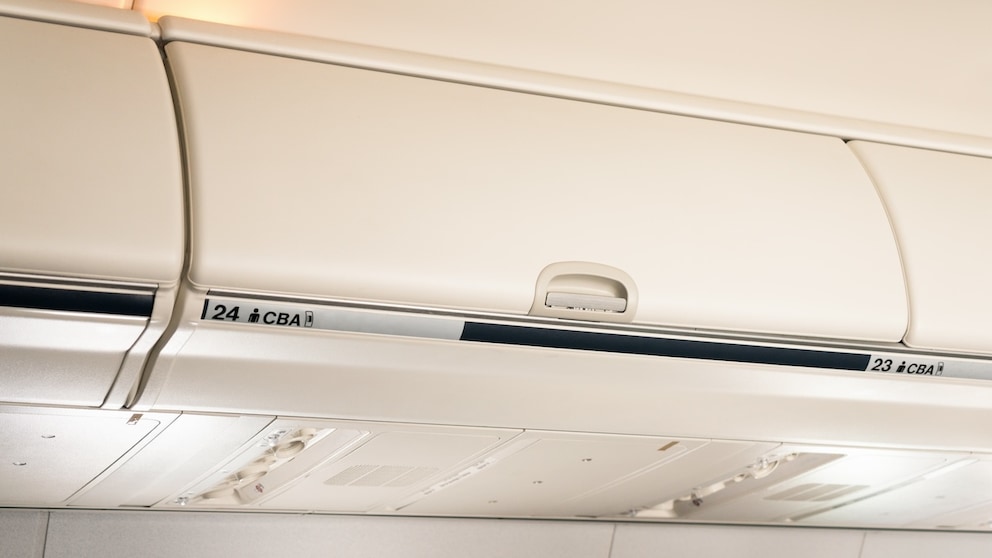
Flying is considered one of the safest ways to travel. However, unexpected incidents can occur in air travel that require the immediate evacuation of passengers. In such situations, the safety of people always takes precedence over personal belongings. Reports of real evacuations and safety studies repeatedly show that passengers lose valuable time in emergencies because they try to take their carry-on luggage before leaving the plane. Against this backdrop, the aviation industry is increasingly discussing measures to address this problem in the future. One solution could be to lock the overhead compartments.
Many people do not want to or cannot do without important items while traveling. Particularly valuable things are often carried in hand luggage to have access to them at all times and to avoid the risk of them being lost in checked baggage. In an emergency, however, these items should be left behind. After all, attempting to retrieve luggage from the compartments during an evacuation can lead to dangerous delays.
The Dangers of Handling Carry-On Luggage in Emergencies
When passengers try to access the overhead compartments in an emergency, the aisles are logically already blocked by them. Bulky luggage can also get in the way and obstruct emergency exits. It can damage evacuation slides and, in the worst case, injure fellow passengers.
Various safety studies also demonstrate that the described behavior can lead to problems. These include scientific simulations from 2023. They show that even a few passengers retrieving their carry-on luggage from the compartments can noticeably delay an evacuation and further block escape routes.
It’s not really surprising. But in stressful situations, rational thinking may fail–many people reflexively reach for their personal belongings. This is likely why it is repeatedly emphasized in safety briefings by cabin crew that carry-on luggage must be left behind without exception in the event of an evacuation. Even more alarming is that passengers continue to ignore this directive. Such an incident occurred last May at Denver Airport when passengers left the plane with luggage via emergency slides despite smoke and an ongoing evacuation.
So far, relying on the common sense or at least the compliance of travelers is not enough. Therefore, the International Air Transport Association (IATA) has launched the campaign “Save a life, not a bag.”
Raising Awareness for Greater Safety in Air Travel
The campaign aims to highlight the dangers that many people apparently underestimate when passengers try to access their luggage in emergencies. The goal is to create better awareness that any hesitation during an evacuation can be life-threatening. For this purpose, an illustrative video was also created for the campaign.

Overhead Compartments Are Not Yet Locked
Nick Careen, vice president of operations and safety at IATA, explained in an interview with “The Guardian” that airlines and manufacturers are not currently planning technical solutions such as automatic locking of overhead compartments. Instead, they want to focus on raising awareness and increasing travelers’ understanding of the dangers. The hope is that this will lead to a lasting change in passenger behavior.
At the same time, Careen admitted that if these efforts are unsuccessful, stricter measures could be considered in the future–such as fines or actually locking the overhead compartments.

Airline Cabin Chief Reveals: What Passengers Get Wrong With Carry-On Luggage

Where Charging Power Banks Is Now Banned–and What Travelers Need to Know
Flight Attendant Warns Against Locking Overhead Compartments
TRAVELBOOK asked an experienced flight attendant for her assessment of IATA’s initiative. As a member of the cabin crew, she is responsible for onboard safety. However, she is critical of the potential locking of overhead compartments.
From the insider’s perspective, who wishes to remain anonymous, safety reasons primarily argue against locking the compartments. A central issue is fires in the overhead compartments–most fires during a flight ignite there, according to her expertise. In such situations, the cabin crew must be able to react within seconds. “You can’t be searching for a key. You grab the fire extinguisher immediately and spray,” she explains.
Medical emergencies are another concern. Passengers might need quick access to important medications during the flight, such as an EpiPen or other life-saving drugs. Locking the compartments could hinder this. Additionally, the flight attendant points out: “And what if the key gets lost?”
She is also critical of technical solutions, such as locking via central control. Additional electronics in the compartments would, in her view, create more potential sources of error or fire. Moreover, during an evacuation, the aircraft’s power supply is largely shut down, so central control for the compartments would no longer function.
The Better Way: Revised Safety Videos
“I believe the best way is to make the possible consequences even clearer to passengers,” she says. In her opinion, safety videos should more clearly explain that an aircraft must be evacuated within 90 seconds in an emergency. She believes many passengers are unaware of this. It should also be emphasized more strongly what dangers can arise if travelers take their carry-on luggage–such as damaging evacuation slides or hindering others during the escape.