


July 11, 2024, 8:13 am | Read time: 8 minutes
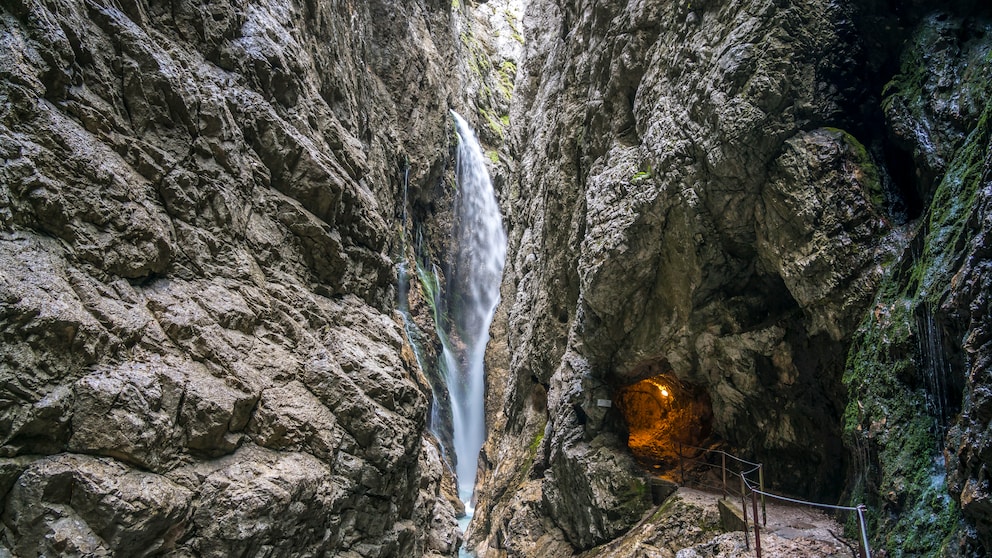
For millennia, water has carved its way down mountains, creating gorges with rushing streams and peculiar rock formations, which are especially beautiful in the summer. These areas offer a respite from the intense heat, with shaded paths and pleasantly cool air. TRAVELBOOK presents eleven spectacular gorges in Germany–get inspired!
Germany is home to many gorges and ravines. They are impressive to behold and demonstrate the powerful force of nature. Mountain gorges form when water, such as rivers and streams, continuously flows down the mountain, gradually carving its path through the rock.
Ravines are the more extreme version. Here, water has cut through the rocks with such force that enormous depressions have formed–sometimes the rocks overhang the surrounding walls. The prerequisite for such a formation is particularly hard rock, which, while shaped by the force of water, remains stable enough to create such impressive natural structures.
Overview
11 Spectacular Gorges in Germany
Over the millennia, numerous gorges and ravines have formed in Germany, not only in the Alpine region but also frequently in the low mountain ranges, Saxon and Franconian Switzerland, and the Black Forest. Nature lovers plan their hiking routes focusing on the ravines and gorges in specific areas.
Also interesting: The Most Spectacular Gorges in Europe
Many tourists visit these beautiful natural phenomena specifically. The journey to and through the gorges is often a special experience. Wooden walkways and paths have been constructed to make the valleys accessible to people, often winding adventurously through the gorges and ravines.
Ehrbachklamm (Rhineland-Palatinate)
The Ehrbachklamm in the Hunsrück region of Rhineland-Palatinate is reminiscent of fairy tale descriptions. Instead of a roaring, rushing river, a gentle stream flows over rocks covered in bright green moss. Visitors walk over wooden walkways and bridges, as well as paths carved into the rock.
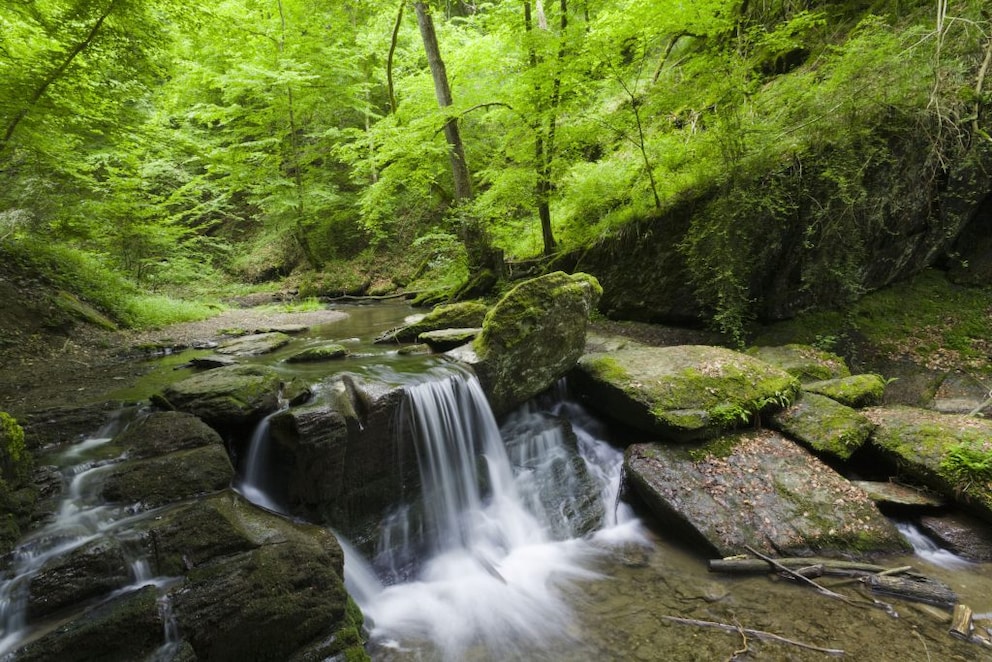
From the trail, you can also make a detour to the former Rauschenberg Castle, now just a ruin. Those willing to take a longer hike can continue to Ehrenburg, which is still well-preserved and offers overnight accommodations.
Leutaschklamm (Bavaria)
The Leutaschklamm is located in the southeastern tip of Bavaria in Mittenwald and partially extends into Austria. You can enter the gorge via the Waterfall Trail, the Kobold Path, or the Klammgeist Trail, which is enclosed by rock walls up to 75 meters high. It was opened in 1880–earlier than any other gorge in the German Alps. At 134 years old, the Waterfall Trail is the oldest path, leading hikers 200 meters deep into the gorge and finally to a 23-meter-high waterfall.
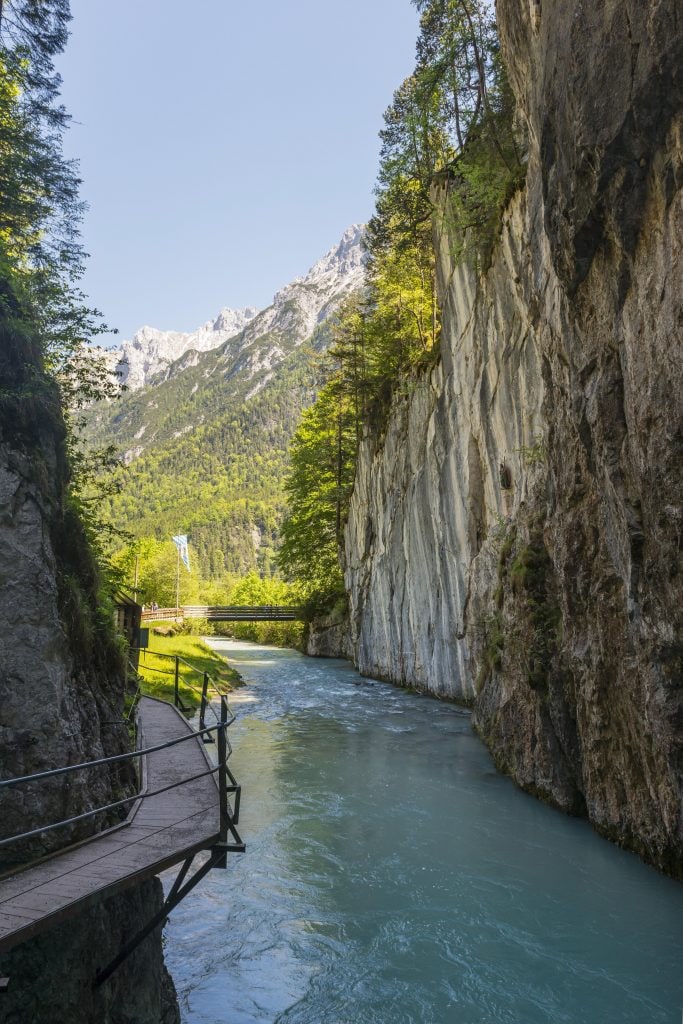
The Klammgeist Trail takes visitors on a three-kilometer journey through the mountain landscape. Along the way, you pass through the so-called Geisterklamm, a part of the Leutaschklamm. At 1,640 meters, the Leutaschklamm is the longest developed gorge in the German Limestone Alps.
Partnachklamm (Bavaria)
The Partnachklamm near Garmisch-Partenkirchen in southern Bavaria is 700 meters long and one of the most impressive gorges in Germany. It is extremely popular because the gorge is very easy to walk through. People who are not very athletic, as well as children, can easily stroll through the valley. The hike through the gorge is also not dangerous.
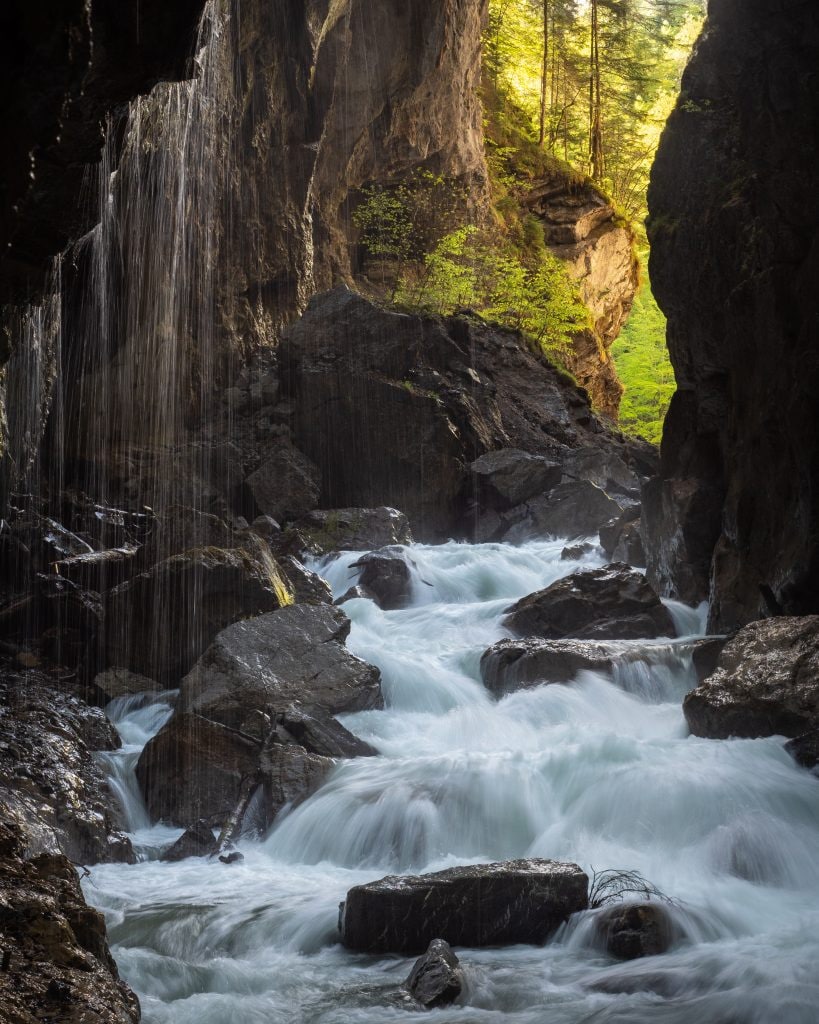
In winter, the water that usually runs down the walls freezes into long icicles, and the gorge resembles a white ice landscape. The rock walls enclosing the Partnach’s water in their valley are up to 86 meters high.
Höllentalklamm (Bavaria)
If the Partnachklamm isn’t enough, you can continue your hike to the Höllentalklamm. It is also located in southern Bavaria, in the Zugspitze region. The gorge is only accessible on foot, but the path through the gorge is easy to walk and suitable for beginners. In some places, it reaches depths of up to 150 meters. Visitors are surrounded by rugged light-colored rocks, many small and larger waterfalls, and cool temperatures, even in summer.
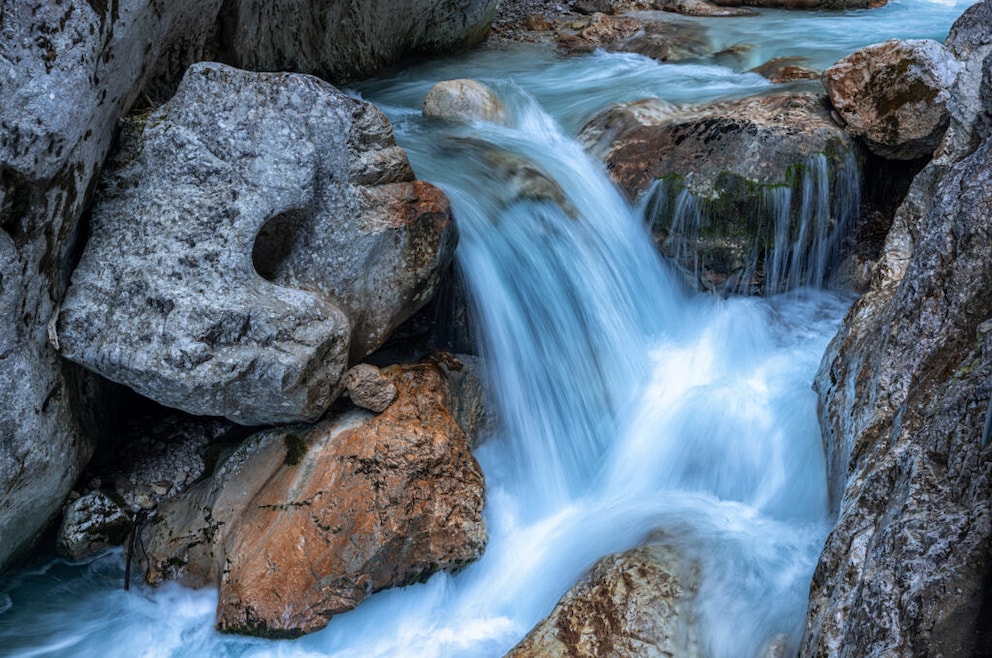
The name of the gorge does not derive from “hell” but rather from the term “hollowing” or “carving out.” The gorge was shaped by the rain and meltwater of the Hammerbach.
Kirnitzschklamm (Saxony)
Another of Germany’s impressive gorges: the Kirnitzschklamm. The Kirnitzsch forms the border between Saxony and Bohemia in the middle of the Elbe Sandstone Mountains. Visitors can hike through the Kirnitzschklamm for several kilometers, but they also have the option to take a boat for an 800-meter stretch. Part of the passengers is always in Germany, the other part in the Czech Republic.
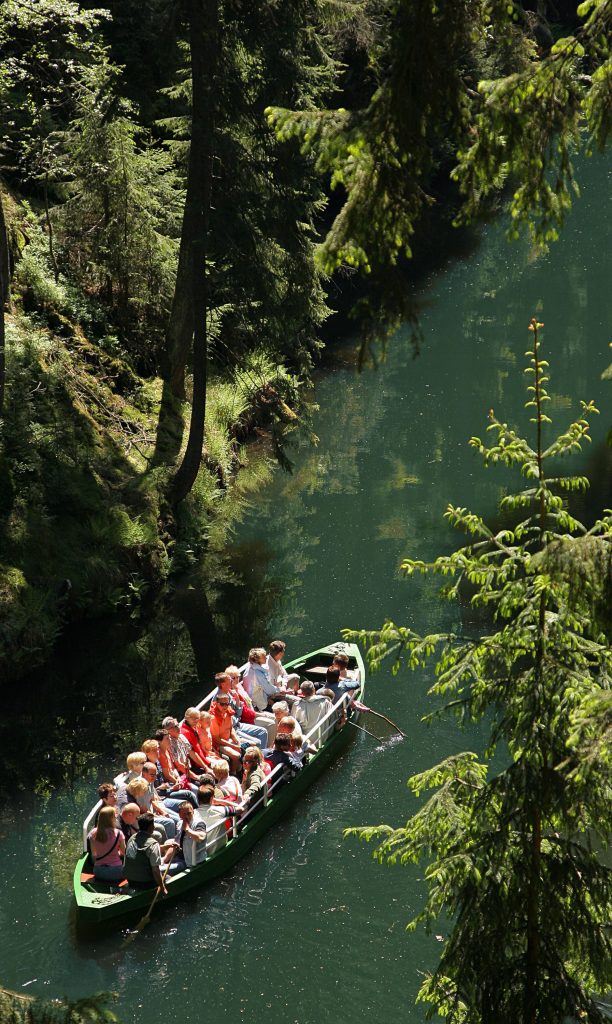
The Kirnitzsch is framed by steep rocks and lush greenery at this point. As beautiful as the water shimmers, swimming is only for the hardy, as the water is quite cold.
Bodetal (Saxony-Anhalt)
The Bodetal has carved its way through the Harz in central Germany over millennia. The valley is ten kilometers long, but strictly speaking, only the stretch between Thale and Treseburg is called Bodetal. As early as 1820, hiking trails were established between the gorges along the Warm and Cold Bode, and in 1937, Bodetal was designated a nature reserve. The rock formations do not appear as rugged as those in the ravines and gorges in southern Germany.
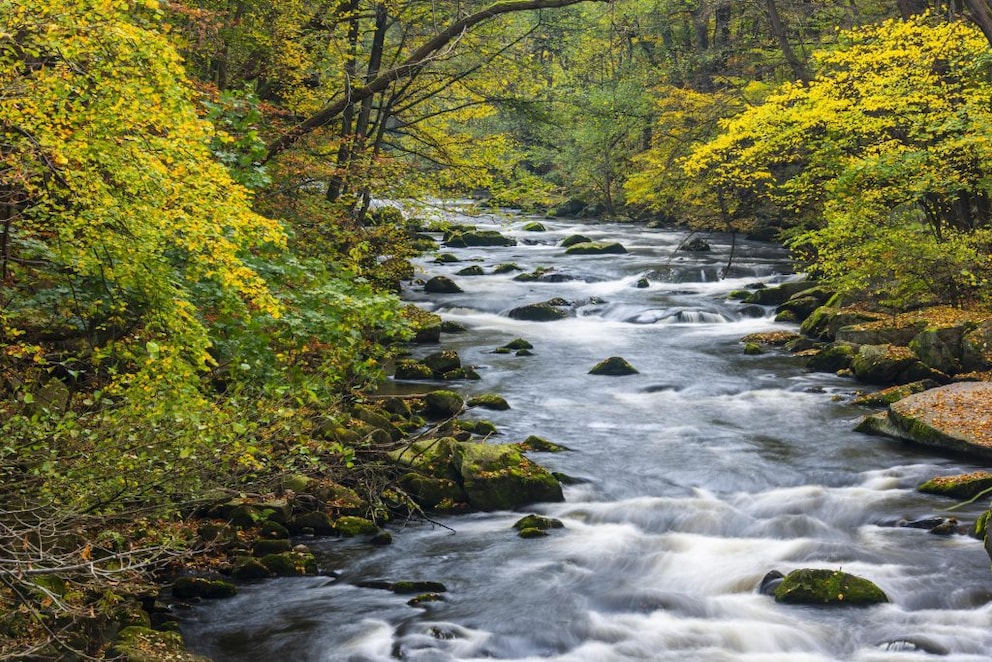
In Bodetal, the rocks are more frequently interspersed with forest areas, and there are fewer waterfalls, but a walk through the gorge is still worthwhile.
Breitachklamm (Bavaria)
Johannes Schiebel called the Breitachklamm near Oberstdorf (Bavaria) “a natural monument of wild beauty.” He lived around 1900, was a pastor, and wanted to do something good for his community: He pushed for the development of the Breitachklamm to generate income for the impoverished village. Today, you can hike between rushing water and bizarre tree and rock formations, but only safely in the warmer months–in winter, the gorge is often closed due to the risk of rockfall from ice formation. In the cold season, a torch-lit hike is even possible.
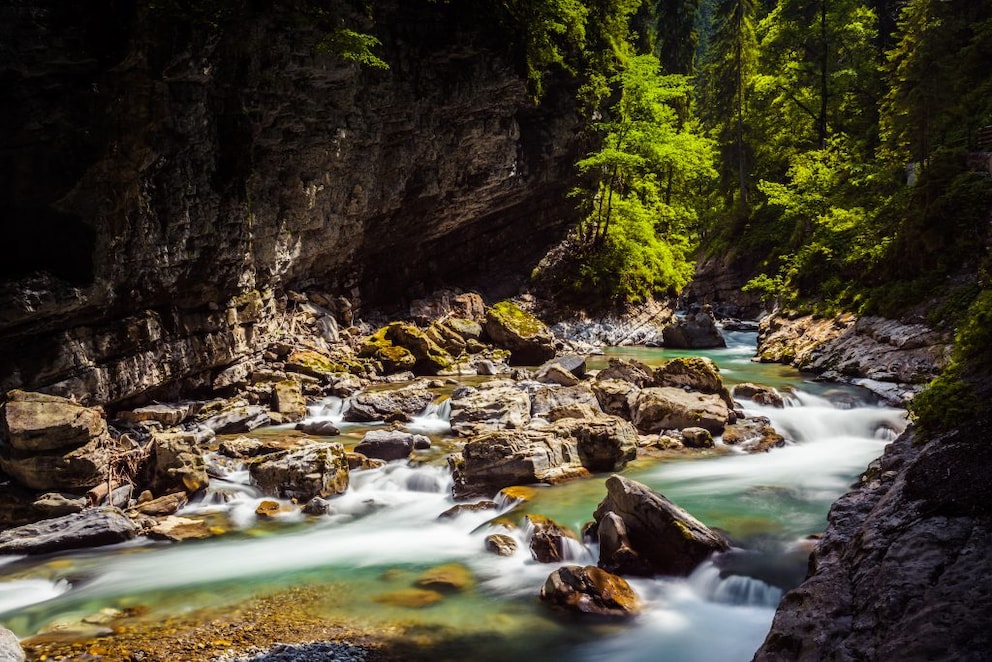
In the Breitachklamm, it never gets too steep, and if it does, you can switch to a well-developed path. However, it reaches depths of up to 100 meters, making it one of the deepest gorges in Central Europe. A visit can be a small part of a long tour or just a short walk.
Also interesting: The Deepest Gorge in Europe That Hardly Anyone Knows
Starzlachklamm (Bavaria)
The Starzlachklamm is located near Burgberg/Sonthofen in the Allgäu and was developed in 1932. It is a so-called Nummulite gorge. The term comes from “nummus,” the Latin word for coin. Animal remains in limestone shells often resemble coins, and geologists have found many of these in the gorge. Millions of years ago, the animals were buried in sea mud. In the Starzlachklamm, fossils of the rare crab “Xanthopsis sonthofenensis” were also found.
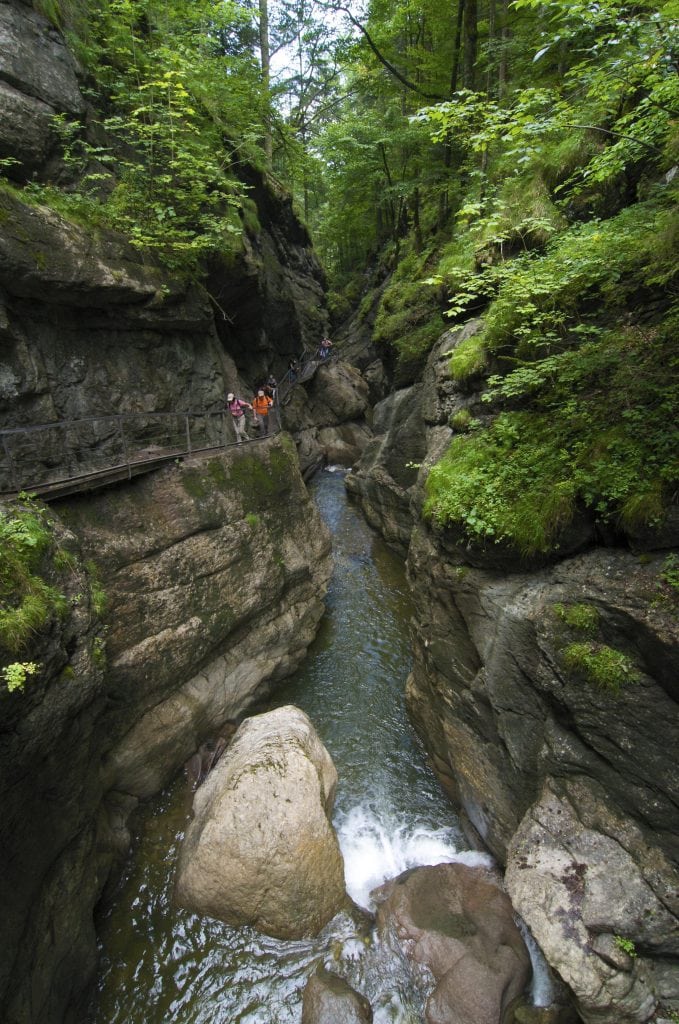
The gorge also has another special feature: In the height of summer, you can jump into the “Gumpen,” smaller basin-shaped water pools formed by the stream in the rocks. This gorge is also sometimes officially closed in winter–this can last until April.
Also interesting: The 29 Most Beautiful Natural Wonders in Germany
Wimbachklamm (Bavaria)
The Wimbachklamm in the Berchtesgaden National Park in Bavaria is only 200 meters long but is considered particularly romantic by hikers. The water flows through very narrow rock formations here, gaining speed. It roars and rushes as you walk over the wooden walkways and bridges.
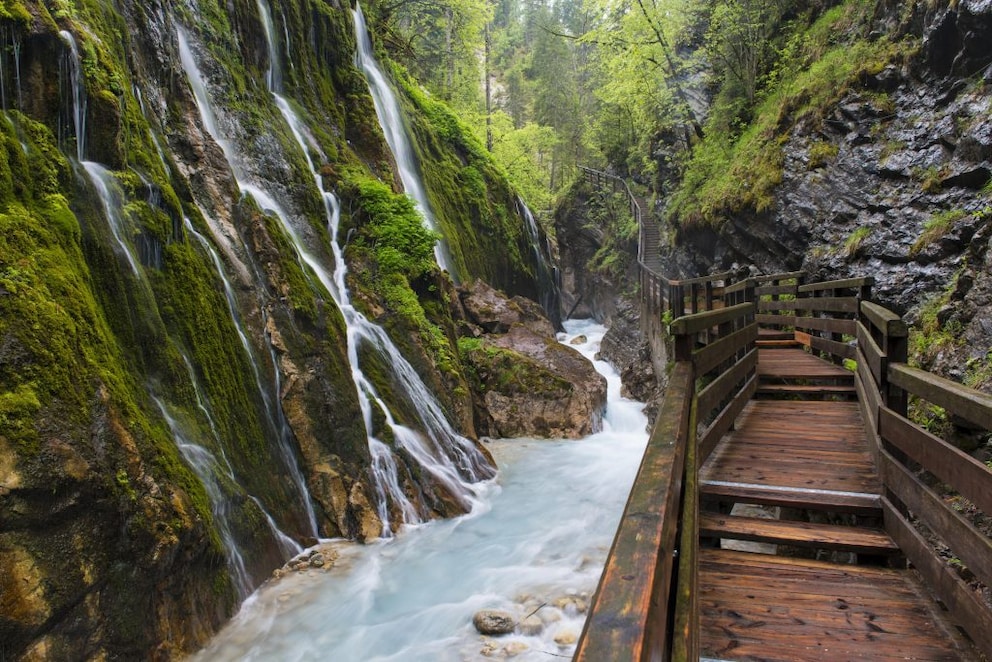
The rocks are steep and covered with moss, with waterfalls cascading down them. At the end of a tour, you can visit the Wimbachschloss, which belonged to the Wittelsbach family, or have dinner at the Wimbachhütte.
Drachenschlucht (Thuringia)
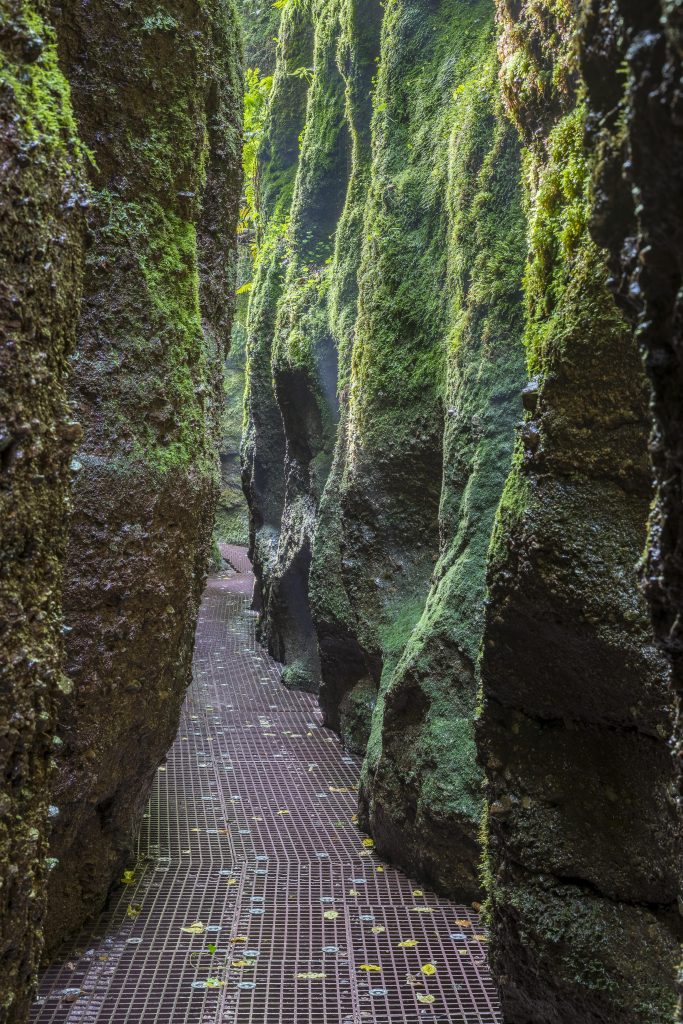
In this gorge south of Eisenach, you can literally walk on water–the path runs 200 meters along a grated walkway over a stream. According to the official website, the 10-meter-deep gorge is more than 250 million years old. You can explore it year-round on an 11-kilometer tour, but unfortunately, the path is not barrier-free. Additionally, the tour is probably not for those with claustrophobia: At its narrowest point, the Drachenschlucht is just 70 centimeters wide.
Ritterschlucht (Saxony)

If you want to climb the approximately 500-meter-high Oybin Mountain in Saxony, you should also plan a visit to the Ritterschlucht: According to “Geo,” it is located not far from the castle ruins on the mountain–all the more surprising that supposedly only a few tourists venture here, as the magazine writes. The path is easy to find, as it is clearly marked with a wooden knight as a signpost.