

May 21, 2026, 8:22 am | Read time: 4 minutes
Near the Chinese city-province of Chongqing lies a natural wonder of truly epic proportions. The Xiaozhai Tiankeng is the deepest sinkhole in the world, where even skyscrapers would disappear. But the truly astonishing aspect is the unique ecosystem that has formed at the bottom of this abyssal doline. It seems to follow its own set of rules.
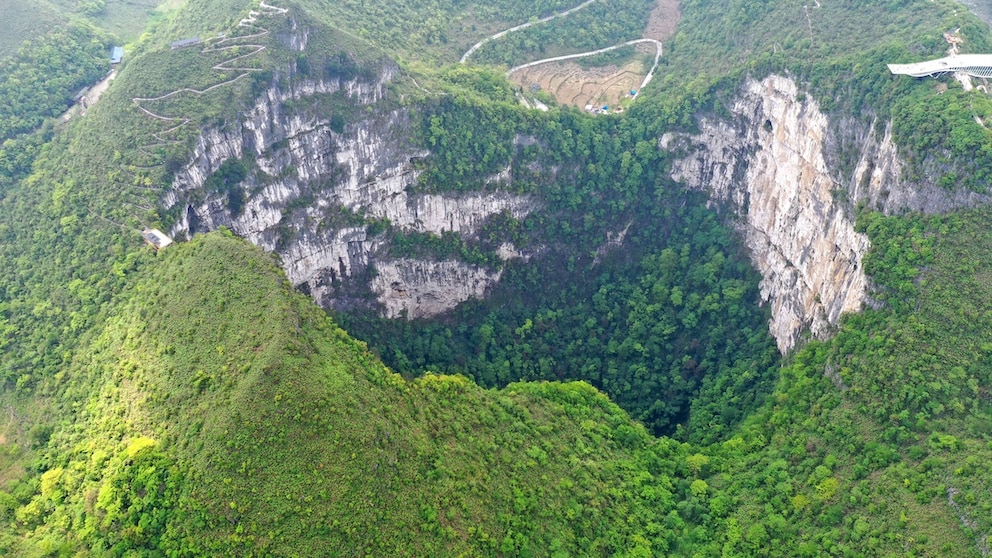
In southwest China, near the metropolis and city-province of Chongqing, lies perhaps the greatest natural wonder of this vast country. And that is meant literally, because among sandstone formations shaped by nature over millions of years, the Xiaozhai Tiankeng yawns as the deepest sinkhole in the world. More than half a kilometer deep and nearly as wide, the earth opens up here in a dizzying chasm. Almost no sunlight ever reaches the bottom of this crater. Yet a unique ecosystem has formed here, unmatched anywhere else in the world.
But let’s start from the beginning. A sinkhole, also known as a doline, forms when an underground cavity collapses due to erosion. In the case of the Xiaozhai Tiankeng, according to the BBC, this process likely took tens of thousands of years. Rainwater steadily eroded the porous sandstone, while a powerful underground river created massive caves and cavities. Then, suddenly, the earth collapsed, creating the enormous hole in the ground. Its dimensions are truly gigantic. It is 626 meters deep and 527 meters wide. That’s enough space to fit the Eiffel Tower twice or fill 40,000 Olympic swimming pools with water.
The Flora Functions Differently Here
Scientists have long been fascinated not only by the dimensions of the Xiaozhai Tiankeng but also by the unique ecosystem that has developed at its base. It’s like another world straight out of a fantasy film, where researchers described more than 1,200 plant species in a 2024 study in the Chinese Journal of Plant Ecology. They examined 64 of them and discovered something remarkable. The flora in the world’s deepest doline actually “functions” differently than comparable systems on the surface. The authors write in their study, among other things: “The leaves of the plants (…) contain less carbon but higher amounts of nitrogen, phosphorus, and other nutrients.”

Also interesting: The Gomantong Caves: Asia’s Grossest Tourist Attraction?
Specifically, this means that the flora in the Xiaozhai Tiankeng is far less frugal with the nutrients available to it than its counterparts growing elsewhere. As a result, the plants in the sinkhole grow considerably faster than usual. The conditions they encounter are more constant due to the unique location than in other places. The temperature is relatively stable, there is high humidity, and little direct sunlight. Scientists observed various survival strategies among the plants. Some even altered their leaf structures to better adapt to the given light conditions.
Discovered Only in 1994
Additionally, the soil in the Xiaozhai Tiankeng creates the special growth conditions that prevail here. Depending on the location studied, the nutrient composition in the soil changed significantly. This directly affects the nutrition of individual species as well as entire plant groups. It is a microcosm that operates according to its own rules. Due to the steep walls, the forest at the bottom of the world’s deepest sinkhole is isolated from the ecosystems on the surface. The name of the place is a combination of two terms. Xiaozhai is an abandoned village in the area, and Tiankeng means “Heavenly Pit.”
Also interesting: The deepest cave in the world in Georgia
Incidentally, according to the BBC, the Xiaozhai Tiankeng was “discovered” only in 1994. Locals had known about it for centuries, but it was then that a British team of cave researchers first attempted to map the massive chasm. An effort that failed five times over the course of ten years. The researchers simply did not dare to navigate larger sections on the rushing current of the still-flowing underground river. Thus, the world’s deepest sinkhole remains a world that likely holds more secrets than it has revealed so far.