

June 5, 2026, 11:58 am | Read time: 3 minutes
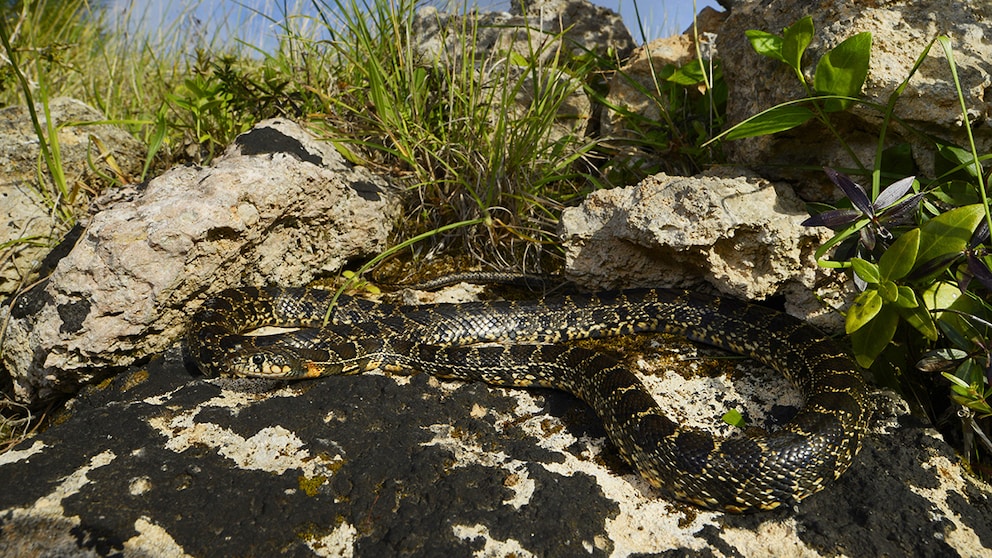
Snake alert on Mallorca and Ibiza! The so-called horseshoe whip snake, an invasive species, has been increasingly spotted on the Balearic Islands. Find out why they are spreading so rapidly and whether they pose a danger to humans here.
The horseshoe whip snake is spreading further on Mallorca, Ibiza, and even Formentera. The snake is not native to the Balearics but is now regularly seen on beaches or swimming in the sea, causing quite a stir among tourists. Videos frequently appear on social media showing the snakes causing a commotion on the beach.
Snakes Are Spreading on the Balearics
Horseshoe whip snakes are not native to the Balearics. So how did they get there? Researchers believe the snakes first arrived from the mainland about 20 years ago, likely hiding in the trunks and roots of olive trees brought over for decorative purposes. On the Balearics, the snakes found perfect conditions. The wall lizards, native mainly to Ibiza, did not recognize the horseshoe whip snakes as predators, leading to a significant decline in their populations.
The snakes, in turn, have thrived and can grow up to two meters long—200 percent larger than on the mainland, reports the “FAZ.”
Due to a lack of food, the horseshoe whip snake continues to spread. The animals are trying to reach new territories and sources of prey, which occasionally leads them into the water. According to researchers, the snakes can swim surprisingly well. This was first documented in April 2024, when a horseshoe whip snake was observed swimming from the east coast of Ibiza to the nearby island of Santa Eulària, a distance of more than 400 meters.
Characteristics of the horseshoe whip snake:
- black upper side, sometimes with a bluish sheen
- yellowish spots form a pattern
- move quickly
- up to two meters long
This Is the Most Venomous Island in the World

What Should I Do if I Encounter a Moose While Hiking?
Are Horseshoe Whip Snakes Dangerous?

Horseshoe whip snakes are not dangerous to humans, as they are not venomous and generally avoid contact. However, they can bite if they feel threatened or are handled. Tourists generally have no reason to worry.
The situation is much more dramatic for the native wall lizard. As mentioned, their numbers have significantly declined or even disappeared because they have no natural defense strategies against the snakes. This could become problematic in the future, as the lizards play a crucial role in maintaining the region’s ecosystems.
Oriol Lapiedra, a biologist at the Center for Ecological Research and Forestry Applications in Catalonia, explains in “The Guardian” that the animals help regulate insect populations, including agricultural pests. According to the expert, everything would change if the lizards disappeared. They are also responsible for pollinating flowers and dispersing seeds.
Government Takes Action Against Invasion
The regional government of the Balearics is trying to combat the spread of the invasive horseshoe whip snakes. Measures are set to be intensified in 2026, with plans for more traps and closer monitoring of affected coastal areas. Additionally, there is a conservation program for the endangered wall lizards to secure the threatened population.