

September 27, 2025, 12:46 pm | Read time: 5 minutes
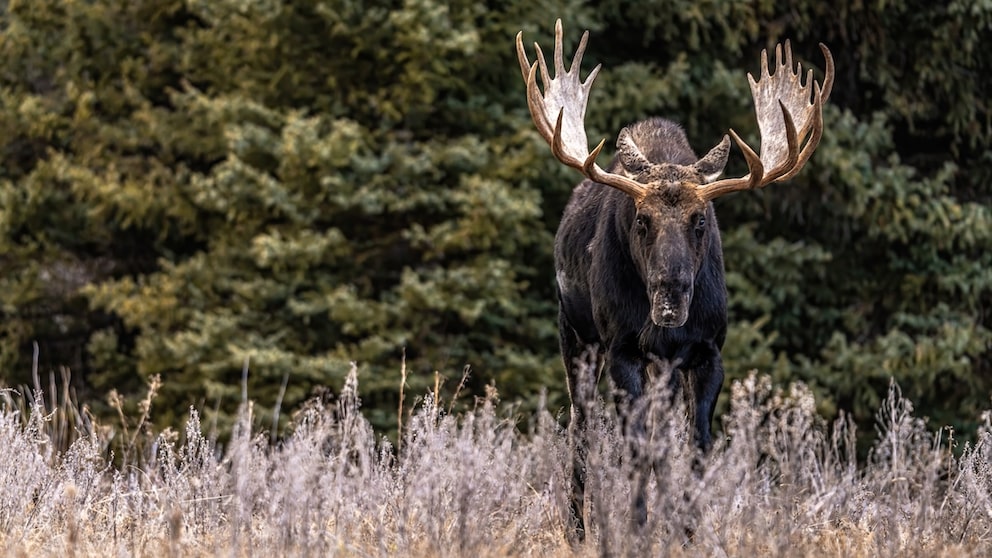
The majestic animals generally avoid contact with humans—yet unexpected encounters with moose can occur. And it’s not so unlikely: The solitary creature often wanders out of its usual territories in search of mating opportunities or new habitats. What this entails and how hikers should behave when encountering a moose—TRAVELBOOK provides insights and consulted an expert.
The moose is the largest and heaviest member of the deer family. According to the “WWF,” it can reach a shoulder height of 2.10 meters and weigh up to 600 kilograms. A potential fight would definitely end in defeat for a human. But rest assured: Moose are herbivores and spend most of their time foraging rather than hunting prey. With their keen sense of smell, they can accurately locate both the direction and distance of an object. However, due to their size and weight, moose have few natural enemies and typically do not flee when encountered, instead holding their ground or attacking only if threatened.
Encountering a Moose—Correctly Interpreting Warning Signs
Jenifer Calvi from the German Wildlife Foundation knows what to do if you suddenly encounter a moose. In response to TRAVELBOOK’s inquiry, she explains: “First of all, you can admire the animal from a safe distance, as you don’t see a moose every day. Then you should continue on your way. As impressive and peaceful as moose appear, they can become dangerous if they feel threatened.” There are important points to consider: “Basic rules are: keep your distance, stay calm, don’t block the animal’s path, and under no circumstances feed it. It’s best to slowly retreat and avoid sudden movements.”
According to “Animals Around The Globe,” a distance of at least 15 meters is recommended. If the moose has its ears laid back, neck hair raised, and head lowered, it is already agitated. If it licks its lips, it’s too late: It is signaling an attack. Moose are lightning-fast and can run up to 56 kilometers per hour. However, it doesn’t always intend to actually attack—it could be a “mock charge,” where the moose rushes forward a short distance, then stops to test you.
These tips help avoid unnecessarily provoking the calm-appearing moose:
- Avoid direct eye contact
- Don’t turn your back
- Speak calmly to identify yourself as a human, not a predator
- Keep dogs away from moose because they resemble wolves
If an attack does occur, endurance is key when running away. Moose quickly lose interest and never chase for long. Another useful tip: Run in zigzag lines, as this can cause the moose to stumble.
Also interesting: How to Behave When Encountering Cows While Hiking
Pay Attention to the Season
There are certain seasonal times of the year when moose are particularly aggressive. This includes the mating season between September and October, during which the testosterone levels in bull moose rise. The large antlers of the males can be especially dangerous. In spring, it’s calving time for cow moose, and they protect their calves. This also makes them more prone to aggressive behavior, so one should be even more cautious during an encounter. Once a calf is spotted, the mother is not far away.

How to Behave When Encountering Cows While Hiking

Map Shows Where Most Shark Attacks Occur Worldwide
Can I Expect Moose in Germany?
“Large populations exist in North America, Scandinavia, Russia, the Baltics, and also in Poland, with a somewhat smaller one in the Czech Republic. From Poland or the Czech Republic, individual moose—often young bull moose looking for their own territory—migrate across the border into Germany,” says wildlife expert Calvi.
Moose “Bert” is the first wild moose in Germany, having migrated from Poland to Brandenburg in 2018 and joined a herd of cows. “Most animals, however, migrate back, and there is no permanent population here. Only moose ‘Bert’ has been living in a nature park in Brandenburg for several years now,” Calvi adds. He now wears a GPS transmitter for research purposes and is even one of the most closely studied moose in the world. Encounters with moose are also increasing in Mecklenburg-Vorpommern, Saxony, and Bavaria.

Another emigrant moose is “Emil”—he recently became a true media star after repeatedly appearing in Austria. As “ZDF heute” writes, the moose likely originated from Poland or the Czech Republic and migrated from there to Austria. Many people excitedly followed his weeks-long strolls through populated areas. He has since been relocated to the Czech Republic and also wears a GPS transmitter.
In Search of True Love
The reason bull moose often migrate long distances is usually to find their mate. They can cover up to 80 kilometers a day. And not just on land! “Surprisingly, these large wild animals are excellent swimmers. They can swim several kilometers, dive up to five meters deep, and stay underwater for several minutes. Their long nose serves as a kind of snorkel,” explains wildlife expert Calvi.