

November 26, 2023, 3:25 pm | Read time: 4 minutes
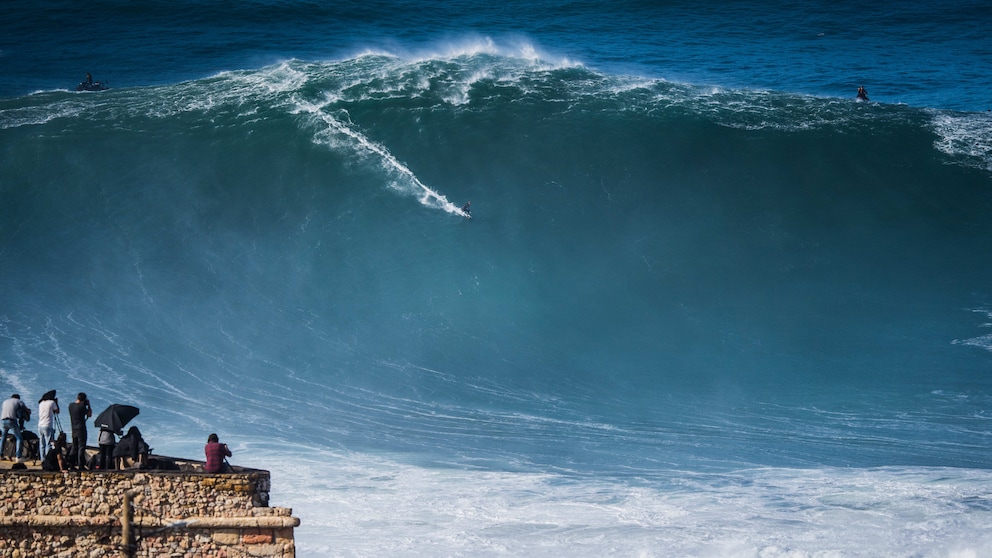
26.21 meters–that’s how high the wave was that German Sebastian Steudtner surfed down at 80 km/h in Nazaré in October 2020. The 37-year-old still holds the official Guinness World Record for it. No one has ever surfed a higher wave before or since. But how do the giant waves of Nazaré actually form?
Giant waves over 30 meters high are not uncommon in Nazaré, Portugal. The beach with the monster waves is legendary but also feared. Surfers often get injured riding the mega-waves, and for some, the ride has even been fatal. Just earlier this year, the well-known surfer Marci Freire lost his life in a giant wave in Nazaré.
Surf Records Keep Being Set in Nazaré
Brazilian Maya Gabeira also knows how dangerous the giant waves can be. In 2013, she had a severe fall during a world record surfing attempt. Fortunately, she was revived. In 2020, she finally broke her own surfing record in Nazaré by conquering a 22.40-meter wave. It was the largest wave ever surfed by a woman. Gabeira had already set a world record in Nazaré, Portugal, in 2018 with a giant wave over 20 meters high.
She wasn’t the first–records for the highest surfed wave in the world have often been set here. Giant waves over 30 meters are not uncommon in the Portuguese town. Even pro surfers like Hugo Vau and Garrett McNamara have already conquered Portugal’s so-called “Big Waves.”
On October 29, 2020, Sebastian Steudtner finally conquered a giant wave of 26.21 meters, for which he received a Guinness World Record entry on Tuesday, May 24, 2022.

Portugal’s Praia De Matosinhos Is One of the Most Extraordinary Urban Beaches in the World

11 of the Most Beautiful Beaches on Bali
How Do the Giant Waves of Nazaré in Portugal Form?
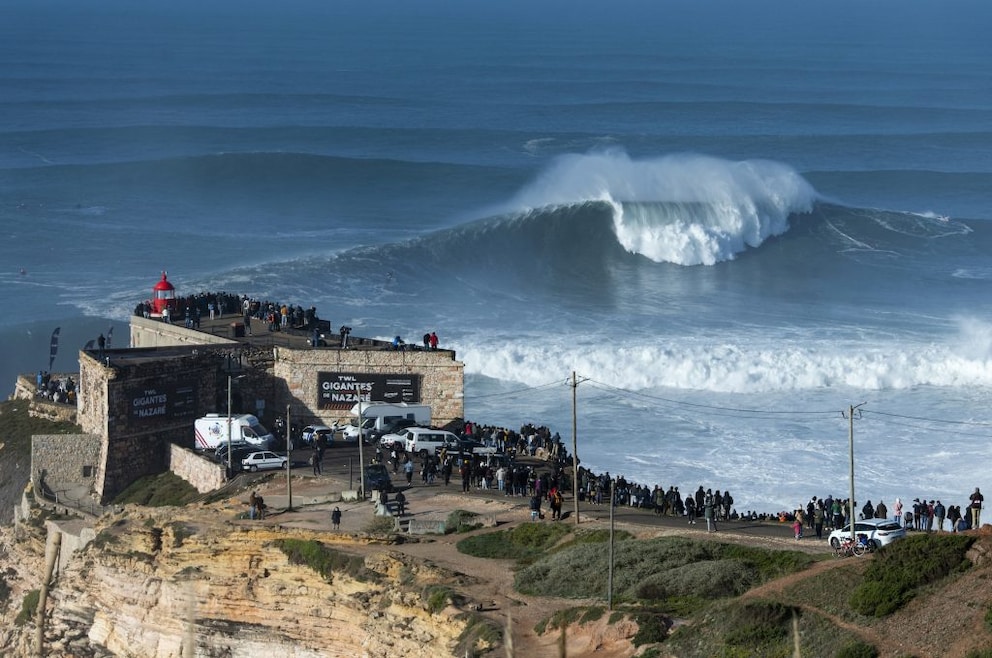
Winter is the season of skyscraper-high giant waves in Nazaré, Portugal. During this time, surfers and spectators flock to the small town on the Atlantic. There, they can watch the water giants and their seemingly tiny conquerors up close. From a safe distance, spectators stand on the dunes or at the lighthouse, which rises on a small fortress over the water. The wave watchers see the masses of water roll in with deafening noise, slowly build up, break at their peak, and then crash as white water spray onto Praia do Norte beach.

Also interesting: The 20 Most Beautiful Beaches in Portugal
What wave enthusiasts don’t see is what happens beforehand. The factors that come together to build the giant waves are unknown to many. The Hydrographic Institute (HI) in Lisbon explains that the phenomenon of the Portuguese monster waves is a combination of several mechanisms. Just a few hundred meters off the coast of the town of Nazaré lies the deep-sea trench Nazaré Canyon. With a length of 170 kilometers and a depth of about 5,000 meters, the canyon plays a crucial role in the formation of the giant waves.
Canyon in the Ocean as the Source of the Giant Wave
The water on the continental shelf is comparatively much shallower. The depth difference alters the speed and direction of ocean currents. Different zones form where the wave converges, as the HI writes. “This process seems to be particularly effective during the prevailing northwest and west swell periods in the area off Praia do Norte,” the institute explains. Since the wave is generated near the coast, the current from the local water channel acts as an “additional mechanism” on its height. When perfect wind speed and direction are added, 20 to 30-meter-high water walls form. With such a sight, it’s no wonder the Portuguese coastal town attracts so many spectators.
Also interesting: The Interview by Our Colleagues at FITBOOK with U.S. Surf Pro John John Florence

The Nazaré Canyon was discovered thousands of years ago. According to the Hydrographic Institute, it was considered an “unfathomable abyss” in ancient times. It wasn’t until the early 20th century that researchers took on the deep-sea trench and conducted the first measurements. That’s why we know today not only about the size of the canyon but also how these giant waves in Portugal form. This knowledge is also essential for the big-wave pros who regularly set new world records in Nazaré.
