

May 5, 2026, 8:32 am | Read time: 5 minutes
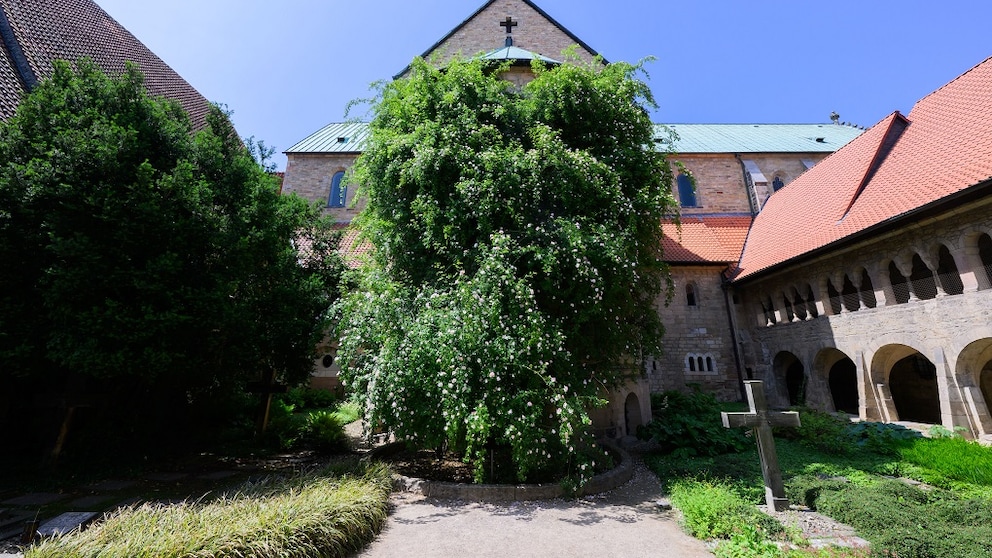
St. Mary’s in Hildesheim, with its cathedral treasure, is one of the most beautiful and significant churches in Germany. Yet every year in early summer, tourists flock here to see another attraction located on the church grounds: the bloom of a plant that the media and the Diocese of Hildesheim itself call the “thousand-year-old rosebush.” A legend surrounds its origins.
Anyone visiting the Lower Saxon city of Hildesheim will likely want to see St. Mary’s Church, whose origins date back to the 9th century. With its impressive cathedral treasure, it has been part of the UNESCO World Heritage, along with St. Michael’s Church, since 1985 and it impresses with its majestic architecture. But once a year, people from Germany and around the world make a pilgrimage to the cathedral to admire the bloom of a rosebush, often described in the media as the oldest in the world. Moreover, the plant has been an unofficial symbol of the city for 80 years, thanks to a story that many locals consider a miracle.
Although its exact age has never been proven, even the Diocese of Hildesheim, to which the cathedral belongs, refers to the plant on its official website as the “thousand-year-old rosebush.” Its origins are said to be linked to a legend that also involves the founding of the church and the city itself, taking us back to the 9th century. A spokesperson for the diocese recounts the beautiful story upon TRAVELBOOK’s request: “In 815, Emperor Louis the Pious, son of Charlemagne, is said to have rested at the site where Hildesheim is now located, possibly while hunting.” According to the tale, a significant mishap occurred during this time.
Divine Sign
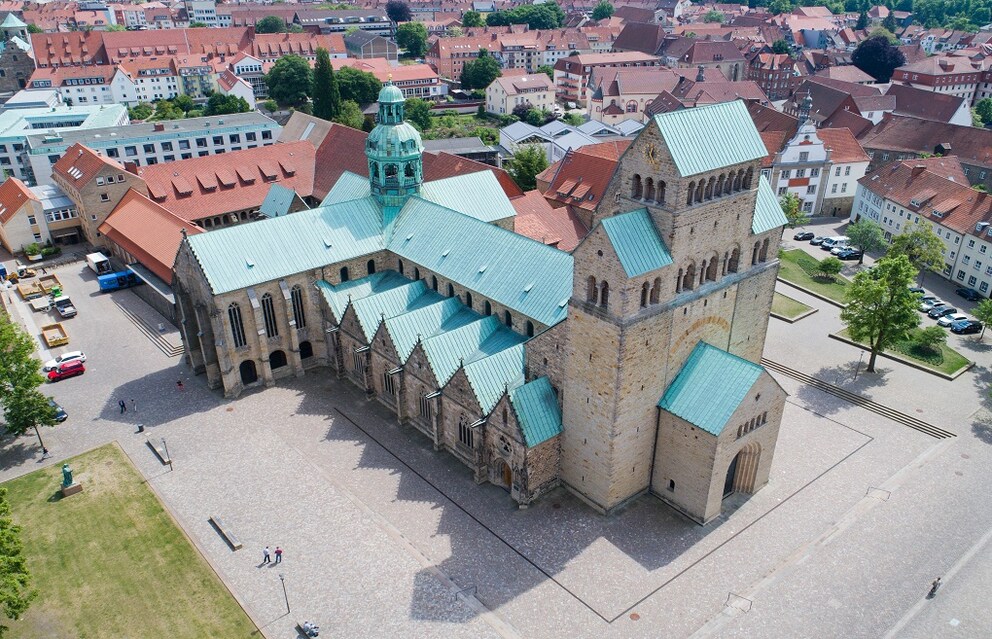
“Someone from Louis’s entourage reportedly forgot a precious reliquary upon departure. It had been hung on a rosebush during an impromptu mass. When this was noticed, the group hurried back. However, the artifact could no longer be removed from the thorny thicket.” Louis interpreted this as a divine sign and ordered the construction of a chapel in honor of the Virgin Mary at the same spot. Over the centuries, this original house of worship evolved through expansions and renovations into the cathedral we know today. Thus, the Diocese of Hildesheim was born, and the surrounding area developed into a town, which received city rights in 1249.

“The fact is that the history of the Diocese of Hildesheim begins in 815. Today, it is the third-largest in Germany by area.” At the apse of the current cathedral, surrounded by a double cloister, one can admire the now six-meter-high rosebush. “A botanical examination of the plant revealed that it must be several hundred years old.” But could it really be the oldest rosebush in the world, as is often reported online? “You won’t hear such superlatives from us. We simply call it the ‘thousand-year-old rosebush.’ And if it’s true that it existed during the time of Louis the Pious, it would be even older.”
The Miracle of Hildesheim

However, the fact that this rosebush still exists is seen by many in Hildesheim as a divine sign. On the night of March 22, 1945, the city was heavily bombed by Allied forces. The cathedral burned to the ground. “Only eight weeks after the catastrophe, new shoots of the rose sprouted from the rubble. For the city’s residents at the time, this was an incredible symbol of hope. It gave them strength and courage. For many, it was nothing short of a miracle. Especially older citizens still get teary-eyed when discussing the topic today.”
All the more reason to ensure the rosebush is always well cared for. A horticultural company is responsible for the maintenance and pruning of the robust plant, which is actually an ordinary dog rose. Every year, around late May or early June, countless people are drawn to the cathedral in Hildesheim to witness the bloom of the miracle rose. “It’s always a highlight that attracts visitors from far beyond Germany’s borders.” During the approximately two-week blooming period, tourists arrive by the busload, as reported by “WELT” (also part of Axel Springer). “The rose has become something of a symbol of the city. Media frequently report on it, and the city’s marketing naturally uses it as well,” the spokesperson said.
Anyone who wants to see what might be the oldest rosebush in the world with their own eyes has the opportunity to do so year-round. Whenever access to the cathedral foyer is open, the plant can also be viewed. It is located on the cemetery grounds. And, of course, during a visit, one can also admire the cathedral treasure and precious church relics for which St. Mary’s is known.