

December 14, 2025, 6:26 am | Read time: 9 minutes
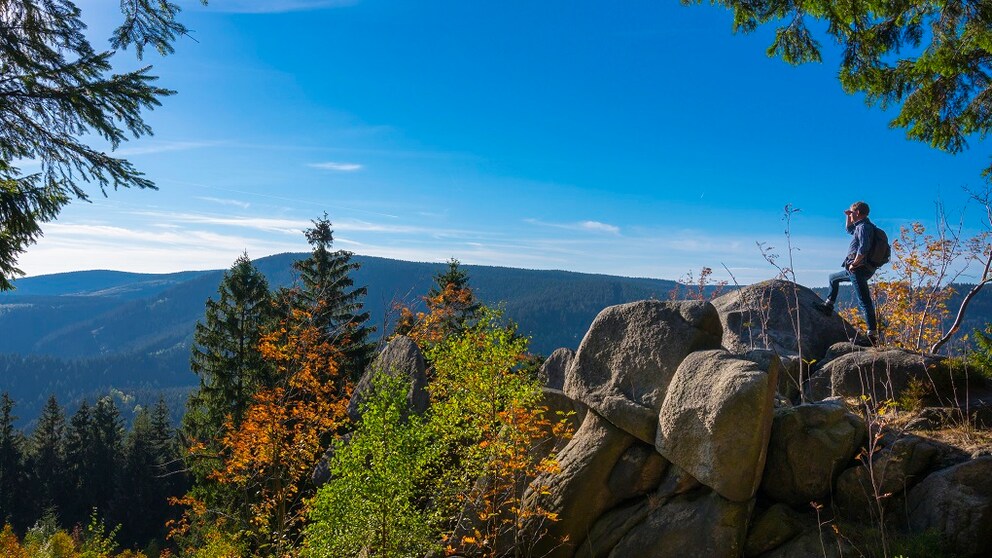
Often traversed by picturesque rivers, it is the valleys in the Harz that give the region its unique character. Some of them are true magnets for nature lovers and hikers, while others remain genuine hidden gems. TRAVELBOOK author Robin Hartmann has been captivated by the beauty of the Harz landscapes for years and has explored some of the most beautiful and wildest valleys in the Harz for you.
And suddenly, they are there—the faces in the stones. On this cold, gray November day, when the fog is so thick that you can barely see five meters ahead, I find myself at one of the most beautiful and mysterious places in the entire Harz. The Celts likely used the Steinmühlental as a cult site, as with a bit of imagination, you can indeed recognize stone faces in the steep, rugged rocks around me. Awe follows goosebumps as I slowly make my way through the fog along a stream running on both sides of the path. And once again, my heart beats faster because I am outside, hiking, free.
The Steinmühlental is just my latest discovery, as for me, it is also and especially the valleys in the Harz that give the uniquely beautiful landscape its special character. Some are gentle, others wild and untamed, making you feel like an explorer. In the eight years I have been hiking in the Harz, my tours through the valleys have often left a lasting impression. Today, I want to take you on a mental journey through some of them, so that you too might soon venture into the sensationally beautiful nature of the Harz. Our journey begins in the small town of Rothesütte, in the absolute middle of nowhere.
Mystical Rocks
My girlfriend and I originally planned to visit a viewpoint called Drei-Täler-Blick, but due to the fog, even I had to admit that it would make little sense. Instead, my girlfriend suddenly exclaimed in delight that I should stop the car. It was in front of the restaurant-café “Kaminstube,” which turned out to be a great find. One of those places that can make an outing special. Inside, a very cozy fireplace was burning, and the fresh local dishes and coffee were absolutely excellent. So good that I bought two pieces of the wild boar aspic from the hostess to enjoy at home.
This typically quirky Harz local also recommended a hike through the Steinmühlental as the fog began to clear. After a short walk through the forest, a wide, tree-lined plain opened up before us, which we simply crossed off-trail—the signage here is quite sparse, so we soon strayed from the “official” path. But soon, the aforementioned mystical rocks rose to our left and right. Especially in this weather, it’s an experience that helps you understand the Celts’ reverence for the valley. On the entire eight-kilometer route, we encountered only three other people.
Also interesting: The wild Bodetal in the Harz
Hiking in Every Season
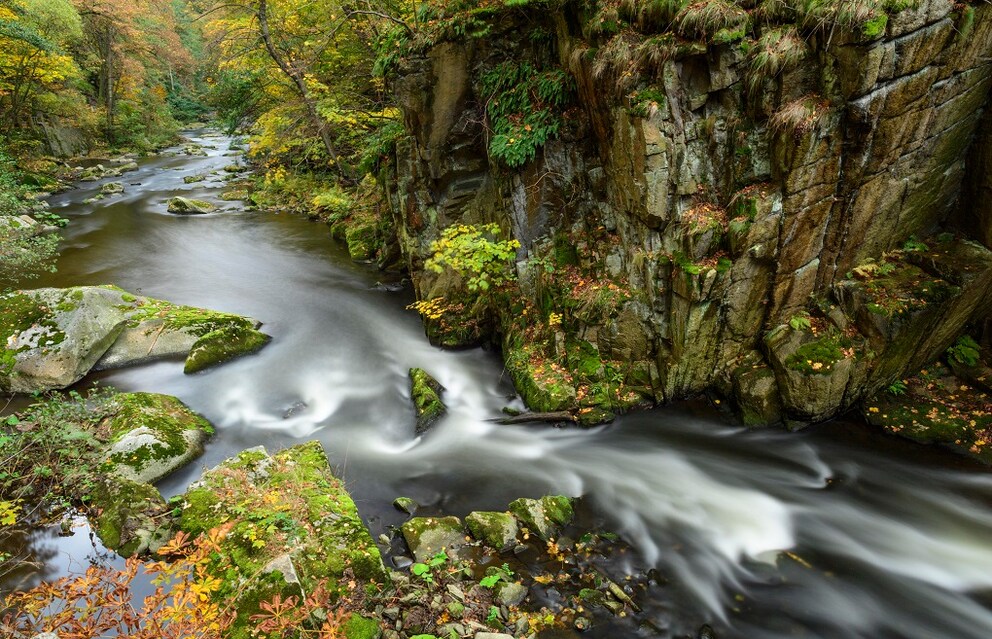
The hike through the Bodetal, the largest, deepest, and undoubtedly most famous gorge in East Germany, is usually much busier. Even the poet Goethe visited it, as did the explorer Alexander von Humboldt. It is most easily reached from the town of Thale, which is also served by Deutsche Bahn. Up to the Königsruhe inn, the route follows wider, flat paths along the Bode River, which gives the valley its name. Beyond that, it becomes wilder, with the paths sometimes narrower and more challenging. Sometimes the Bode rushes through narrow gorges like a wild stream, sometimes it meanders broadly and leisurely along the path.
In about two and a half hours, you can cover the roughly 10-kilometer stretch from Thale to Treseburg. I have walked this route in every season, each offering its own unique charm. In spring, wildflowers and wild garlic bloom beautifully along the path; in autumn, a keen-eyed hiker might find porcini mushrooms. In summer, you can cool your feet in the river, and in winter, with a bit of luck and patience, you might spot wild mouflons on the slopes. However, in this season, you must also pay attention to the weather, as cold can cause rockfalls in the Bodetal. Sometimes the valley is even completely closed.
Hiking Through History
If you wish, you can extend your tour along the Bode through the villages of Treseburg and Altenbrak. It’s worth it because the former boasts perhaps the most beautiful beer garden in the entire Harz, belonging to the “Pension Sternschnuppe.” In Altenbrak, you can enjoy fresh fish at the Zordel trout farm or visit “Café Fontane,” which not only serves good food but also rewards you with a unique view of the town and the vast landscape. Just one more steep climb away is the “Forsthaus Todtenrode,” which sells homemade meat and game specialties that are unmatched in quality and price.
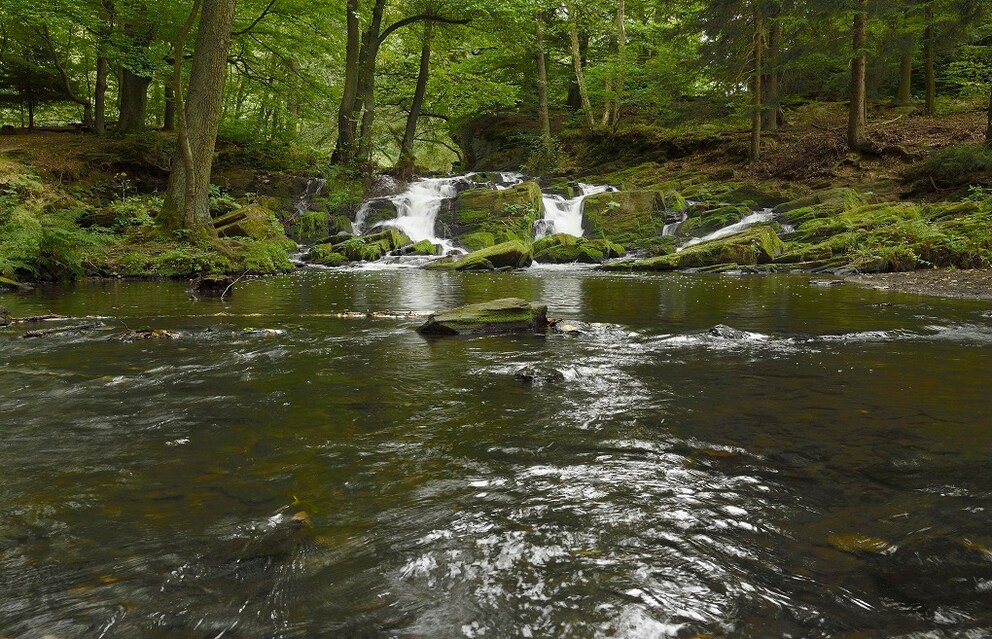
From Thale, you can also reach the equally beautiful Selketal on foot. Also named after the river that flows through it, hikers can easily spend several days exploring here. Along the clear spring, there is even a nature trail for young hikers. And adults can truly disconnect, as there is little to no cell reception in the area. Along the route, numerous castles and palaces await, such as Falkenstein Castle. Still an impressive fortress today, it was here that a piece of German history was written, accessible via a very steep ascent.
Also interesting: The little-known beauty of the Okertal
The “Harz Atlantis”
And that is meant literally, as the nobleman Eike von Ragow wrote the so-called “Sachsenspiegel,” the most important German legal work of the Middle Ages, at the castle. The Anhalt castle ruins are also worth the strenuous climb. Along the route, you will see numerous testimonies to the centuries-old mining history in the Harz. Near the town of Mägdesprung, a climb to the Köthener Hütte viewpoint is worthwhile. Of course, the valleys in the Harz are particularly impressive and beautiful when viewed from above. Highlight: If you wish, you can also traverse the Selketal with the Harz narrow-gauge railway. The fare is even included in the Germany ticket.
You can also spend several days hiking through the particularly wild and lonely Okertal. One possible tour starts in Goslar and leads through places like Schulenberg and along the Okertalsperre, where even ships operate. The construction of the dam caused the old Schulenberg to sink into the floods, which is why it is sometimes referred to as “Harz Atlantis.” In the unincorporated area of Romkerhalle, there are two attractions to explore. Namely, the highest waterfall in the entire Harz, created by an English royal, and the self-proclaimed “smallest kingdom in the world,” a former hunting lodge of the monarch, now a quirky hotel.

The Most Beautiful Rivers and Waterfalls in the Harz

Spectacular Bodetal Hiking Trail in the Harz Fully Accessible Again
Through the National Park
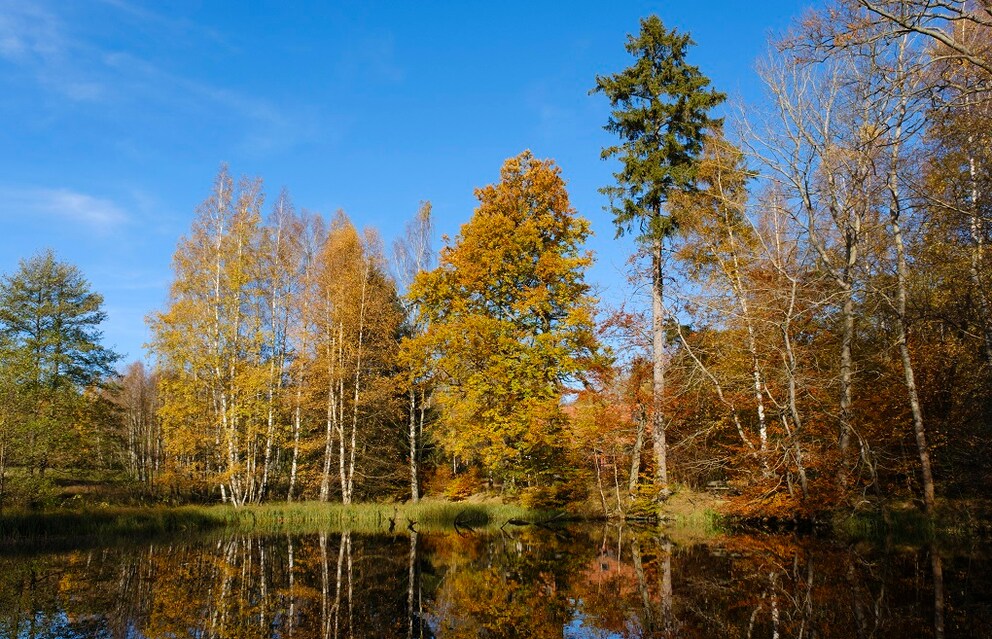
From the Treppenstein or the Kästeklippen high above the Okertal, after a strenuous climb, you have a unique panoramic view of the land. Just like from the Wolfswarte near Altenau, an almost 1,000-meter-high Bruchberg. If you wish, you can also stop in the historic mining town of Altenau. Of the numerous restaurants, the “Klippengrill” is the best; you can stay relatively cheaply and well at the “Hotel Engel.” A visit to the beautiful “Heißer Brocken” spa is almost a must, where you can relax in one of the many saunas or soak in hot brine healing water.
Not only great nature but also a piece of our country’s history awaits hikers in the Eckertal. Like all the previous valleys, it is named after the river that flows through it, running right through the Harz National Park. If you wish, you can start from Schierke with a challenging tour over the Wurmberg, the second-highest peak in the Harz. The descent then quickly leads to the Eckersprung, the source of the river. Following it, you reach the Ecker reservoir. Until 1989, the inner-German border ran right through it, significantly complicating its operation. You can still see the demarcation stones with the inscription “DDR” on the dam wall.
Also interesting: The most beautiful alternatives to the Harz National Park
Waterfalls and Healing Springs

You can extend your day hike from here through the Radautal to the Radau Waterfall, a beautiful cascade that unfortunately lies right next to a highway today. For me, it is still the most impressive waterfall I have seen in the Harz. It is a detour, but hungry hikers can also reach two great inns along this route for a possible stop. One is the “Molkenhaus” with its large (beer) garden, where wildlife feedings also take place from December. But my favorite is the “Rabenklippe” inn with its hearty homemade specialties. In an adjacent large enclosure, you might be lucky enough to spot lynxes.
And you are almost in Bad Harzburg, where two more valleys await hikers in the area of the steeply sloping town. One is the Krodotal, which offers great views over the town. And then there’s the Kalte Tal, through which the famous treetop path of Bad Harzburg runs. Especially in the golden hues of autumn, it offers an unforgettable walk. For young guests, the scavenger hunts at various stations along the roughly one-kilometer-long route are exciting. Fed by nine healing springs, the town was especially popular as a spa resort in the past. The soothing water can also be enjoyed in the local brine spa.
However, my discovery of the year was the Innerstetal and the small fairy-tale town of Wildemann located there. It also calls itself Little Tyrol and is sensationally nestled in steep, densely forested slopes, even for the Harz. It was pouring rain, and I took refuge in the lovingly run “Café am Bohlweg.” There, I not only enjoyed a fabulous aspic with fried potatoes but also got the local gossip from the entire village, which was also present. I am amazed myself, but I have hiked and/or newly discovered all the valleys described here in 2025. I can hardly wait to see what the new year in the Harz will bring for me.