

December 23, 2022, 3:51 pm | Read time: 4 minutes
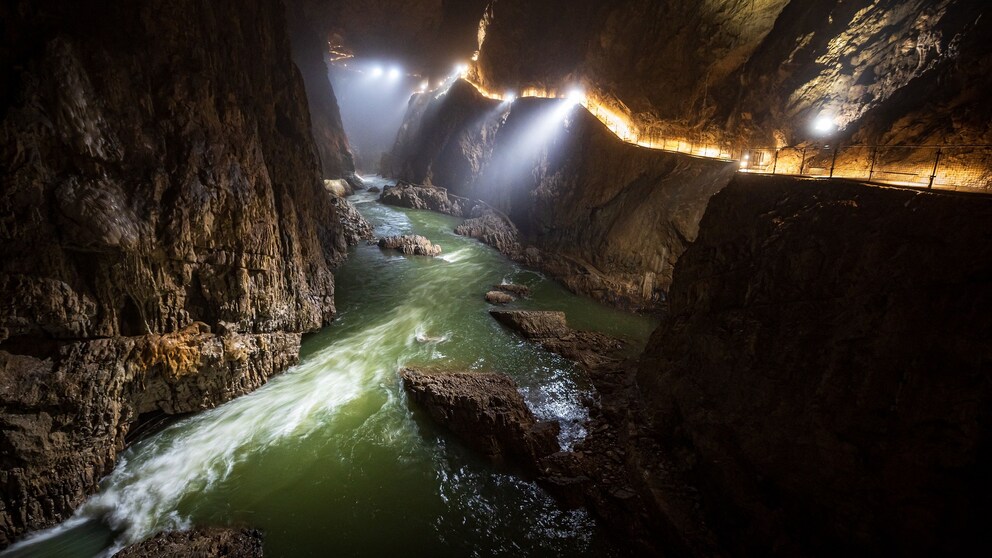
In southwestern Slovenia lies one of Europe’s most beautiful natural wonders. The Škocjan Caves were impressively shaped by a river that flows through them. This also created the world’s largest underground canyon, now referred to as Slovenia’s “Grand Canyon.”
To visit Slovenia’s greatest natural wonder, one must venture underground. Nestled in the UNESCO World Heritage-protected Karst landscape of Kras, the Škocjan Caves are located in the country’s southwest. This several-kilometer-long system of underground tunnels and halls boasts a truly spectacular superlative. Here, hundreds of meters below the earth, lies the largest subterranean canyon in the world.
Often called Slovenia’s “Grand Canyon,” this is one of the many Škocjan Caves that form an extensive underground network. According to the official site of the location, it is 3.5 kilometers long, up to 60 meters wide, and up to 140 meters deep. Its name, the Rushing Cave, is also quite fitting. It comes from the Reka River, which runs underground here and has significantly shaped the cave network. Over millions of years, its water has carved into the soft sandstone, creating the bizarre formations that tourists from around the world admire today.
One of the Largest Caves in the World
Of course, the “Grand Canyon” is the biggest attraction for visitors to the Škocjan Caves. But they also offer other truly impressive sights, such as the Martel Hall, the largest of all the caves here. With a volume of 2.3 million cubic meters, it is not only one of the largest in Slovenia but also in the world. It is up to 146 meters high, 300 meters long, and 120 meters wide. Other “rooms” like the Velika Dvorana, the “Great Hall,” are true natural wonders as well.
Also interesting: The Gomantong Cave: Asia’s Grossest Tourist Attraction?
Visitors are almost incidentally amazed by the massive stalactites that time and water have formed in the Škocjan Caves. The largest of them, the “Giant,” stands 15 meters tall. In the over six-kilometer-long system of passages and caves, there are also 26 waterfalls up to 30 meters high. This underground world has also produced a unique and rare flora and fauna. Among others, cave salamanders, several species of bats, as well as crabs and insects, live in the caves.
Ancient Cult Site
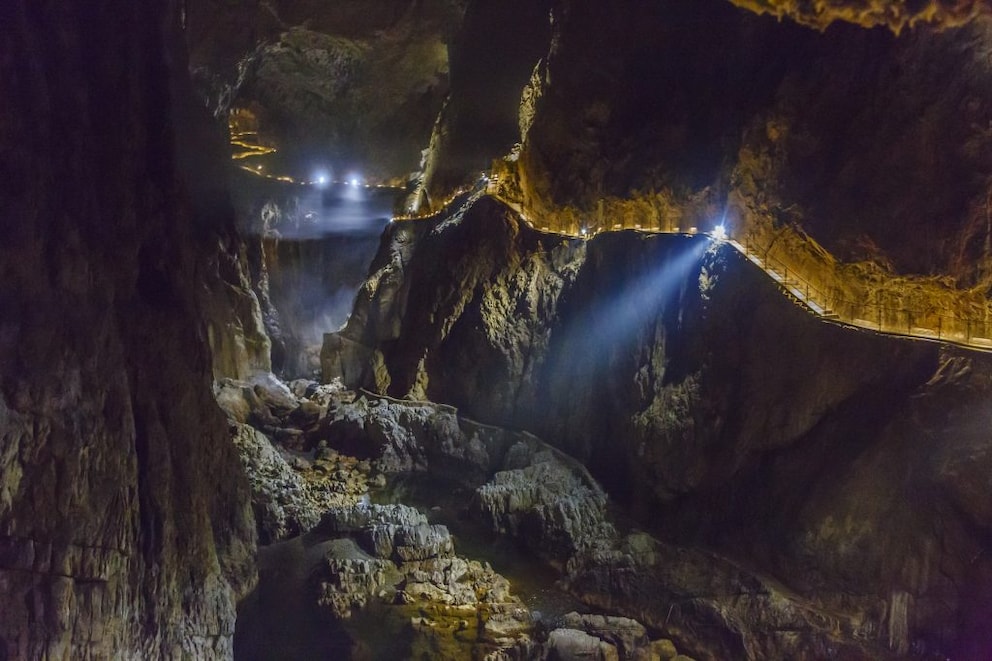
Given their archaic dimensions, it is not surprising that the Škocjan Caves were an important cult site for people from the entire Mediterranean region thousands of years ago. Archaeological finds show that guests from as far as Italy, the Balkans, and Greece attended the sacrificial ceremonies held here. As early as three millennia ago, the nearby village of Škocjan was an early cultural and spiritual center. Around 60 B.C., the Greek scholar Posidonius of Apamea first mentioned the caves in writing. Since then, they have fascinated countless generations.
The first tourism around the Škocjan Caves began in 1823 when paths to the site’s natural wonders were first established. Since 1819, there had been a guestbook here, but only a few hundred people visited each year. In 1884, the German-Austrian Alpine Club leased the caves and began organizing tours. Since 1986, the site has been recognized as a unique natural wonder and a UNESCO World Heritage site, holding several other protection statuses.
Also interesting: Mammoth Cave in Kentucky: The Longest Cave in the World
Today, visitors can choose between two underground routes. Those who want to explore the Škocjan Caves extensively can take a five-kilometer route. The approximately three-hour tour also involves overcoming about 1,000 steps. The shorter route includes three kilometers and up to 800 steps. Opening hours and entrance fees vary by season. For example, the caves are open longer in the summer, but admission costs more, up to 24 euros for an adult.