

March 4, 2026, 10:48 am | Read time: 4 minutes
Near the Saarland capital of Saarbrücken lies a unique natural phenomenon in Germany: the so-called Burning Mountain. The rock formation gets its name from an underground coal seam fire that has been smoldering for centuries. Occasionally, smoke still rises from the ground, making the site a small tourist attraction. A famous German poet may have sparked this interest.
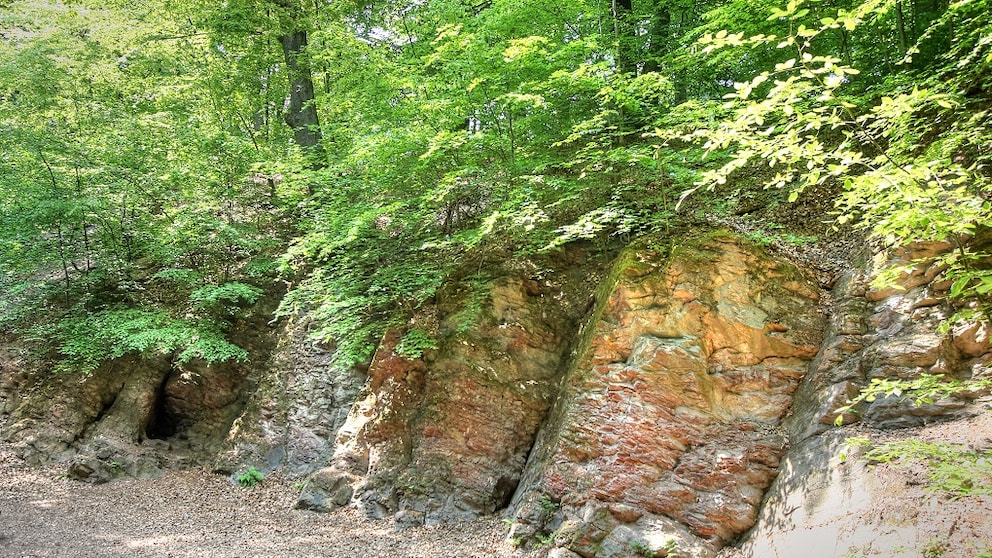
Anyone hiking around Saarbrücken between the Dudweiler district and the town of Sulzbach can witness a unique natural phenomenon in Germany. Along a well-marked themed trail lies the Burning Mountain. It is named for the underground coal seam fire that has been smoldering for several centuries. No one can say how this event originally occurred. Yet visitors sometimes see sulfurous smoke rising from the earth’s interior. And if you place your hand on the rock, you might even feel the warmth emanating from the still-active fire.
Various online sources, such as the official tourism site of Saarbrücken, cite the mid-17th century as the most likely starting point for the underground fire. Some even specifically mention that the Burning Mountain ignited in 1668. According to tradition, a shepherd’s fire, while camping nearby with his flock, may have led to the ignition and the smoldering fire that is still active today. The site got its name due to the strong smoke development that lasted at least a century. Through cracks in the rock, the subterranean glow was reportedly visible.
Distinguished Visit
Initially, the population tried to extinguish the smoldering fire underground. But soon, the Burning Mountain proved to be a treasure trove in the truest sense. The slate layers over the burning coal seam were naturally roasted by the heat. This process produced alum, a much more valuable raw material than slate. At the time, alum was important in medicine, paper production, as well as tanning and dyeing. Its extraction continued until nearly the mid-19th century. Today, alum can be produced artificially.
The fact that the Burning Mountain was an early tourist attraction is evidenced by a distinguished visit in 1770. None other than the poet prince Johann Wolfgang von Goethe visited the phenomenon, which is now protected as a natural monument. He wrote about his impressions on-site, saying: “We entered a gorge and found ourselves in the region of the burning mountain. A strong sulfur smell surrounded us; one side of the cave was almost glowing, covered with reddish, white-burned stone; thick steam rose from the clumps, and you could feel the heat of the ground even through thick soles.”
Tours to the Burning Mountain

In 1990, a plaque was installed on-site to commemorate Goethe’s visit. However, those searching for a mountain on their tour might walk right past the natural phenomenon. In reality, the Burning Mountain is actually a gorge about 500 meters long and up to 20 meters deep. The sulfurous steam rising from the earth can still be observed here, especially on days with damp weather. The warm air from the fire can also be felt at some rock crevices. As a natural monument, the Burning Mountain is a popular excursion destination today.
Despite this, the city of Saarbrücken is surprised by the TRAVELBOOK inquiry about the Burning Mountain: “No tourist has ever asked about it,” a staff member says amusedly. She then refers to a local who regularly offers tours to the natural wonder. Delf Slotta knows the site like the back of his hand, saying: “I simply fell in love with the industrial history of my home, Saarland. And that includes the Burning Mountain.” In 2003, he even helped install the signage and trail system that guides visitors there today. On his website, tours can be booked again starting in March 2026.
The Burning Mountain, incidentally, is reminiscent of a similarly spectacular but much more dramatic story—the lost U.S. town of Centralia. Here, too, an underground coal seam caught fire over 60 years ago and continues to smolder. The environmental and human impacts were so severe that Centralia is now a ghost town. The heat caused the asphalt to crack, craters formed in the ground, and once nearly swallowed a boy. Due to the strong formation of carbon monoxide, the town, which once had 2,000 residents, became permanently uninhabitable. The fire here could burn for another 250 years.