

February 24, 2026, 10:12 am | Read time: 5 minutes
A total solar eclipse is an event that occurs annually worldwide, but not always in the same location. For many people, the experience is unique. TRAVELBOOK provides information on where you can see the total solar eclipse this year, whether it will be visible in Germany, and how to prepare for it.
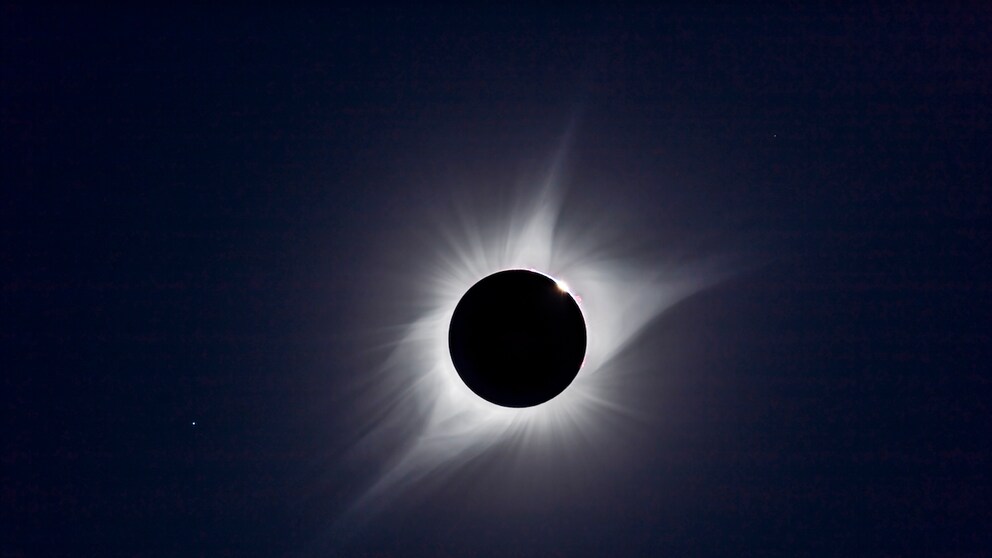
On August 12, 2026, the moon will move between the Earth and the sun. In some places, this astronomical event will result in a total solar eclipse. This means the sun will be completely covered for a few minutes, casting a shadow on the Earth. While solar eclipses occur about twice a year, a total solar eclipse can only be observed at a specific location on average every 375 years, making it extremely rare. This year, vacationers in Mallorca, among others, can look forward to sightings of the total solar eclipse. But they are not the only ones.
Overview
In These European Countries, You Can See the Total Solar Eclipse
The so-called zone of totality, where the total solar eclipse can be experienced, will pass over the Arctic Ocean, eastern Greenland, western Iceland, and northern Spain on August 12, 2026. Those spending their summer vacation on one of the Spanish Balearic Islands are in the right place: Mallorca, Menorca, and Ibiza are directly in the zone, as explained in a BBC article. On the Spanish mainland, the total solar eclipse is expected to be visible in the mountain regions of northern central Spain, including Burgos and Soria. The time and astronomy information site timeanddate lists Bilbao, Oviedo, Valladolid, and Zaragoza as possible locations for viewing the solar eclipse in Spain. Besides Spain, the information site also mentions Portugal as a country where the total solar eclipse can be observed, but it does not specify individual locations.
Two other European countries where you can experience the total solar eclipse in August are Iceland and Greenland. In Iceland, the BBC recommends Breiðafjörður Bay as the best vantage point, while timeanddate lists Ísafjörður, Borgarnes, Reykjavík, and Keflavík as possible places to see at least part of the total solar eclipse.
In Greenland, the “zone of totality (…) will include remote, uninhabited areas of the eastern Greenland coast and the sea,” writes the BBC, recommending viewing the solar eclipse during a cruise. Timeanddate mentions the research station Station Nord as an option.
How Mallorca Is Preparing for the Solar Eclipse Rush

Where to See the Blood Moon on Sept. 7
Can You See the Total Solar Eclipse in Germany?
No, at least not the total eclipse. To see the complete eclipse of the sun, you must travel to one of the mentioned countries. However, a partial solar eclipse can be seen from Germany, with visibility varying by location. According to the Sternwarte Rodewisch, the sun in Germany will be “significantly covered by 84 percent in the north and 90 percent in the far south of the country by the moon.”
A solar eclipse map from timeanddate shows color-coded areas where the partial solar eclipse will be particularly strong or at least weakly visible. Accordingly, the chances seem quite good in southwestern Germany, as well as in neighboring countries such as France, the southern part of the Netherlands, Belgium, Luxembourg, Switzerland, and also in western Austria, as well as in various other Western European countries and northern Africa. You can view the map here. The information site also provides an overview of all countries where the partial solar eclipse can be observed.
According to the information site, the partial eclipse in Germany will begin on August 12 at 5:34 p.m., the total eclipse will start at 6:58 p.m., and it will reach its peak at 7:46 p.m. Experts estimate the end of the total solar eclipse at 8:34 p.m., and the partial eclipse at 9:57 p.m. The Sternwarte Rodewisch, however, states that the partial darkening will begin at 7:19 p.m. and the maximum coverage will occur at 8:12 p.m. For those who want to watch the solar eclipse, it is advisable to arrive at the viewing point a bit earlier to be sure.
How to Prepare for the Solar Eclipse
Besides researching a good vantage point, safety is particularly crucial when preparing for a solar eclipse. Looking directly at the sun can be very dangerous for the eyes, especially when using cameras, telescopes, and the like. Therefore, solar eclipse enthusiasts should equip themselves with appropriate protective glasses in advance.
The information site Sonnenfinsternis.org warns: “Never look at the sun without proper eye protection (certified special protective glasses)—severe eye damage up to blindness can result.” Looking through binoculars or a telescope without a suitable filter is even more dangerous. Those using aids should never use eyepiece filters. Safe options include “special objective filters for solar observation, which you can obtain from specialist retailers.”