

January 8, 2026, 10:03 am | Read time: 3 minutes
Mont Blanc in the French Alps is the highest mountain in the European Union. But the massive mountain is shrinking. Here’s why.
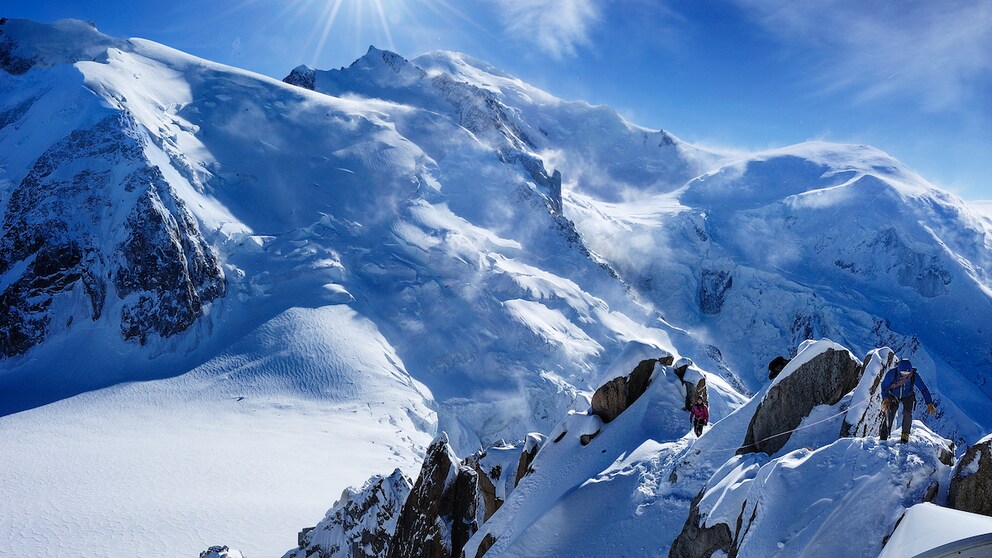
Mont Blanc is remeasured every two years. Fluctuations are normal, but a trend has emerged in recent years: The massive mountain in the French Alps is shrinking. Previously recorded at 4,810 meters, the latest data shows a new height: The highest point of the massive mountain range now reaches 4,807.30 meters. Mont Blanc has shrunk by 2.7 meters, and this appears to be just the beginning.
Melting Ice Cap
Mont Blanc has a geological peculiarity: The summit is covered with an ice cap. According to the Italian-French research mission that measured the mountain range, this ice layer is currently 21.30 meters thick. It is this ice that causes the rock massif to shrink as it melts away piece by piece. If it disappears completely, Mont Blanc’s height could be reduced to 4,786 meters. It would still remain the highest mountain in the European Union, as the second highest, Switzerland’s Dufourspitze, is 4,634 meters high.
The ice melt at Mont Blanc’s high altitudes is a consequence of climate change, writes the Austrian Press Agency (APA). It cites the northern Italian foundation Montagna Sicura, which was involved in the research. According to Montagna Sicura, climate change has reached altitudes long considered largely unaffected. Researchers describe the fact that climate change is noticeable even up there as “alarming.” Measurement series on Mont Blanc’s height are conducted every two years by surveyors from the French department of Haute-Savoie, according to APA.
Mountains Increasingly Unstable
The current measurements were conducted using drones, ground, and satellite radar. The researchers aimed not only to determine Mont Blanc’s actual height. “The topographic survey also served to capture the entire environment of the summit to measure future changes and developments,” explains Fabrizio Troilo, research coordinator at Montagna Sicura, to APA.
These insights are crucial for assessing the severe impacts that glacier melting can have. Far more important than correcting Mont Blanc’s current summit height is the mountain’s stability itself. The magazine “Geo” explains: “When millennia-old ice giants disappear and the permafrost in loose rock layers thaws, entire mountain slopes become unstable.” According to “Geo,” all glaciers in the Alps could disappear by the end of the century if temperatures continue to rise unchecked.
The magazine relies on a study by French researchers from December 2024, showing that the erosion rate in the Mont Blanc massif has nearly doubled over the past century. Rock walls at altitudes below 3,800 meters are affected by instability, the study says. The research team sees the likely cause in the “current strong permafrost degradation.” The speed at which the massif is eroded is apparently also linked to a rockfall of 20,000 m³. According to the study, it is statistically likely that such events, where rock masses and ice break off, will occur again in less than six years. It is therefore expected that further and probably larger rockfalls will occur in the region in the near future.