

July 29, 2025, 4:48 am | Read time: 5 minutes
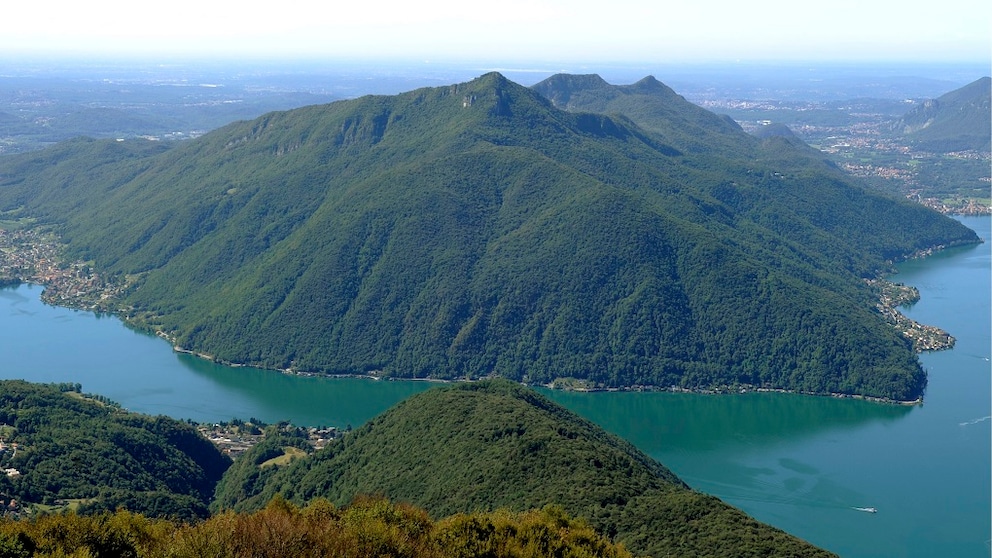
Monte San Giorgio, located on the border between Switzerland and Italy, is globally renowned as the “Mountain of Dinosaurs.” The discoveries here have significantly contributed to the understanding of life in that era and continue to captivate countless visitors annually at a spectacular museum. This is also thanks to a very peculiar coincidence.
At the foot of the Southern Alps, between the Swiss canton of Ticino and the Italian province of Varese, lies a place where one can delve deep into the past of our planet. Surrounded by the two southern arms of Lake Lugano, Monte San Giorgio, at just 1,097 meters high, is far from a giant among the peaks here, yet it is by far the most spectacular. It is also known today as the “Mountain of Dinosaurs” because it is one of the world’s most important sites for marine fossils from the Middle Triassic period, an era that began almost 250 million years ago. TRAVELBOOK takes you on a journey into prehistoric times.
According to its official website, the history of Monte San Giorgio began in the mid-19th century on the Italian side. In 1854, the first publication on fish fossil discoveries was released by Emilio Cornalia, a paleontologist and director of the Natural History Museum in Milan. During this time, the first sensation was also discovered on the mountain—the skeleton of an ichthyosaur, an extinct marine reptile. The Italian Society of Natural Sciences, which led the first excavations starting in 1963, was not particularly gentle in its pioneering work. By using explosives, they managed to make further geologically significant discoveries.
Peculiar Coincidental Discovery
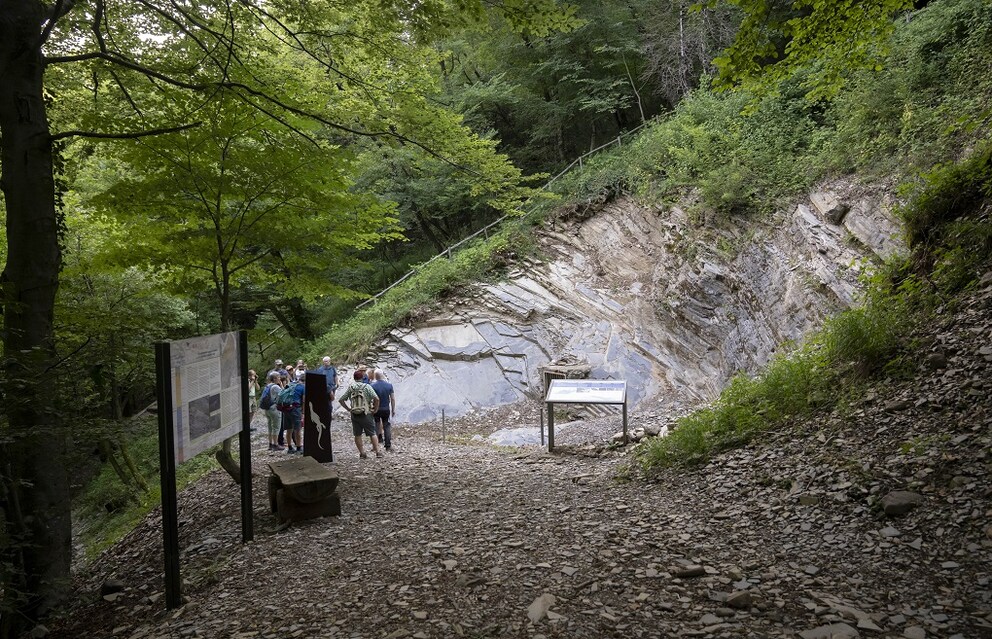
At the beginning of the 20th century, the first fossil finds also emerged on the Swiss side of Monte San Giorgio. This occurred during the extraction of its rock, which was then needed to produce an antiseptic oil called “Saurolo.” In 1919, a peculiar coincidence gave dinosaur research a boost, as the Fossil Museum in Meride informed TRAVELBOOK: “Paleontologist Bernhard Peyer discovered a well-preserved ichthyosaur fin in a pile of rocks intended for oil distillation.” Following this lucky find, excavations began in Switzerland at the “Mountain of Dinosaurs” in 1924. “From the six fossil-bearing layers of Monte San Giorgio, more than 20,000 fossils have been extracted to date. In total, there are about 25 species of reptiles, 50 species of fish, more than 100 species of invertebrates, and several plant species, mainly conifers.”
Also interesting: Cal Orcko: Bolivia’s Fascinating Dinosaur Quarry
The uniqueness of Monte San Giorgio lies in its six different layers. Typically, a site contains only one such layer, which can be assigned to a specific geological period. However, due to the nature of the finds on site, it is possible to observe the evolutionary development of certain organisms that lived in the same environment for several million years. A low point for research was World War II, especially in 1943. During an Anglo-American bombing of the city of Milan, the Natural History Museum was almost completely destroyed. Important fossil finds from Monte San Giorgio were lost forever.
Experience the Past Virtually

Under the direction of Emil Kuhn-Schnyder, excavations at Monte San Giorgio continued from 1950 onward. The discoveries made here by 1968 led, among other things, to the founding of the Paleontological Institute and the Paleontological Museum at the University of Zurich. This institution still holds the largest collection of fossils from the “Mountain of Dinosaurs.” Excavations continue and still yield some spectacular discoveries. In 1996, on the Italian side, the fossil remains of a Saltriosaurus, the largest carnivorous dinosaur ever known in Italy, were found. In 2006, the Dino Mountain received a special honor by being included in the UNESCO World Heritage list.
At the Fossil Museum in Meride, Switzerland, visitors today have the opportunity to experience prehistoric times in an impressive way. For example, on a hiking trail between Meride and Serpiano. “Thanks to the ‘MSG Triassic Park’ app, numerous virtual experiences can be accessed along the way.” From a viewing platform, one can also see the excavation sites at Monte San Giorgio. The museum itself offers several attractions on four floors, such as the Meride Beach, an animated, interactive 3D model. 240 million years ago, there was no mountain here, but a tropical beach. Visitors can even dive virtually into the ancient sea and get up close to the dinosaurs.
Also interesting: Merkers Mine: Germany’s Unique Mine
Those who wish to visit Monte San Giorgio or the museum can do so from Tuesday to Sunday, from 9 a.m. to 5 p.m. Admission for adults costs 12 Swiss francs, approximately 13 euros. Visitors aged 6 to 16 pay half price. Guided tours are also available in German, English, Italian, and French. In Besano, Italy, there is also a fossil museum with finds from Monte San Giorgio. It has the same prices but is only open on Tuesday, Saturday, and Sunday. Please refer to the official website for visiting hours.